

🤝 Top Collaborators



🤓 Latest Submissions
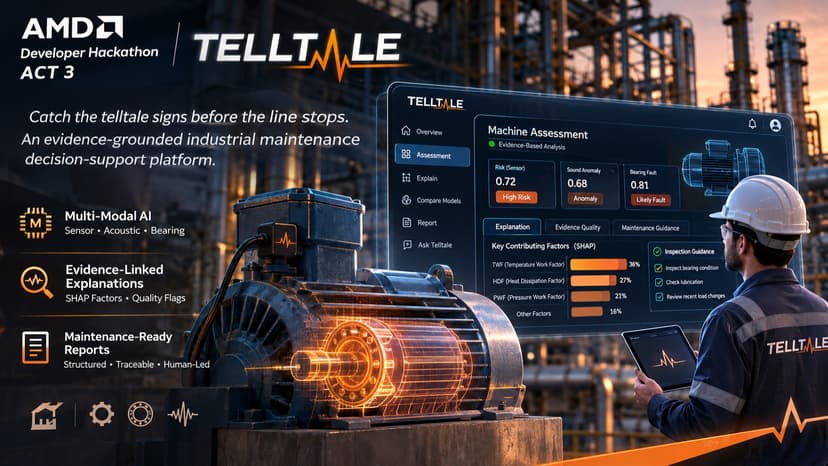
Telltale: Evidence-Grounded Maintenance AI
Industrial maintenance teams often receive disconnected sensor readings, sound anomalies and model scores without a clear explanation of what they mean or what evidence is missing. Telltale bridges that gap through an evidence-grounded maintenance decision-support workflow. The platform brings together local machine-learning services for sensor failure-risk estimation, machine-sound anomaly detection and bearing fault classification. A FastAPI backend organizes available results into assessment snapshots, preserving original scores, model provenance and data-quality limitations. A central AI analysis service uses AMD Token Factory for three interpretation tasks: AI Result Explanation, Multi-Model Analysis, and Evidence & Uncertainty Review. Structured template-based workflows support Maintenance Report Generation and Ask Telltale, providing predictable outputs grounded in available assessment data. Our separately developed frontend is being integrated with these APIs to present model indications, missing evidence and maintenance context in one technician-focused experience. Existing approved playbook guidance supports inspection recommendations where applicable. Telltale's distinction is not simply combining models: it separates prediction from explanation, keeps different score types distinct and makes uncertainty visible. Missing evidence is never treated as proof that a machine is healthy. AI-generated interpretations support human review rather than autonomous equipment control. The result is a traceable path from machine signals to maintenance understanding, helping technicians review indications, prioritize inspections and document findings without presenting model predictions as confirmed mechanical diagnoses. Technologies: Python, FastAPI, Pydantic, LightGBM, SHAP, ONNX Runtime, NumPy, pandas, SciPy, React, and AMD Token Factory API.
18 Oct 2026

