
🤓 Latest Submissions
Theta Council
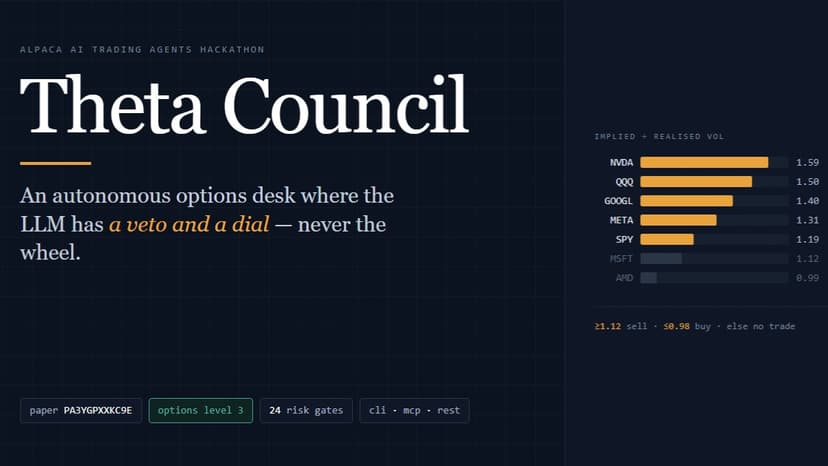
Theta Council is an autonomous multi-agent options desk built on Alpaca's Trading API, MCP server and CLI. It trades one measurable edge: the variance risk premium — the persistent gap between what the market charges for movement (implied volatility) and what an underlying actually delivers (realised volatility). Every cycle it computes vrp_ratio = ATM implied / 20-day realised across a liquid universe. Above 1.12 it sells defined-risk premium; below 0.98 it buys; in between it stands aside, which is most of the time and is the point. It then prices its own edge in dollars rather than adjectives: any vertical spread is valued twice, once at implied volatility (what we get paid) and once at realised (what we think it's worth). The difference, after a bid/ask haircut, is the expected value in dollars, and edge_ratio = EV / max_loss ranks every candidate. If EV isn't positive, the structure is never built. Five agents run the desk. The Analyst reads regime in ATR units so SPY and NVDA are comparable. The Vol Scout issues the sell/buy/stand-aside verdict. The Architect turns opinions into real strikes from the live chain — bull put spreads, bear call spreads, iron condors, long call and put spreads — all submitted as single Alpaca `mleg` orders so no leg is ever momentarily naked. The Position Manager owns exits (55% of max profit, 2x credit stop, 0.40 delta breach, and a time cutoff scaled to each trade's own life) and runs BEFORE entries every cycle, because closing a winner returns the risk budget a new entry then uses. A Bandit keeps a Beta-Bernoulli posterior per regime x structure, so a structure that has been losing gets smaller before it gets abandoned. The language model — Featherless AI, open-weight, OpenAI-compatible — does the one thing arithmetic cannot: cross-sectional judgement. It sees the whole slate at once and catches that three candidates are the same index bet in three costumes, or that a 1.4x premium across every megacap simultaneously
4 Sep 2026
ROCmOps AI War Room
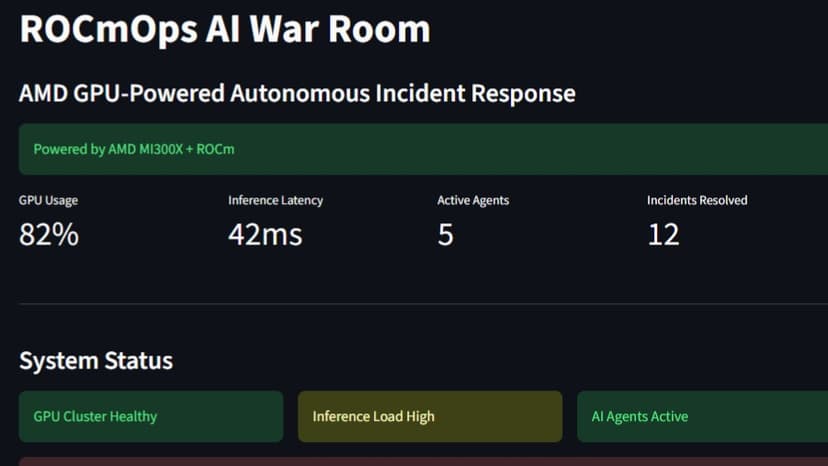
ROCmOps AI War Room is an autonomous AI-powered incident response platform built on AMD MI300X GPUs using ROCm acceleration and AMD Developer Cloud infrastructure. Modern AI infrastructure environments are increasingly complex and difficult to manage. Infrastructure incidents such as GPU memory failures, inference latency spikes, container instability, and workload bottlenecks often require manual investigation and remediation, resulting in increased downtime and operational overhead. Our platform solves this problem using a multi-agent AI operations architecture capable of autonomous infrastructure monitoring, log analysis, root cause analysis, remediation generation, GPU optimization, and postmortem reporting. The system provides a real-time operational dashboard powered by Streamlit, displaying live ROCm GPU telemetry including GPU utilization, VRAM allocation, and thermal metrics streamed directly from AMD infrastructure. The platform includes five specialized AI agents: • Log Analysis Agent • Root Cause Analysis Agent • Remediation Agent • GPU Optimization Agent • Postmortem Report Agent When an infrastructure incident is detected, the platform autonomously analyzes production logs, identifies root causes, generates remediation recommendations, applies ROCm optimization strategies, and creates enterprise-grade incident reports. The solution demonstrates how autonomous AI operations can dramatically reduce infrastructure incident response time from hours to seconds while leveraging AMD GPU acceleration for scalable enterprise AI systems. Technologies used include: • AMD MI300X GPUs • ROCm • AMD Developer Cloud • Python • Streamlit • Docker • Autonomous AI Agent Architecture
10 May 2026


