

🤓 Latest Submissions
ELARA — Your Voice Agent
ELARA is a secure, real-time voice friend built for the AssemblyAI Voice Agent Hackathon. You speak naturally; ELARA listens, understands, and replies out loud — no typing required. At the core is AssemblyAI’s real-time streaming speech-to-text (universal-3-5-pro). The browser never sees the long-lived API key: a server route mints a short-lived, single-use token, opens a WebSocket, and streams PCM16 audio frames directly from the microphone. Partial transcripts appear while you speak. Sessions are cleanly terminated so billing stays accurate. When a question needs fresh facts (weather, news, prices, scores), a deterministic router sends the turn to live web search via Bright Data SERP. The model answers only from real results. If search fails, ELARA says so instead of inventing current information. Everyday chat (jokes, feelings, opinions) is answered from memory without a lookup. The full pipeline is a locked 5-stage brain running entirely on the server: input safety (Groq), optional fast assist (Gemini), main response (Groq), reorganize + emotion (Groq/Ollama), and output safety (Groq). Keys never leave the server. Audio is never stored by ELARA. Privacy and safety are built in: Supabase Auth with Row Level Security, anonymous + Google + email sign-in, layered safety gates, and clear disclosure that Bangla currently uses the browser’s speech recognition as a fallback. ELARA is designed for hands-busy users, accessibility needs, and anyone who wants a voice agent that is fast, honest, and private. Built with Next.js, Supabase, AssemblyAI, Groq, Google AI, and Bright Data.
30 Sep 2026
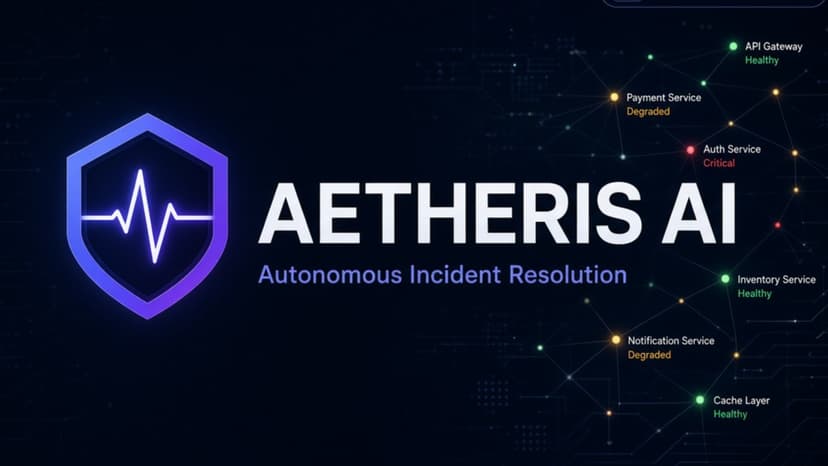
AETHERIS AI — Autonomous Incident Resolution
Problem When production incidents occur, developers still follow a manual treadmill: investigate logs and traces, write a patch under pressure, hope tests catch regressions, wait for review, deploy, and frequently roll back. The process is stressful (often at 3 a.m.), error-prone under fatigue, and leaves almost no verifiable audit trail of what changed and why. Mean time to recovery stays high and risk of secondary failures remains real. Solution AETHERIS AI is a safety-gated autonomous repair pipeline for production incidents. It is deliberately not “AI writes patches.” It is “AI resolves incidents safely — or knows when to stop.” The system runs a deterministic state machine: Incident → Diagnose → Patch → Test → Audit → Gate → Canary → Rollout or Quarantine. Three hard constraints keep autonomy bounded: 1. 3-attempt hard cap — after three failed repair attempts the incident is quarantined and handed to a human with full evidence. 2. HMAC-signed evidence at every step — diagnosis, patch, test results and gate decisions are cryptographically tagged so the release gate can verify integrity before any rollout. 3. Deterministic safety gates — GO / NO-GO is decided by explicit policy checks (test pass rate, audit trust, security/regression risk, evidence validity), not by an LLM’s opinion. Two live demo paths prove the contract: • Safe Repair (NULL_ERROR) — diagnosed, patched with a defensive null-guard, tests passed, audit signed, canary healthy → ROLLED_OUT. • Controlled Failure (SCHEMA_DRIFT) — three progressive failures, gate blocked, attempt limit reached → QUARANTINED with complete evidence for human review. Vague or non-actionable free-text input is rejected with a clear “needs clarification” response instead of producing a fake successful repair. Target users SRE, platform and backend engineers who own production services and want faster recovery without sacrificing safety or auditability. How users interact A dark-themed enterprise dashboard lets users launch preset scenarios or paste a real error description / stack trace. The full pipeline runs in real time; every state transition, Bob activity log, patch diff, test result, audit finding and cryptographic evidence is visible. Users can verify the HMAC signature and reset demos. What makes it unique Most “AI coding” demos stop at generating a patch. AETHERIS treats the patch as only one step inside a closed-loop, fail-closed, evidence-backed repair system. Autonomy is bounded by policy and attempt limits; humans remain in control through quarantine and full audit trails. The system was built with IBM Bob IDE as the primary engineering partner and uses watsonx.ai / Granite patterns for the diagnose–patch–audit agents at runtime. Impact Minutes instead of hours for many classes of incident, elimination of blind “ship and hope” rollouts, and compliance-ready auditability by default.
27 Sep 2026

RoadGlyph + SourceTrace: OCR & RAG on AMD ROCm
Two Dockerized, fully offline solutions for the AMD AI League, both built FROM the required ROCm PyTorch base with Qwen3-VL-8B-Instruct weights baked into the image, so neither needs network access at grading time. RoadGlyph (Mini Challenge 2, OCR) reads road signs and license plates. python3 /app/app.py --input-image <path> writes /app/output/<stem>_output.json with "text" and "confidence". A resident model server keeps the model loaded between images, a watchdog writes a valid fallback JSON before the 30 s limit, and deterministic post-processing applies the transcription conventions for plates, stop signs, speed limits and advisory plaques. SourceTrace (Match 3, RAG) answers questions about a mixed document collection and cites exactly the supporting files. --index builds the index once and --query answers each question. Defensive parsers handle the file types, a vision-language step reads pictures, and retrieval combines BM25 with optional dense search and multi-hop lookup. Answers are grounded verbatim, checked by a separate verification call, and citations are pruned to the exact supporting set. When the documents do not support an answer, it refuses with an empty answer and no citations.
1 Dec 2026
Ideon-Your Business Partner
"Ideon is an all-in-one AI-powered startup co-founder and business strategist engineered to accelerate the process of turning raw ideas into market-ready products. Early-stage founders, solo developers, and innovators frequently struggle with the time-consuming tasks of market validation, competitor discovery, target demographic mapping, and financial forecasting. Ideon eliminates these bottlenecks by automating thorough market research and business strategy creation within a matter of seconds. By taking a simple textual prompt describing a business vision, Ideon leverages an advanced multi-LLM architecture to perform deep analytical reasoning. The platform generates structured outputs including comprehensive competitor landscapes, detailed user persona profiles, revenue and cost structure estimations, risk assessment frameworks, and pitch-ready strategic decks. Furthermore, Ideon incorporates an interactive AI co-pilot that allows users to iteratively refine their plans, adjust strategic priorities, and customize business outputs through dynamic conversational guidance. Technologically, Ideon is built on a high-performance stack utilizing Natively AI for seamless application delivery, Supabase Edge Functions for resilient serverless computation and low-latency API orchestration, and top-tier LLM engines including Google Gemini and Groq for rapid, high-accuracy inference. Ideon empowers creators, product managers, and hackathon teams to bypass months of manual planning, reduce strategy risks, and launch high-impact business ventures with total confidence."
10 Aug 2026
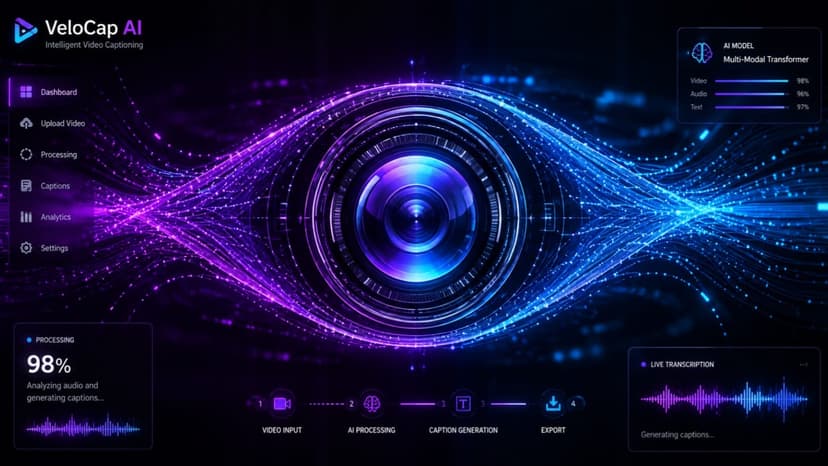
VeloCap: High-Speed Video Agent
Our Video Captioning Agent for Track 2 bridges high-speed visual processing with context-aware language generation, turning any video into accurate, style-specific captions — formal, sarcastic, humorous_tech, and humorous_non_tech — as clean, structured JSON. System Architecture & Workflow Built in Python and packaged in a lightweight linux/amd64 Docker container, the agent runs a streamlined pipeline: it reads incoming tasks, retrieves the source video, and uses headless OpenCV to extract 24 evenly spaced frames, each resized to 640×360 for fast, token-efficient inference without losing semantic detail. A ThreadPoolExecutor processes multiple videos concurrently, cutting total runtime significantly, while retry logic with backoff covers both downloads and API calls — so a single transient failure never crashes the run. The Engine: MiniMax M3 via Fireworks AI The submission form only offers a generic "AI/ML API" category, but the model actually powering the agent is MiniMax M3, served through Fireworks AI — chosen deliberately for three reasons: 1)Native multimodality — trained from the ground up on text, image, and video together, enabling deeper semantic fusion across frame sequences than a bolted-on image-to-text pipeline. 2)Efficient MoE architecture — ~428B total parameters with only ~23B active per token, delivering frontier-level reasoning at speeds a dense model of similar size can't match. 3)Massive context window — 512K tokens comfortably holds all 24 base64-encoded frames in a single call, with no truncation or memory loss. Performance & Reliability Frame optimization and parallel execution let the agent process multiple clips and generate a full set of style-specific captions for each in roughly 16–20 seconds end-to-end. Retry logic and failsafes at every stage — download, extraction, API call — ensure the agent never crashes and always returns valid JSON, in line with Track 2's evaluation requirements.
13 Jul 2026


