

🤓 Latest Submissions
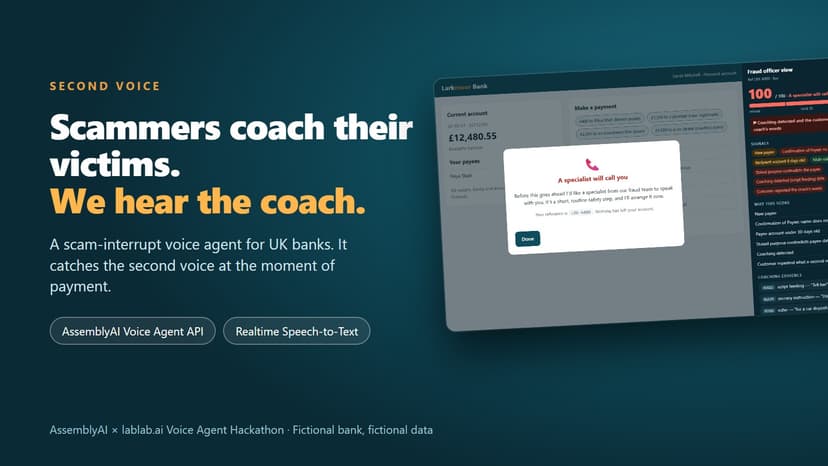
Second Voice: it hears the scam coach
In authorised push payment scams the victim makes the payment themselves, often with a scammer still on the phone coaching them through the bank's checks: "tell her it's for a car deposit, don't mention me." UK banks lost £576.4m to these scams in 2025 (UK Finance), and since October 2024 the sending bank must reimburse eligible victims, so the loss now lands on the bank. Second Voice is a short Voice Check that opens in the banking app when a payment looks risky. An AssemblyAI Voice Agent talks to the customer, asks what the payment is for, and runs the bank's checks (Confirmation of Payee, recipient-account risk, customer history) as tools. A second stream, AssemblyAI Realtime Speech-to-Text with speaker labels and loudness, listens to the whole room from the same microphone and looks for coaching language and for the customer repeating the coach's words. If it hears a coach, the agent gently asks: "Is there someone there with you?" A transparent points table, never the LLM, decides: release, pause for 24 hours, or escalate to a fraud specialist. Every hold offers a human, and a fraud officer watches the same call live with an itemised "why this score" and an exportable audit record. It fails safe (mic denied or connection lost means a hold, never a release) and stores no audio. Tested end to end in headless Chrome against the live APIs (coached scam escalated 7 of 7, honest customer released 2 of 2) with 455 automated tests. Limits are stated plainly: it hears coaching at conversational volume within arm's reach of the laptop, not whispers across a room.
30 Sep 2026

EasoLab's Alpaca AI Trading Agent
Alpaca AI Trading Agent is an autonomous options trading agent that runs unattended, evaluates real market data every 15 minutes, and trades weekly SPY iron condors on a strategy backtested against a full year of real Alpaca historical option data. The architecture is a strict three-layer pipeline: an Analyst (a Featherless LLM) debates market regime and risk for the audit trail, but is advisory-only and can never approve or block a trade. A Governor does the actual thinking deterministically — real Black-Scholes math, real strike selection off the live option chain — because LLMs have documented 15-40% error rates on option math done in token space, and this project treats that as a hard constraint, not a caveat. An Executor validates the resulting order against a strict schema and submits it as one atomic multi-leg order through the Alpaca CLI. No order ever reaches the broker without passing through deterministic validation. The strategy itself — Hybrid VRP+Skew — sells premium only when two independent real-data signals agree: implied volatility priced richer than realized volatility, and put-call skew that isn't already elevated. Backtested at Sharpe 2.53, 90.9% win rate, and under 2% max drawdown. Four more aggressive, directional strategies were also researched and backtested specifically to check whether something could beat the index outright — none did once tested against real data, and the most promising one on paper was actually the worst performer once real data hit it. This isn't a backtest-only submission. It runs live on a GitHub Actions cron against a dedicated paper account, with hard risk gates (2% risk per trade, a 6% total-drawdown kill switch, spread rejection, 0-DTE auto-liquidation) and a full structured audit log committed back to the repo after every cycle — including the cycles where it decides to do nothing.
4 Sep 2026


