
🤓 Latest Submissions
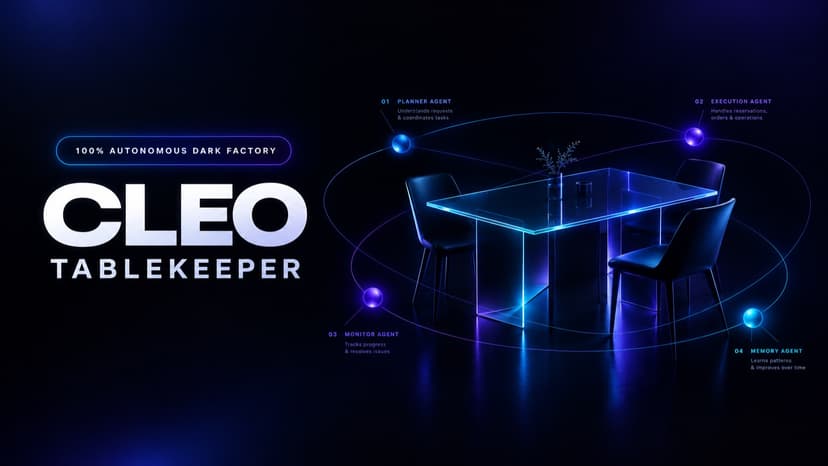
CLEO Tablekeeper: Autonomous Dark Factory
CLEO Tablekeeper is a lights-out autonomous software factory built inside BAND Desktop for the Tablekeeper track. Operating strictly under the "Mandor" philosophy, four specialized coding agents built, designed, verified, and shipped all four progressive stages of an enterprise hospitality reservation engine from a single dispatch without a single line of human-authored product code—operating on $0.00 metered spend. To eliminate deadlocks and silent drift, our factory architecture is guided by the empirical MAST multi-agent taxonomy (arXiv:2503.13657). We deployed four specialized seats: @cleo-prime (Chief Architect translating requirements into ledger clauses R-1.1..R-4.8), @cleo-forge (Engine Synthesizer developing transactional mutexes and replanning logic), @cleo-sentinel (UI/UX Guardian delivering mobile-first 375px/1280px responsive interfaces with zero horizontal scroll), and @cleo-release (Adversarial QA holding absolute veto power to reject incomplete handoffs). Key achievements across the four stages include: - Stage 1: Core booking engine with IANA timezone math (Berlin/New York) and concurrency locks (120/120 checks pass). - Stage 2: Responsive browser UI with dynamic DOM lifecycle contracts (24/24 static checks + Playwright UI pass). - Stage 3: Explainable availability matrices, chronological audit trails, dynamic versioned policies, and atomic recurring series (14/14 checks pass). - Stage 4: Emergency table closures with deterministic 3-tier optimization (minimizing moved bookings first, unused capacity second, option rank vector third) under optimistic revision locks (8/8 checks pass). The project passes Gates 1, 2, and 4 cleanly under the official harness check, and proves Gate 3 compliance in network-isolated Docker containers with strict resource limits. Provenance is verified via the unedited session room.json and git commits.
6 Oct 2026
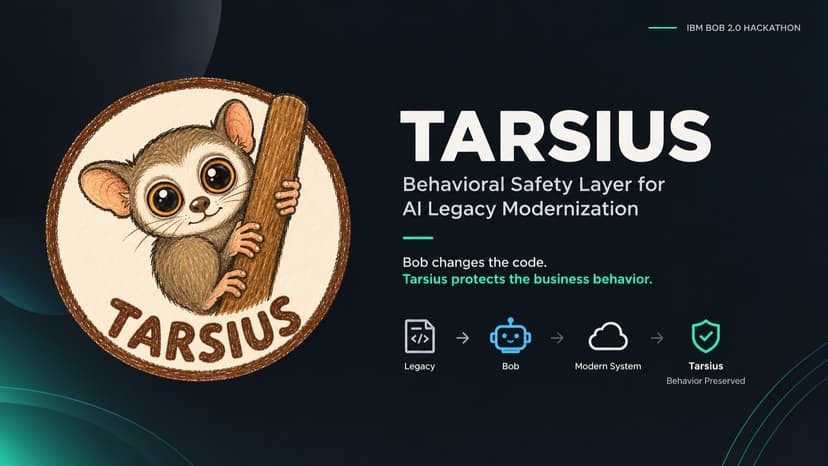
Tarsius: Behavioral Safety Layer for IBM Bob 2.0
Over $3 Trillion in daily global financial transactions rely on mission-critical legacy enterprise systems written in IBM i RPGLE and Mainframe COBOL. Today, the organizations maintaining these foundational systems face an unprecedented demographic challenge: 72% of RPG developers are over the age of 50, and the institutional skills shortage has become the number one concern across enterprise IT. When senior engineers retire, decades of vital institutional tacit knowledge vanish with them—including undocumented edge cases, oral operational carve-outs, and unwritten regulatory agreements. While modern AI coding assistants like IBM Bob 2.0 excel at syntactic translation, they can only read what has been explicitly written down. Peer-reviewed research indicates that unconstrained LLM translations retain merely 9% to 19% behavioral equivalence on legacy edge cases, leading industry analysts to project that over 70% of mainframe exit modernizations will fail to deliver their anticipated returns. Tarsius solves this critical knowledge gap by serving as a native behavioral safety layer engineered directly into IBM Bob 2.0. Rather than hoping an AI model will accurately guess implicit behavior, Tarsius captures undocumented institutional rules before code generation begins, formalizes them into binding governance contracts, and rigorously verifies the modernized software using differential behavioral testing. Our primary target users are enterprise engineering teams modernizing core legacy systems and the senior subject matter experts whose specialized operational knowledge must be permanently preserved before retirement. Users interact with Tarsius seamlessly through IBM Bob 2.0 and a dedicated governance dashboard. During the discovery phase, Bob's Legacy Analyzer inspects legacy source code alongside existing specifications to uncover undocumented branches and specification contradictions. When an anomaly is detected, Bob engages the domain expert in a brief Socratic inquiry directly within the chat interface, converting oral rationale into structured business rules. These rules enter an inventory where a zero-LLM deterministic triage classifier routes them into auto-approved, glance, or must-review categories. Architects use the Tarsius Studio dashboard to inspect rules against explainable risk heatmaps and record immutable approvals into an append-only SHA-256 hash-chained ledger. Approved rules automatically compile into binding contract documents that are re-injected into Bob's subagents across context compaction cycles to guarantee total alignment. What makes Tarsius unique is its pre-generation governance model. Existing developer tools focus exclusively on post-hoc debugging or code archaeology, whereas Tarsius asks the foundational question that no other tool addresses: what must not change? By separating knowledge extraction from code synthesis, Tarsius eliminates the self-fulfilling test fallacy where an AI writes unit tests that merely confirm its own incomplete assumptions. Through its Behavioral Equivalence Test Harness, Tarsius verifies modernized outputs against legacy behavior using deterministic test vectors. On our dual-workload benchmark spanning IBM i RPGLE order validation and Mainframe COBOL funds transfer, Tarsius elevated behavioral equivalence from 67% to 100%, transforming fleeting human memory into verifiable, permanent enterprise governance.
27 Sep 2026
SentinelVoice: Autonomous Voice Treasury Guardian
In 2024, multinational engineering firm Arup lost $25.6 Million after a finance employee was deceived by a deepfake CFO during an emergency video call. While the Voice AI industry has rapidly engineered compliant, polite assistants, this very design makes conventional voice bots the ultimate Trojan Horse for executive impersonation and Business Email Compromise wire fraud. When pressured by an urgent executive tone, traditional voice agents blindly obey. SentinelVoice inverts this paradigm, transforming conversational AI from an obedient clerk into an unyielding, Zero-Trust Treasury Interrogator specifically engineered to safeguard corporate liquidity. Operating over high-performance full-duplex WebSockets, SentinelVoice leverages the AssemblyAI Voice Agent API to stream 16kHz audio with sub-800ms turn-taking, actively interrogating callers while remaining completely immune to executive intimidation or false urgency. Underneath speech recognition, SentinelVoice extracts physical vocal-cord biometrics directly from raw audio buffers using the YIN pitch algorithm and Levinson-Durbin linear predictive coding formants. By cross-referencing caller acoustics against enrolled executive baselines, it immediately flags neural vocoders exhibiting unnaturally rigid glottal micro-jitter. To eliminate vulnerabilities associated with stolen credentials, SentinelVoice replaces static PINs with dynamic RFC 6238 TOTP rolling hardware tokens. High-value wire transfers exceeding corporate thresholds are automatically locked inside a SOX 404 Escrow State Machine. Capital is only released once vocal acoustics, ERP beneficiary ledgers, and out-of-band cryptographic tokens reach consensus. Deployed live on Railway Cloud, SentinelVoice bridges generative voice intelligence with deterministic enterprise risk management to stop deepfake fraud in its tracks.
30 Sep 2026


