
🤓 Latest Submissions
Requirement-Aware Code Review with IBM Bob
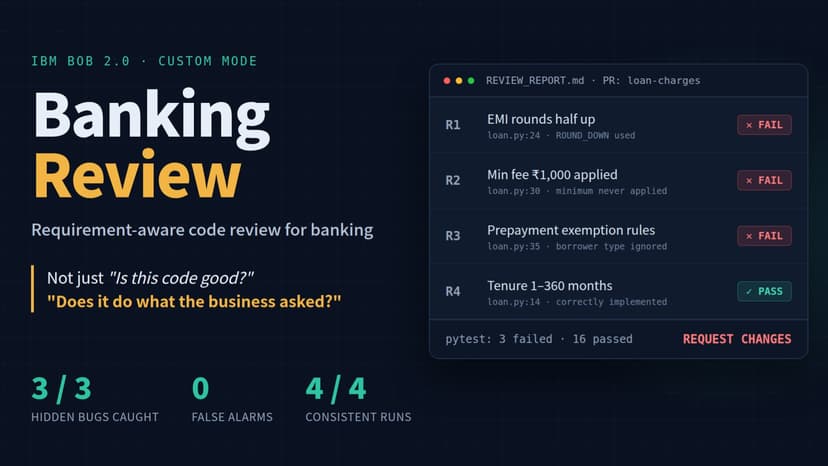
THE PROBLEM Code reviews check whether code is well written. They rarely check whether it does what the business asked for. In banking, that gap is expensive. A pull request can be clean, lint-free and pass every test, yet still round an EMI the wrong way, skip a minimum processing fee, or waive a prepayment charge the bank should collect. This happens because requirements and code live in different worlds. Business Analysts write rules in requirement documents; developers interpret them; tests are written from the developer's interpretation, so they share the same blind spots. Reviewers focus on code quality and security, not fee schedules or rounding rules. Business-rule errors therefore surface late, in QA or UAT, causing rework, retesting and release delays. If they reach production, they become customer complaints, revenue leakage and compliance risk. THE SOLUTION Banking Review is a custom IBM Bob 2.0 mode that reviews a pull request against the Business Analyst's requirement document. Target users: developers and code reviewers, QA engineers, and Business Analysts in banks and fintech teams. How they use it: the reviewer opens the repository in IBM Bob, selects the Banking Review mode, and gives one command. Bob then: Reads the requirement document and extracts every acceptance criterion as a testable check. Compares the code against each business rule and pinpoints the exact line that violates it. Writes one test per acceptance criterion and runs them, so each violation is proven by a failing test, not just asserted. Runs a standard code-quality review alongside. Produces a report with a traceability matrix (rule, code line, test, result), explains each issue in business terms such as undercharging or revenue leakage, and gives a clear verdict. Bob never changes application code or commits. It reviews, proves and reports. WHAT MAKES IT UNIQUE Existing AI reviewers ask "Is this code good?" Banking Review asks "Does this code do what the business asked for?" It is designed from a Business Analyst's perspective, linking the requirement sentence, the code line and the test in one report that developers, QA and BAs can all read. HOW IT ADDRESSES THE PROBLEM It shifts business-rule checking left, from UAT to the pull request, where fixes are cheapest. It removes the manual effort of tracing each rule to code and tests. And it is consistent: the same review runs the same way every time, regardless of who is reviewing. RESULTS Our demo uses a retail loan module whose pull request passes all eight of its own tests. Banking Review caught all three hidden business-rule violations (EMI rounding down instead of half up, a missing Rs 1,000 minimum fee, and a prepayment exemption that ignored borrower type), raised no false alarm on the correctly implemented tenure rule, and produced identical results across four runs. NEXT STEPS Running on every pull request in CI, analysing the impact of requirement changes, and reading BRDs and regulatory circulars directly.
27 Sep 2026
Voice Triage Agent
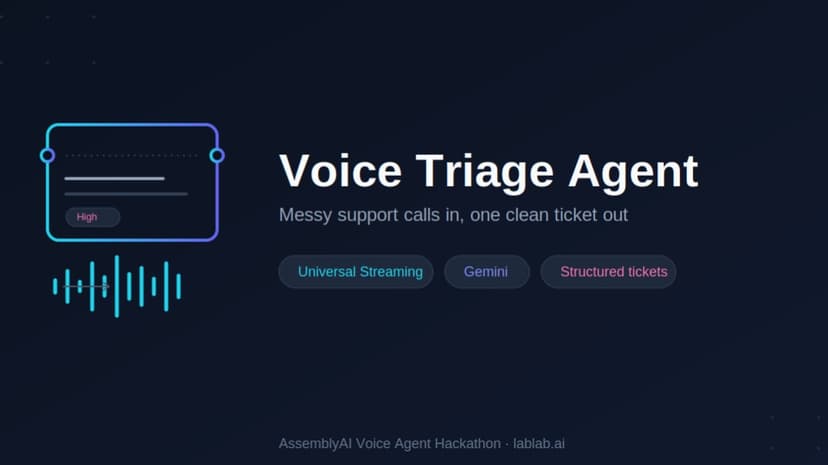
THE PROBLEM Support calls are messy. Callers pause, restart, go off-topic, and often mention the key detail last ("I have a client demo in an hour"). Agents then retype everything into a ticket and guess the category and priority. THE SOLUTION Voice Triage Agent automates that first step. The caller describes the problem out loud; the agent listens in real time, asks one follow-up question at a time by voice, and produces one structured ticket with category, priority, summary, and full transcript. HOW IT WORKS 1. Speech streams live to AssemblyAI Universal Streaming, which returns formatted turns in real time. 2. Each turn, with the full conversation, goes to Google Gemini, which updates one ticket and decides the agent's next reply. 3. The reply is spoken back. The mic is muted while the agent speaks, so it never hears itself. 4. When the call ends, the ticket is saved as JSON with the transcript. HOW WE USE ASSEMBLYAI - Universal Streaming for low-latency live transcription - Tuned turn detection so mid-sentence pauses don't cut callers off - Key-term prompting for support vocabulary ("log in", "billing", "client demo") WHAT MAKES IT DIFFERENT - One call = one ticket: fragments are merged and transcription errors corrected from context - Context-aware priority: deadlines raise urgency automatically - Stays on task: off-topic requests are politely redirected - Always-valid output: strict JSON schema BUSINESS VALUE Faster first response, consistent categories, and correct priorities with no retyping. Fits helpdesks, IT service desks, and SaaS support; tickets are ready for Jira, Zendesk, or Freshdesk. NEXT STEPS Phone-line integration (Twilio), direct helpdesk integration, a live dashboard, and barge-in. TECH STACK Python 3.12, AssemblyAI Universal Streaming, Google Gemini, PyAudio, Windows speech voices.
30 Sep 2026


