

🤝 Top Collaborators


🤓 Latest Submissions

Synthetix Alpha
Synthetix Alpha is an autonomous options, equity and crypto trading agent with one hard rule: LLM agents research, a deterministic runtime trades. Agents read arXiv quant-finance papers and write strategies as declarative JSON specs: option legs by delta, DTE window, signal gates, exits, sizing. A backtester replays real option chains day by day with fills at mid plus half-spread, a same-day volume floor, split adjustment and commissions. Candidates are scored on worst year and drawdown, re-tested on an unseen vendor and underlying and swept for fragility. Kaggle chains, DoltHub volatility surfaces 2019-2026, FRED, Yahoo Finance earnings, FOMC dates and Finnhub news feed it, and WRDS validates spreads and factors. It caught its own error: on minute bars from the price a market order actually gets, the gap fade's edge was an opening-print artefact, and we say so. On a Hostinger VPS a scheduler fires at 09:31, 09:45, 15:50 and 15:56 ET and runs three sleeves: put credit verticals (sell 20-delta, buy 10-delta, 65 DTE, exit at 65% of credit, 2x stop or 21 DTE), an equity gap fade (ten most negative volatility-scaled gaps, open to close) and crypto dislocations (24h move below -3.5 sigma, 48h hold). The options screen spans 1,500 names: IV/RV 1.25-2, $20M ADV, chain spread under 10%, no earnings within 30 days. Every order clears governance.yaml gates: positive NAV, 20% total and 5% daily drawdown halts, 1x leverage, 10% per name, 12 slots, defined-risk only, 3% of equity at risk, and a crossing check (bid/ask credit at least 60% of mid). Multi-leg limit orders go through the Alpaca CLI with client order ids hashed from legs and date and deduplicated at the broker; a paper-only assertion refuses live keys. A dashboard (FastAPI on Render, Next.js on Vercel) shows the screen, positions and execution ledger; a Featherless-hosted LLM critic reviews each candidate as a risk officer; every approval re-runs the deterministic gate before a paper order is placed.
4 Sep 2026
Fallthrough
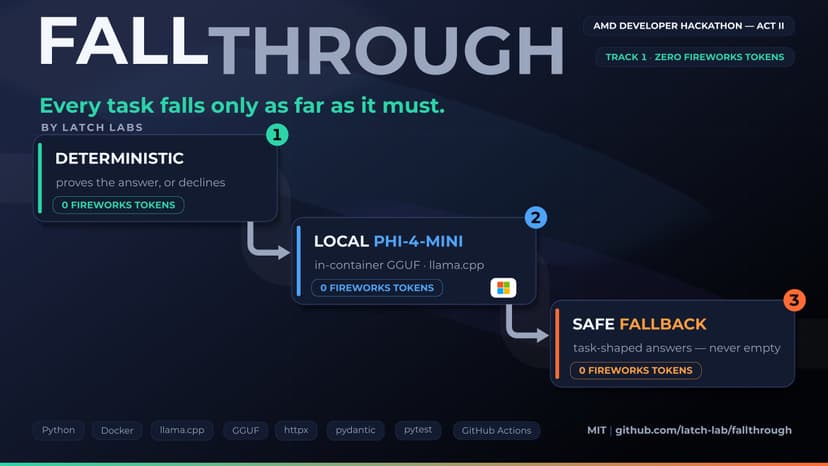
Fallthrough is a batch-processing agent for mixed Track 1 tasks. It handles each prompt independently and chooses the lowest-cost route that can produce a useful answer. Supported problems are handled by deterministic solvers inside the container. These routes only commit when they can verify the complete result; otherwise, the task falls through to a local language model. All remaining tasks are answered by a bundled, four-bit Phi-4 Mini model running through llama.cpp, or Qwen for coding tasks. The model loads once per batch and requires no network connection or runtime download. Generation is bounded to keep the complete container run within the judging limit. If a task times out or local inference fails, Fallthrough returns a task-specific, non-empty fallback so that one failure cannot invalidate the whole batch. Results are written in the required evaluator format. The final image makes no external API calls and uses zero Fireworks tokens.
13 Jul 2026


