

🤝 Top Collaborators




🤓 Latest Submissions
DevCore
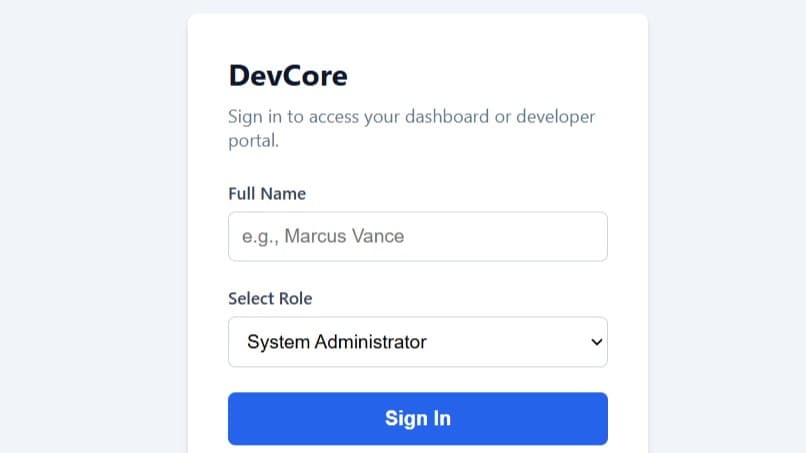
When new developers join a software project, they routinely face a frustrating operational bottleneck: valuable time is wasted digging through scattered documentation, unorganized chat notes, and messy folder hierarchies just to understand the baseline setup. This friction delays initial contributions and creates an unnecessary barrier to entry for incoming engineering talent. We solved this specific challenge by developing DevCore, a centralized, web-based developer onboarding and resource hub deployed live via GitHub Pages. DevCore acts as an all-in-one command center designed specifically for developers, engineering leads, and technical teams who need immediate access to structured codebase overviews, intuitive navigation, secure authentication flows, and core project tools without the usual guesswork. Users interact with the platform through a clean, responsive web interface that seamlessly guides them from authentication to core workspace assets. What makes DevCore uniquely creative is its marriage of strict compliance logging with a lightweight, minimalist frontend architecture built using pure JavaScript, HTML, and CSS—completely removing heavy framework bloat while remaining entirely version-controlled on GitHub for instant team handoffs. It efficiently addresses the chaos of onboarding by replacing fragmented communication channels with a single, highly organized portal that gets new contributors up to speed in minutes rather than days.
27 Sep 2026
Adjudicate — AI Insurance Claim Triage
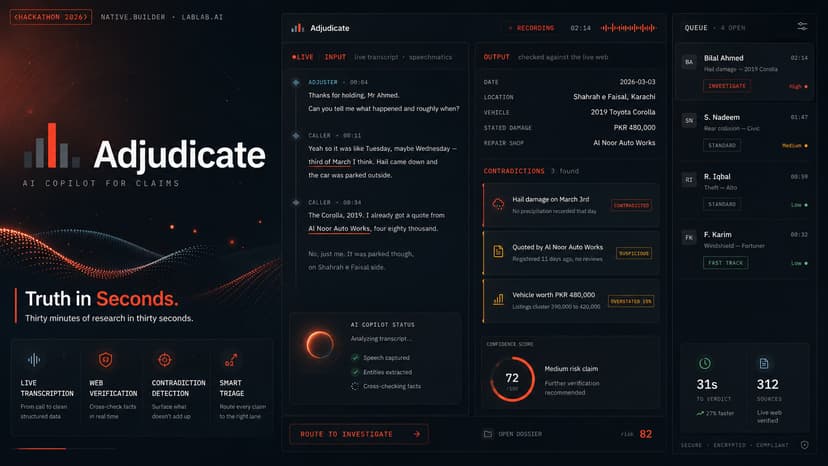
Adjudicate is an AI agent for insurance First Notice of Loss calls. Today, an adjuster gets one call and no time to verify anything in it — claims that would fall apart under ten minutes of scrutiny go through unchecked, because nobody has ten minutes to give. Adjudicate listens to the call live, extracts the claim's key facts as the caller speaks, and checks those facts against real public data while the call is still happening — historical weather records, business registries, and other public sources, depending on what the claim actually needs checked. A hail claim triggers a weather lookup; a different claim triggers something else entirely. That dynamic decision-making is the core of the product, not a fixed script. The result is a dossier: a risk score, a routing recommendation, and a contradiction table showing exactly what was claimed versus what the evidence shows — with a source link on every finding. Where evidence is genuinely unavailable, Adjudicate says so instead of guessing, which we treat as a feature, not a gap. In a real test run, Adjudicate checked a flight-delay claim's stated cause against historical weather data, found no precipitation was recorded that day, and returned a contradicted verdict with a 35/100 risk score in 127.4 seconds — against a roughly 30-minute manual baseline. The application (Queue, Live Intake, and Dossier screens) is built and deployed on native.builder, connected directly to Supabase as its data layer. A lightweight backend service handles the parts native.builder's own documentation notes aren't yet supported standalone: live audio streaming and multi-API orchestration across Speechmatics for real-time transcription and diarization, AI/ML API for structured field extraction, and public data sources for verification. Adjudicate is built for insurance adjusters and SIU teams — not to replace their judgment, but to give them the scrutiny they've never had time for.
10 Aug 2026

Preflight: AI Agent QA & Reliability Harness
Preflight is an AI Agent QA and Reliability Harness that helps teams detect and prevent AI agent failures before they reach production. AI agents are becoming increasingly capable, performing complex tasks through tool usage, decision-making, and multi-step reasoning. However, they can fail in unpredictable ways through hallucinations, unsafe actions, incorrect tool calls, prompt injection attacks, and unexpected behavior across multi-turn conversations. Developers can connect their AI agent endpoint to Preflight, where the platform automatically generates diverse testing scenarios, including normal interactions, ambiguous requests, edge cases, and adversarial attacks. These scenarios are executed through simulated multi-turn conversations to evaluate how the agent behaves under realistic conditions. Preflight uses a dual AI judge pipeline to analyze each interaction. A fine-tuned Gemma 3 safety judge, trained on AMD infrastructure, provides domain-specific safety evaluation, while DeepSeek V4 Pro serves as an independent reasoning verifier. Together, the models evaluate task success, hallucination risks, instruction following, safety issues, and prompt injection vulnerabilities. The final verdict is determined through consensus logic: if both judges classify an interaction as unsafe, it is blocked; if both classify it as safe, it is allowed; and if they disagree, the case is flagged for human review. Preflight produces a reliability report containing an overall reliability score, failure statistics, and detailed failure transcripts. By leveraging AMD Developer Cloud and ROCm-powered infrastructure, Preflight enables scalable parallel testing and supports the fine-tuning and deployment of specialized AI evaluation models. Our vision is to provide developers and organizations with a pre-deployment reliability layer for AI agents, helping teams ship safer, more trustworthy AI systems with confidence.
13 Jul 2026


