
🤝 Top Collaborators




🤓 Latest Submissions

Multilönd AI
A missing charger is easy to add while a box is open. Once the lid closes, the same mistake becomes rework or a customer return. In hand assembly and packing, the next step often hides the last one. Multilönd AI checks work at those visible moments. A station camera watches the bench; when the scene is steady, one frame goes to an open vision model with a checklist question that describes what correct looks like. Fixed rules, not the model, decide the result: Pass moves on, Fix it marks the problem with a red box, Retake asks for a clearer view. A step that covers earlier work (closing a lid or panel) stays locked until its checks pass or a person writes an override reason. Every attempt is saved with its photo, unit ID and time. The web app runs live on a camera or on a recorded video, and anyone can write their own checklist in plain lines, so a new product is a new checklist, not a new machine. Our demo is an accessory-box pack-out; the same engine also checks a PC build. AMD: inspections run on DeepSeek V4.1 Flash, an open-weight model, on AMD Token Factory. Because the model is open, it can run on a factory's own AMD GPU so product photos never leave the site. Results: on 34 MVTec AD cable photos (earlier run, Gemma 4 on AMD Token Factory), a generic question caught 2/24 defects; a question describing the correct cable caught 14/24, with zero false alarms on 10 clean photos and about 5.7 s per check. Ten defects still escaped, so broader validation is our next step.
18 Oct 2026
BobGuard
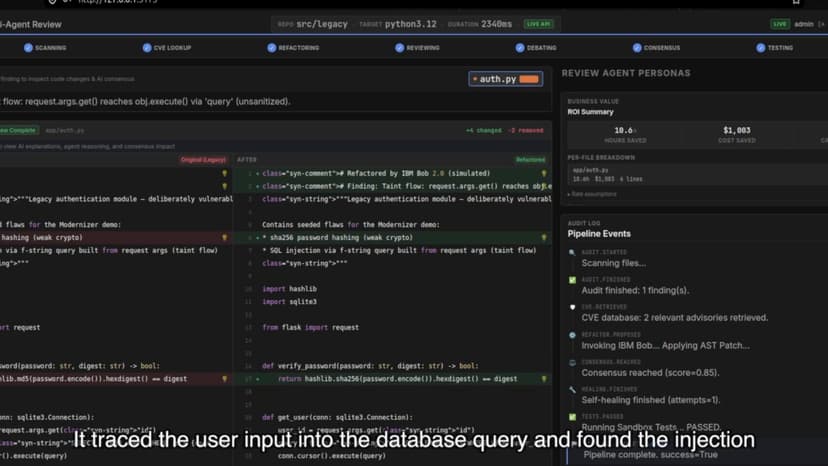
In large organizations, updating legacy systems is terrifying because a minor change can break decades of interconnected infrastructure. This fear paralyzes engineering teams, turning a simple 5-line security patch into a 9-month administrative nightmare of manual review committees and slow regression testing cycles. Consequently, companies often ignore critical vulnerabilities because doing nothing feels safer than touching old code. To solve this specific challenge, we built BobGuard, an autonomous legacy modernization and security remediation engine powered by IBM Bob 2.0. Target users include enterprise DevSecOps teams, legacy system maintainers, and platform engineers who need to ship securely at startup speed. Engineers interact with BobGuard through a streamlined, human-in-the-loop Terminal User Interface (TUI). The user submits a local repository path to the CLI, prompting BobGuard to scan the codebase, orchestrate an AI-driven fix, and test it. Finally, the user is presented with a color-coded, side-by-side diff and a risk report, allowing them to simply type 'y' or 'n' to approve the deployment and maintain absolute executive control. What makes our solution creative and unique is that, unlike standard LLM coding assistants that blindly generate text, BobGuard utilizes a zero-trust, multi-layered verification architecture. This includes a Multi-Agent Consensus where three distinct IBM Bob personas (Security Expert, Performance Guru, and Legacy Maintainer) debate the proposed code, a custom Abstract Syntax Tree (AST) parser that structurally guarantees no dangerous functions were hallucinated, and an isolated sandbox that executes the patch against existing unit tests. If a test fails, a self-healing loop feeds the stack trace back to IBM Bob to fix the error autonomously. This effectively and efficiently addresses the stated issue by completely eliminating the manual bottleneck of software maintenance. By automating static analysis, consensus review, and test execution, BobGuard compresses 9 months of enterprise caution into 90 seconds of verified safety, complete with a built-in Business ROI Engine that instantly calculates the financial cost, human hours, and computing resources saved on every run.
27 Sep 2026
Delegate
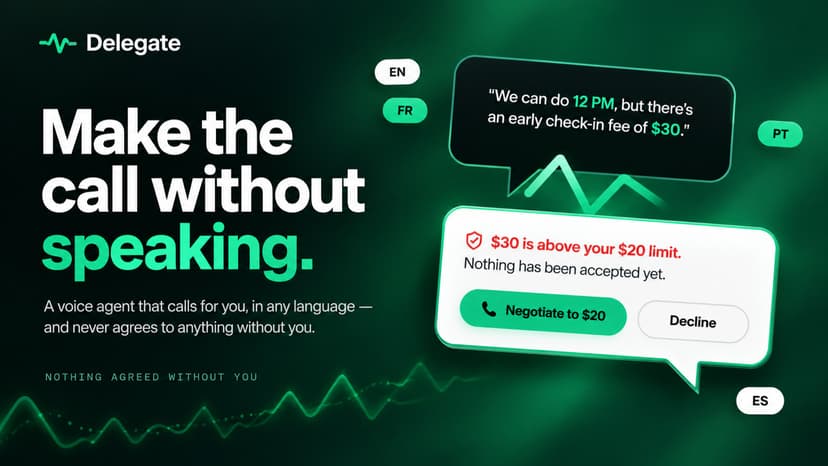
Calling a hotel, internet provider to negotiate takes time. It's harder still when the conversation isn't in your first language. Handing it to an AI entirely is risky, because it might agree to a price you never approved or share details it shouldn't. Delegate sits in the middle. You describe what you need in plain words,Delegate turns that into clear rules: your goal, your spending limit, and what it must never say Then it holds the conversation for you. For each reply, Delegate drafts a response and checks it against your rules. It shows you the draft alongside a translation into your language. Nothing is said until you approve it. If the other side asks for more than you allowed, or asks for something you said never to share, Delegate stops and gives you one-click options instead of deciding for you. Approved replies are read aloud in a natural neural voice When the conversation ends, Delegate gives you a summary: what was agreed, what's still open, and the outcome. Key features: Plain-language setup: your request becomes structured limits and an opening line. Human approval on every commitment: a spending limit and dealbreakers are checked before anything is said. Bilingual: you read and approve in your language while the business hears clear English. Five languages are supported. Live speech: AssemblyAI streaming transcription for the other side, plus a natural voice for the agent. Negotiation memory: terms you approve mid-conversation are remembered and counted as successes. End-of-conversation summary: confirmed points, unresolved items and the outcome. Private pilot: passcode access, expiring invitation links for the other participant, and deletable saved conversations. Built with Python (FastAPI, AssemblyAI for speech-to-text and the Voice Agent API, GPT-4o mini through AI/ML API, and edge-tts for the neural voice. It's deployed with Docker. Current scope: the business side joins through a shared browser link. Dialing real phone numbers is the next step.
30 Sep 2026
Adjudicate — AI Insurance Claim Triage
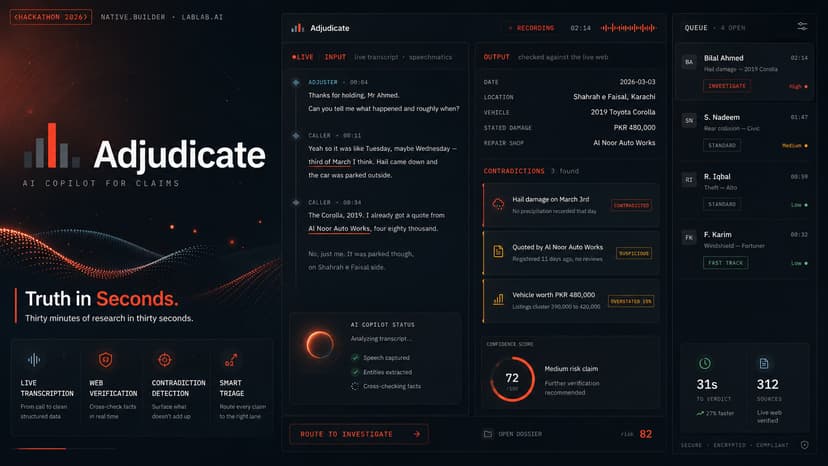
Adjudicate is an AI agent for insurance First Notice of Loss calls. Today, an adjuster gets one call and no time to verify anything in it — claims that would fall apart under ten minutes of scrutiny go through unchecked, because nobody has ten minutes to give. Adjudicate listens to the call live, extracts the claim's key facts as the caller speaks, and checks those facts against real public data while the call is still happening — historical weather records, business registries, and other public sources, depending on what the claim actually needs checked. A hail claim triggers a weather lookup; a different claim triggers something else entirely. That dynamic decision-making is the core of the product, not a fixed script. The result is a dossier: a risk score, a routing recommendation, and a contradiction table showing exactly what was claimed versus what the evidence shows — with a source link on every finding. Where evidence is genuinely unavailable, Adjudicate says so instead of guessing, which we treat as a feature, not a gap. In a real test run, Adjudicate checked a flight-delay claim's stated cause against historical weather data, found no precipitation was recorded that day, and returned a contradicted verdict with a 35/100 risk score in 127.4 seconds — against a roughly 30-minute manual baseline. The application (Queue, Live Intake, and Dossier screens) is built and deployed on native.builder, connected directly to Supabase as its data layer. A lightweight backend service handles the parts native.builder's own documentation notes aren't yet supported standalone: live audio streaming and multi-API orchestration across Speechmatics for real-time transcription and diarization, AI/ML API for structured field extraction, and public data sources for verification. Adjudicate is built for insurance adjusters and SIU teams — not to replace their judgment, but to give them the scrutiny they've never had time for.
10 Aug 2026

AlphaStream Omni
Our platform is a unified financial intelligence terminal built for the Fireworks AI hackathon, combining three independent systems into a single trading workflow: spot a macro risk, check a company's exposure, verify leadership sentiment, then ask a cross cutting question, all without leaving the terminal. Apex Quant acts as the entry point, a global macro intelligence map that surfaces emerging risks by region and industry. Once a risk is flagged, SupplyGraph pulls SEC EDGAR data to build a live supplier and competitor graph, filtered by industry category using official SIC codes, so a trader can instantly see which companies are exposed to that risk and through which relationships. From there, AlphaStream Omni analyzes the actual earnings call audio of the affected company. Using Whisper for transcription, FinBERT for text sentiment, librosa for vocal prosody analysis, and Gemma 3 12B running on Fireworks for reasoning, it evaluates not just what executives said but how they said it, catching vocal stress and tone shifts that raw transcripts miss. The result is a buy, sell, or hold signal backed by cited evidence from the actual call. Tying all three together is an Omni Assistant that lets users query across every layer at once, whether that means asking about a specific company's supply chain, a sector wide sentiment trend, or a single moment in an earnings call. The impact is real. Institutional grade financial intelligence has historically been locked behind expensive terminals. By combining macro data, supply chain graphs, and voice driven sentiment analysis into one accessible, AI powered product, we are giving retail traders and smaller funds the same kind of edge that used to require a six figure subscription.
13 Jul 2026
Filing Pulse - Know the Moment It Matters
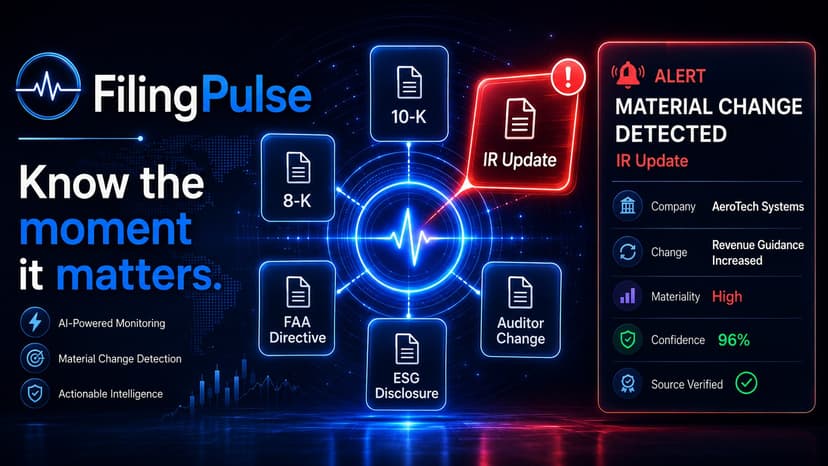
FilingPulse is an AI agent that monitors company filings and investor-relations pages, detects material changes, and pushes structured alerts with what changed, why it matters, confidence, and source link. Today, teams either refresh SEC filings, investor-relations pages, regulatory portals, and news sources manually — or they pay for expensive enterprise terminals. Smaller teams are priced out, which means they often discover important changes late: a delayed 10-K, an auditor resignation, a revised risk disclosure, a quiet investor-relations page edit, or a regulatory update. FilingPulse solves this by giving users a company watchlist. The agent continuously monitors public filing portals and investor-relations pages, detects whether page content has changed, filters out cosmetic edits, and only escalates materially relevant changes. Each alert is enriched by an LLM and returned in a structured format: what changed why it matters confidence score source URL company history The system is designed around a cost-efficient architecture: Bright Data handles live public web access, including bot-protected and JavaScript-heavy pages; then FilingPulse normalizes the page, hashes the meaningful content, compares it against previous snapshots, and only calls the AI model when a real change is detected. For the demo, FilingPulse monitors a curated watchlist of companies including Super Micro Computer, MicroStrategy, Unilever, Boeing, Carvana, Tesla, Palantir, and JPMorgan Chase. Each company represents a different compliance risk: filing delays, crypto treasury exposure, IR page edits, FAA/DOJ regulatory risk, covenant risk, CEO disclosure risk, contract concentration, or regulatory capital pressure. The result is a live feed of material filing intelligence for teams that cannot afford to find out late.
31 May 2026

AI Virtual Puppet Theater
AI Virtual Puppet Theater is an immersive AI powered browser experience that transforms users into live digital puppeteers through real time gesture control, facial tracking, and cinematic storytelling. The project combines computer vision, realtime animation, and interactive stage design to create a magical virtual theater where users control expressive 3D characters using natural human movements. Using webcam based hand tracking and facial detection, players can perform combat, emotional reactions, celebration animations, and cinematic interactions. The system tracks gestures, blinking, eye movement, facial expressions, and head motion to make puppet characters feel emotionally alive and deeply connected to the user. Characters react dynamically with expressive eyes, animated emotions, smooth movement interpolation, and theatrical body language. The platform includes a complete cinematic story mode featuring dramatic sequences between a King, Lion, Hero, and mysterious dark creature, brought to life through curtain transitions, realtime lighting, particle systems, and synchronized animation, all running directly inside the browser. The technical stack includes Next.js, TypeScript, Tailwind CSS, React Three Fiber, Three.js, Zustand, MediaPipe, TensorFlow.js, face-api.js, and Framer Motion, with strong focus on low latency interaction and immersive presentation quality.
19 May 2026

Creators Studio
Creator's Studio is an end-to-end AI-powered content creation platform designed to revolutionize how digital content is produced. Our system leverages a sophisticated multi-agent framework, orchestrated by Coral Protocol, to transform a single text prompt into a complete, professional-grade video package. Here’s how it works: a user provides a raw idea—for example, “a quick tutorial on baking chocolate chip cookies.” Our AI agents then spring into action. The Script Agent, powered by Mistral AI, refines the input into a compelling narrative. The Narrator Agent, using ElevenLabs, generates a natural and expressive voiceover. The Video Agent automatically produces a stylized, caption-ready video perfectly synced to the audio. Finally, the Publisher Agent mints a unique NFT on the Solana blockchain via Crossmint, providing the creator with instant, verifiable proof of ownership. We eliminate the need for multiple complex tools and technical skills, making high-quality content creation fast, accessible, and secure. Creator’s Studio isn't just a tool; it's a new paradigm for the creator economy.
21 Sep 2025


