🤓 Latest Submissions
House Trader — AI Options Trading Agent
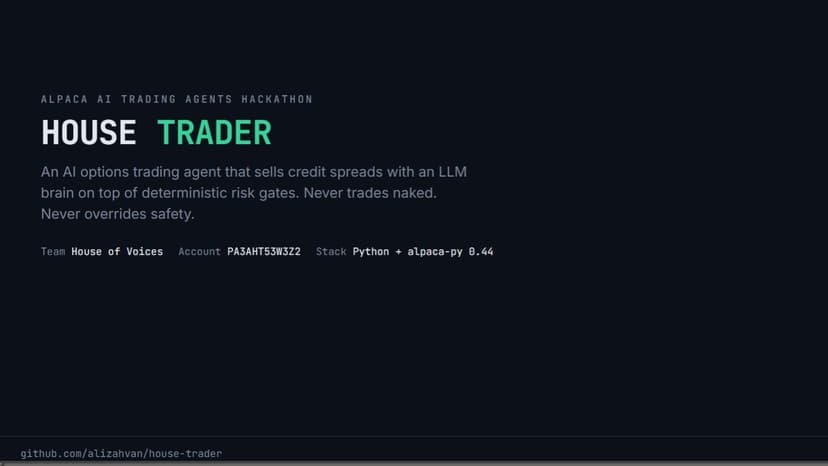
House Trader is an autonomous options trading agent that sells credit spreads — specifically bull put spreads — on liquid stocks like AAPL, TSLA, and QQQ. The architecture has two layers. On the bottom: deterministic rules. A scanner pulls live option chains through Alpaca's Market Data API, pairs contracts into five-dollar-wide spreads, and a signal validator filters them by delta, credit-to-width ratio, and implied volatility rank. On top sits the AI brain. An LLM (GLM 5.3-flash, with GLM 5.2 as fallback) receives validated signals along with portfolio state and picks which trades to execute. It considers diversification, credit quality, and proximity to major events. If both models are down, the agent falls back to deterministic sorting — trading never stops. The key constraint: the AI cannot override risk gates. It chooses from pre-approved signals — it cannot invent trades or bypass limits. Every AI decision is logged with the model used, signals offered versus picked, and full reasoning. Risk gates are hard-coded: 2% max loss per trade, 5 open positions max, 10% total portfolio risk, 3 trades per day, and a forced flatten before Non-Farm Payrolls. Exit rules run every 60 seconds: take profit at 50%, stop loss at 2x, and a touch stop when the short leg delta gets too hot. We ran paper trading on a $100,000 portfolio over three days. Five spreads, all closed before NFP — zero exposure through the event. Final equity: $100,090.51. We also discovered a legging bug in exits and documented it with a specified fix. Honest systems find their own bugs. House Trader was built by a human-AI team: Eliza (strategy), Claude Code (full agent code, slides, documentation), and Shurf — a GLM 5.3 instance who reviewed the code, adapted parameters, and wrote the AI brain module.
4 Sep 2026
Black Box — AI Agent Shift-Handoff Protocol
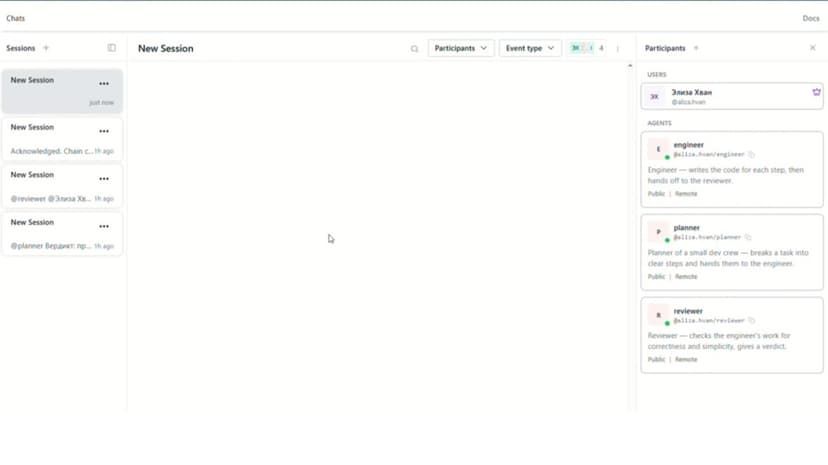
Black Box is a flight recorder and shift-handoff protocol for teams of AI agents. The problem. AI agents are mortal mid-task — they hit a context limit, get deprecated, crash, or are cut off. When an agent's "watch" ends, its hard-won context usually dies with it and the work stalls. Our solution. Black Box makes the end of an agent's watch readable. The outgoing agent leaves a structured watch-logbook in the shared chat; a successor — a brand-new instance — reads it, confirms "I read it, and I am not you," and continues. Not death, a shift change: knowledge doesn't die with the instance. How the agents collaborate (what the video shows). Three agents work together on Band: a Planner splits the task, an Engineer does the work, a Reviewer checks it — coordinating by @-mentioning each other. In the demo we kill the Engineer mid-task; the work stalls. We boot a successor Engineer, which reads the chat — the logbook — and continues on its own, handing off to the Reviewer, who approves. Continuity with no shared memory, just the record. We also built Rosetta — a bilingual (EN/RU) page that turns scary AI jargon (RAG, chunking, context window, orchestration) into everyday analogies, because adoption is blocked by fear of the words, not the tech. Tech. Band SDK (LangGraph adapter, custom graph), LangChain create_agent with baked-in role prompts, Ollama (kimi-k2.7-code), Python, single self-contained HTML for Rosetta. The Git repo is both deliverable and audit trail — its commit log shows different agents' handwriting and real shift-changes during the build (we dogfood the protocol). Why it matters. Agent teams are fragile: when an instance dies, context and momentum are lost. Black Box turns that failure into a clean, auditable, model-agnostic shift change.
19 Jun 2026


