
🤝 Top Collaborators

🤓 Latest Submissions
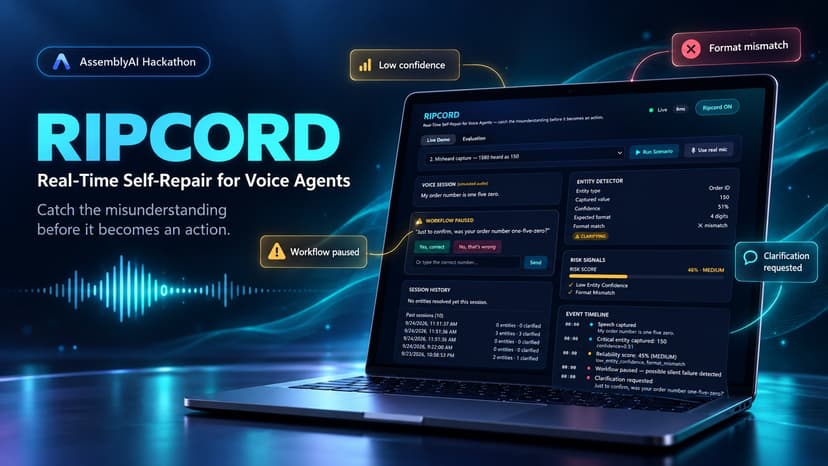
Ripcord: Real-Time Self-Repair for Voice Agents
Ripcord is a real-time self-repair and reliability layer designed for voice agents. Voice systems can sound confident even when they have misunderstood a critical detail such as an order number, date, quantity, address, or account identifier. If the workflow continues without verification, a small transcription error can become a real-world failure. Ripcord focuses on catching these silent failures before an action is executed. It evaluates critical entities using signals such as transcription confidence, expected formats, validation rules, and reliability risk. When the captured information appears uncertain or inconsistent, Ripcord pauses the workflow and generates a targeted clarification instead of allowing the agent to continue blindly. For example, if an order ID is expected to contain four digits but the system captures “150” with low confidence, Ripcord flags the format mismatch, raises the risk level, pauses the workflow, and asks the user to confirm or correct the value. The interface includes live and simulated scenarios, entity detection, risk scoring, clarification handling, session history, and an event timeline that explains why an interruption occurred. AssemblyAI provides the speech intelligence used in the voice pipeline, while Ripcord adds the reliability layer between speech understanding and downstream actions. The goal is simple: help voice agents detect, pause, clarify, repair, and then resume safely.
30 Sep 2026

Assumption Zero: Human Requirement Verification
Modern software can pass every automated test and still fail the people it was designed to serve. Many systems silently assume that every user has a surname, permanent address, conventional phone number, reliable internet connection, or other standardized identity and access conditions. These assumptions are often distributed across multiple layers of an application, including the frontend, APIs, backend validation, database schema, automated tests, and documentation. Because each individual component may appear technically correct, these human-facing failures can remain invisible until a real user is blocked. Assumption Zero is a human requirement verification system designed to uncover these hidden assumptions before they reach production. The platform analyzes both software requirements and the repository itself. Specialized analysis agents inspect the frontend, backend, APIs, database, tests, and resilience logic in parallel. Assumption Zero then maps requirements to concrete implementation evidence and constructs an Assumption Graph showing where a human requirement is supported, contradicted, or missing across the software stack. Instead of only reporting code smells, Assumption Zero converts detected assumptions into realistic counterexample human journeys. For example, our demonstration follows Noor, a user with one legal name, no permanent address, an international Pakistani phone number, and potentially unreliable connectivity. Although the application may appear functional for conventional test data, Noor's journey exposes failures caused by mandatory surname fields, address requirements, restrictive phone validation, or assumptions about continuous network access. The system traces each failure back to the relevant code and requirement, presents supporting evidence, and proposes coordinated repairs across affected layers. Developers can review the proposed changes, apply fixes, and run verification again to determine whether the original user journey now succeeds without creating regressions elsewhere. The target users are software engineering teams building systems where human accessibility and inclusivity are critical, particularly public-service, nonprofit, healthcare, education, emergency-response, and accessibility-focused applications. What makes Assumption Zero different is its focus on the gap between technical correctness and human correctness. Traditional testing asks whether software behaves according to predefined test cases. Assumption Zero asks a deeper question: What assumptions did we make about the human using the system? By combining repository-scale analysis, requirement-to-code evidence mapping, cross-layer reasoning, counterexample journey generation, repair planning, and regression verification, Assumption Zero turns hidden assumptions into visible, testable engineering problems. The result is software that is not only technically functional, but more resilient to the diversity of real people and real-world circumstances.
27 Sep 2026

CoAct — Consensus-Gated Bimanual Manipulation
CoAct is a consensus-gated bimanual manipulation system built around a simple question: what should a robot do when two embodied viewpoints produce different interpretations of the same human instruction? In shared environments, spatial language can be ambiguous. Two robotic arms observing the same workspace from different viewpoints may ground an instruction to different objects or locations. Instead of immediately acting on one interpretation, CoAct treats this disagreement as a safety signal. Each SO-101 agent independently observes and grounds the instruction. A consensus engine compares their interpretations before physical execution is permitted. When disagreement occurs, CoAct diagnoses the ambiguity and attempts to resolve it through re-observation and confirmation. Its key interaction mechanism is live-correctable hover confirmation. Before committing to manipulation, the robot approaches the interpreted target while remaining interruptible. Speechmatics real-time transcription listens for human corrections during this window. If the user says, “No, the large plate,” CoAct can detect the correction, abort the current motion, retract, update the intended reference, re-ground the instruction, and evaluate consensus again before continuing. The prototype combines bimanual SO-101 robot models, MuJoCo simulation, independent grounding, consensus reasoning, ambiguity diagnosis, inverse-kinematics motion control, a safety-oriented state machine, asynchronous event handling, and Speechmatics real-time ASR. CoAct introduces a deliberate checkpoint between interpretation and physical commitment, enabling robots to recognize conflicting interpretations and remain responsive to human correction. **CoAct: Consensus before commitment. Correction before consequence.**
16 Sep 2026
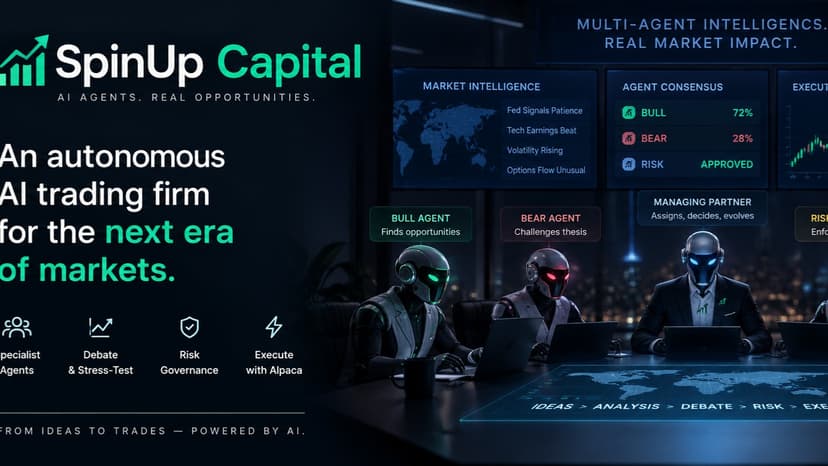
SpinUp Capital — Autonomous AI Trading Firm
SpinUp Capital reimagines algorithmic trading as an autonomous AI investment firm rather than a single trading bot. A Managing Partner agent analyzes market events and decides whether to route an opportunity to an existing specialist or create a new one. Specialist agents focus on domains such as earnings, macro events, volatility, and hedging. Before receiving permission to trade, every newly created agent enters an Agent Arena, where it is tested across simulated market scenarios and evaluated on strategy quality, risk compliance, and consistency. For live decisions, specialist agents generate options trade proposals while Bull and Bear agents independently challenge the thesis. A Risk Governor acts as an independent control layer, checking exposure, position sizing, strategy structure, and portfolio constraints before an order can proceed. Rejected proposals can be revised through a trade-surgery process that reduces size or restructures the strategy rather than simply bypassing risk controls. Approved trades are executed using Alpaca’s Trading API in the paper trading environment, allowing the system to operate against real market infrastructure without risking real capital. SpinUp Capital also integrates Alpaca tooling through MCP/CLI-based workflows to give autonomous agents structured access to brokerage functionality. The result is a multi-agent trading system that demonstrates agent specialization, autonomous decision-making, adversarial reasoning, risk governance, options trading, and end-to-end brokerage execution. Instead of asking whether one AI model can predict the market, SpinUp Capital asks a different question: what if an entire investment firm could operate autonomously?
4 Sep 2026
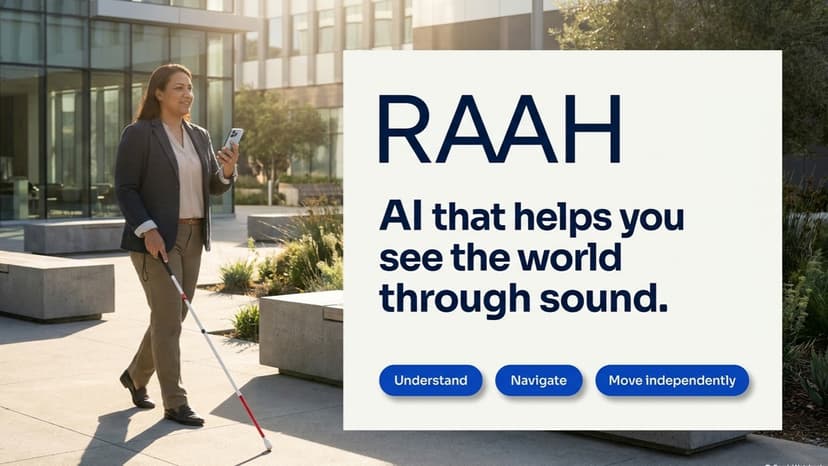
RAAH: AI Visual Assistant
RAAH is an AI-powered visual assistant designed to help blind and visually impaired people interact more independently with the world around them. People with visual impairments frequently face everyday challenges such as understanding unfamiliar surroundings, reading printed information, interpreting signs, and identifying objects. RAAH brings several of these assistance needs into one accessible AI experience. Using multimodal AI, RAAH can analyze visual information and communicate meaningful descriptions to the user. Its core experiences include Vision, which helps users understand scenes and objects; Read Text, which extracts and explains text from images; Live Guide, which provides contextual visual assistance; and Ask RAAH, which allows users to ask questions about what they see. The application uses Google Gemini for visual understanding and natural-language reasoning, with Supabase Edge Functions handling the backend AI integration. The frontend is built with React and TypeScript and focuses on a simple, accessibility-oriented interaction model. RAAH's goal is not simply to recognize objects, but to turn visual information into useful, understandable guidance that can help users make sense of everyday situations with greater confidence and independence.
10 Aug 2026


