
Andrey Kurnoskin@andreysk0303
🤝 Top Collaborators


🤓 Latest Submissions

Readback: a voice agent that proves what it heard
In prescription intake a recognition error does not look like an error. The prescriber says hydromorphone, the recognizer returns morphine, both are real drugs, the dose is plausible, and the confidence can still be 1.00. A plain read-back does not save it: the caller hears "morphine, correct?" and says yes out of habit. Readback is a pharmacy intake agent built on AssemblyAI's Voice Agent API and Universal-3.5 Pro streaming. The agent proposes each value; a gate on our server decides whether it may be written. A value enters the order only if a validator proved it or the caller confirmed it aloud: - NPI and DEA numbers are checked by their checksums. - Drug, strength, form and route must exist together in the FDA NDC catalogue. - Drug, strength, quantity, directions and patient name are read back every time. - A drug name on the ISMP List of Confused Drug Names is asked again at any confidence. The agent names every drug the list pairs with it, and only a spoken name answers. A yes writes nothing. This is enforced in code, not in the prompt. A confirmed value has exactly one constructor, and commit_order runs in hold mode and is refused while any required field is unproved. Every field keeps its source words with millisecond timecodes, the recognizer's confidence and the validator's verdict. After the call the server fetches AssemblyAI's own transcript and marks each field in the receipt as witnessed or not. Over 20 seeded pair mishearings answered with a reflex yes, a plain read-back writes the wrong drug 20 times and Readback 0 times. The cost is published beside it: 21 of 59 correct drug names get the longer question. Every figure carries the command that produced it and the set size. No microphone needed: /demo replays a synthesised session through the shipped gate with the pair rule on and off. Live calls so far used a synthesised caller, not a human voice. A technology demonstration, not a medical device; synthetic data only.
30 Sep 2026
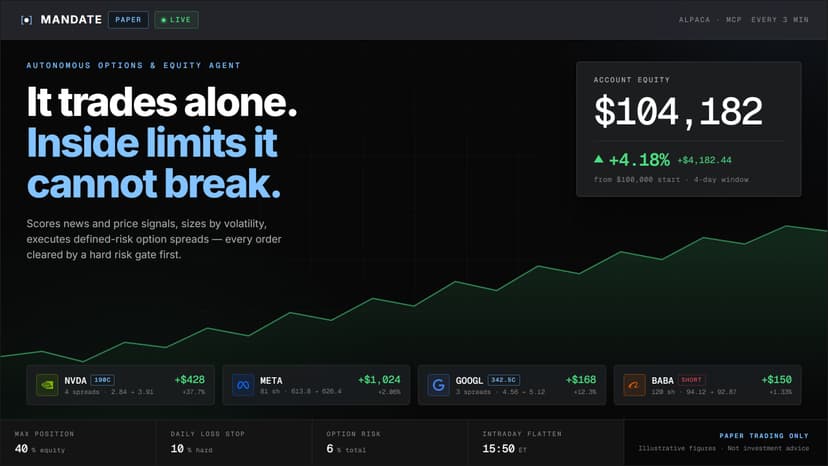
MANDATE — The Stateful Multi-Agent Trading Desk
MANDATE is an autonomous, stateful multi-agent trading desk for Alpaca paper markets that operates continuously across market and off-market hours. In the background, a persistent research process collects attributable news, market events, corporate actions, movers, and IPO activity, organizing them into an evolving graph of connected evidence. Instead of treating each trading cycle as an isolated prompt, MANDATE carries this accumulated context forward. New information is linked to events, companies, hypotheses, and prior research, allowing agents to reason over fresh market signals together with the continuously evolving news graph. A main trader combines quantitative signals with context retrieved from this graph to produce an evidence-bound trading plan. Independent market, risk, and execution agents challenge each hypothesis before any action reaches the broker, creating a true multi-agent decision process rather than a single model approving its own trades. LLMs never receive direct broker write access. A deterministic execution boundary revalidates market state, portfolio constraints, liquidity, exposure, and order parameters before submission. Invalid output, stale evidence, unavailable critics, or breached limits resolve to PARK or HOLD. MANDATE supports equities and defined-risk options strategies, including long premium and debit spreads. Its live operator console exposes hypotheses, background research, agent activity, tool calls, evidence dependencies, positions, exit policies, and P&L. MANDATE is not a trading chatbot that wakes up when prompted, but a persistent multi-agent system whose understanding of the market continuously evolves and informs future decisions.
4 Sep 2026


