
🤓 Latest Submissions
Pin Desk
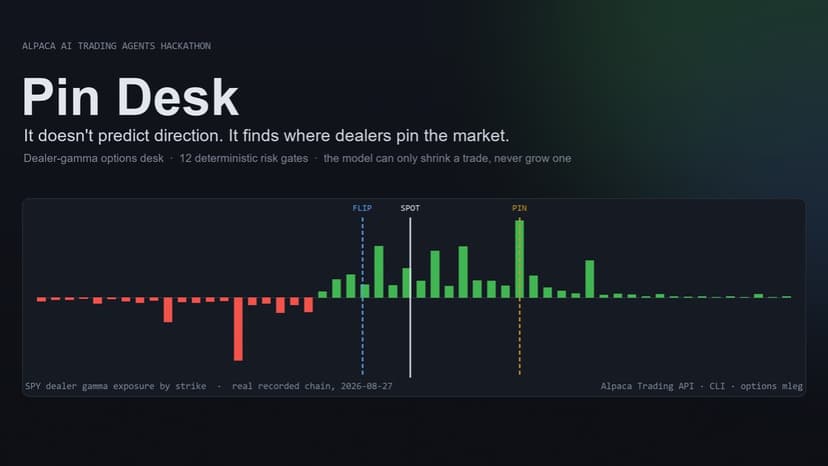
Pin Desk is an autonomous options trading agent that doesn't predict direction — it maps where market makers are forced to hedge. When dealers are short the options retail is long, they buy weakness and sell strength to stay hedged, which pins price near the strikes carrying the heaviest open interest. Pin Desk computes that pressure across the live options chain, finds the exact strike where net dealer gamma flips from positive to negative, and sells defined-risk iron condors around the pin — but only while dealers are long gamma and actively damping price moves. When the regime flips, the desk stands down entirely rather than selling premium into a market that's about to amplify, not absorb, volatility. An LLM sits inside the loop, but its authority is deliberately narrow: it can abstain from a trade or apply a conviction multiplier between 0 and 1 to shrink position size — nothing more. It cannot choose strikes, change an expiration, or increase a position past what the deterministic system already sized. That clamp is enforced twice (schema and code) and tested against adversarial inputs. If the model is unreachable, the desk trades deterministically and logs that it did. Every proposal — approved, vetoed, or stood down — passes through twelve independent risk gates covering position sizing, portfolio concentration, credit quality, liquidity, tenor, and duplicate-position protection, with the full refusal reasoning written to an append-only journal. Two of those gates exist because the desk caught its own mistakes live on paper: a knife-edge regime call it shouldn't have trusted, and an attempt to double an existing position. Built on Alpaca's Trading API, Market Data API, and official CLI, with autonomous execution, a live Streamlit dashboard, and 180+ tests — including verified live fills on paper trading.
4 Sep 2026
EdgeGuard: Cost-Optimized Hybrid AI Router
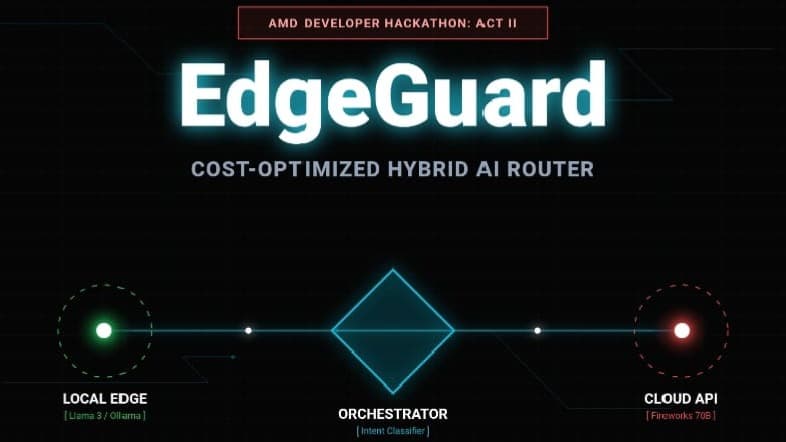
Enterprise AI deployment faces a massive scaling issue: sending every minor query to massive, paid cloud models drains API budgets rapidly. To solve this for Track 1, I built a highly optimized hybrid AI orchestration backend designed around strict token efficiency. The system architecture intercepts incoming queries and utilizes a lightweight, local LLM as a dynamic intent classifier. If a query is categorized as basic general knowledge or summarization, the local edge engine handles the generation entirely for zero cost. It then runs a self-evaluating cascade to ensure output quality. If the edge model fails its self-evaluation, or if the initial query is classified as high-complexity (like advanced programming or mathematics), the agent instantly escalates the prompt to the highly capable Fireworks AI API. To maximize efficiency, the agent integrates a local hashing cache for instant zero-cost returns on repeated queries. Finally, a persistent telemetry engine runs in the background, logging execution times, routing paths, and exact "Tokens Saved" metrics to a CSV database, providing hard, measurable data to prove the system's cost-saving capabilities.
13 Jul 2026


