
🤓 Latest Submissions

PatientKeeper Retorno
PatientKeeper Retorno turns unresolved clinic follow-up into an accountable next administrative step. Inspired by daily work supporting medical practices, it combines eight fictional return cases with a doctor workspace for an illustrative bunion and bunionette episode. The doctor assigns ownership, a next action and an administrative due date, reviews exact sources and messages, and records a simulated reply or refusal before human closure. Changed sources invalidate earlier reviews; conflicts and clinical questions require handoff. A secretary is not required to operate the new workspace. On October 16, the local app called an Evolus workflow connected to Gemma through AMD Token Factory, with a read-only knowledge library. One run returned pure JSON in 8.149 seconds with two literal citations, mandatory human review and unchanged case state. Configuration was verified; execution metadata does not independently report model identity or hardware. The source includes the optional API integration, disabled by default, and a validated Linux/arm64 container. Earlier direct Gemma attempts and the separate Qwen AMD GPU pilot remain documented. The public demo is static: recorded proof, no live inference or WhatsApp sending. Consultation notes extract selected transcript segments with references. PT/EN audio transcription runs only in the configured local CPU version. No signed medical record or clinical protocol is generated. EN/PT/ES, dark mode and a fictional read-only doctor calendar support exploration. October 5 scaffolding and event work from October 12-16 are disclosed. Illustrative scenario: six records/day at fifteen reported manual minutes versus ten assumed assisted minutes would free thirty minutes/day, including preparation, review and corrections. Savings are unmeasured. All cases are fictional; no patient data is used.
18 Oct 2026

Figueira OCR and RAG: reviewable AI on AMD
Figueira OCR and RAG are two reviewable AI prototypes by Athos Felipe at FIGUEIRA for the AMD/LabLab Academy. The MC2 OCR delivery is preserved as R03. It extracts text from vehicle plates and road signs into atomic JSON output using a persistent Qwen2.5-VL worker. Its source matched all ten published OCR examples on an AMD Radeon Pro W7900D; those examples are not a hidden-test accuracy benchmark. MC3 adds an offline, persistent RAG worker. It indexes supported document, spreadsheet, code, log and image files, retrieves relevant passages and returns a concise answer with minimal relative file citations. Unsupported or unreadable evidence produces an explicit refusal. The AMD GPU is required; there is no silent CPU fallback. Qwen2.5-VL-7B-Instruct is pinned to a fixed revision and the model weights are included in the MC3 image. The R05 source pilot passed all ten public MC3 cases plus four independent synthetic cases on the W7900D with PyTorch 2.13.0+rocm10.0.0. Model loading and indexing took 37.378 seconds, the query phase took 39.812 seconds, and peak GPU allocation was 18.212 GB. The worker and free AMD session were stopped after exporting the evidence. These results validate the source pilot, not the final OCI image on a GPU, unseen document accuracy, hidden evaluation scores or an official award. The separate MC2 and MC3 image fields identify their respective deliverables.
1 Dec 2026

Tablekeeper — Figueira Dark Factory
Tablekeeper makes restaurant reservations dependable when guests book simultaneously, retry after a lost response, or change their plans. This revised delivery was built from an empty result repository by three existing BAND seats: planner, builder and independent reviewer. One initial human task covered all four stages. Generic mandates define the method; the official specification defines the product. The full room export preserves 3,154 events and the sole human dispatch. Four standalone folders cover the reservation API; a responsive booking UI with single and combined tables; effective-dated policies, truthful history and recurring reservations; then atomic series amendments and deterministic closure replanning. A retry recovers its original receipt while an explicit confirmation lookup shows the current seating. The final isolated harness passed 575 cumulative executions across the four folders: 120, 145, 152 and 158. These represent 158 distinct shipped official cases. Independent Stage 4 review passed 511 distinct case IDs. Earlier failures remain preserved: browser review caught large-number rounding despite green shipped tests; a color-only change was rejected, then the numeric repair passed the same checks. The video uses actual R03 room footage, a labelled timelapse and a post-run demonstration of the accepted app. The English presentation and repository explain the method, evidence and limits. Runtime needs no external API. State is ephemeral and uses one process. Model spend is unverified, not zero; hidden judging tests remain unknown. The original submission and factory history are preserved.
6 Oct 2026
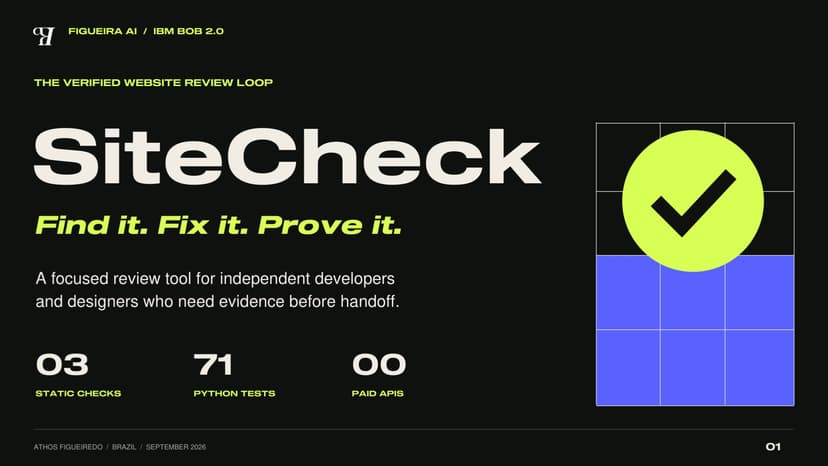
SiteCheck — Verified Website Review Loop
I build websites and visual systems for clients. Before a handoff, I need more than a list of things that might be wrong: I need to show the source of a problem and prove what changed after a fix. That is why I built SiteCheck. SiteCheck is a small, local review loop for freelancers, designers and independent developers. It checks three static patterns: images without an alt attribute, form fields without a supported accessible name, and relative links whose destinations are absent from the supplied files. Each finding carries a rule ID, location, evidence and a suggested correction. The Python tool exports JSON and a self-contained HTML report; the live browser version accepts pasted HTML or a project folder and exports JSON without uploading the files. The demo is deliberately concrete. Three issues become two after I add a form label: one verified correction, two remaining findings and zero new regressions. A reproduction command generates fresh evidence and asserts those counts. The updated comparison tracks individual occurrences, so fixing one of two images does not hide the other. The September 26 review passes 71 Python tests, including 29 new regression cases, plus 17 browser verification scenarios covering six languages, local file handling, inert HTML parsing and mobile/desktop layouts. The original narrated video records the earlier 42-test state; the updated video adds current browser execution and the presentation carries the latest results. SiteCheck runs without a paid runtime API. It does not crawl websites, verify external HTTP links, interpret server routes or replace a complete accessibility audit. I have not claimed a measured productivity speedup. Its value is a focused handoff: understandable evidence, an explicit human decision and a repeatable recheck. The editorial design makes that evidence readable instead of burying it in a dashboard.
27 Sep 2026
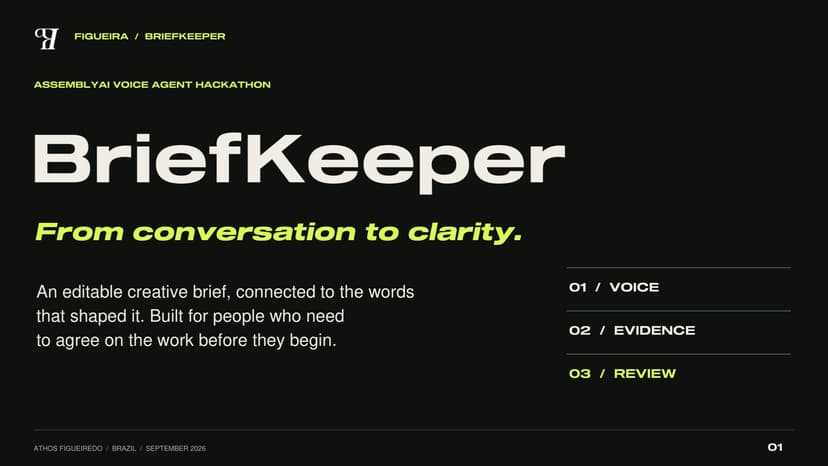
Briefkeeper — From conversation to clarity
Briefkeeper helps independent designers and small creative agencies capture a usable brief during a voice conversation. It organizes objective, audience, deliverables, visual direction, timing, constraints and budget into seven editable fields. Each accepted AI update includes an exact quote from the client transcript. Unknown details remain open questions. Designers can inspect source statements, edit fields, review change history and export Markdown or JSON. New client speech resets existing review approvals so a later correction cannot silently retain an old approval. Empty or malformed tool updates are rejected. The browser streams speech to AssemblyAI Voice Agent API and plays spoken replies. Six interface and conversation language options, language-matched narrators and adjustable playback volume are available. Recognition has not been validated in every language. Short-lived tokens come from a protected endpoint, keeping the API key server-side. The hosted prototype requires a private reviewer access code and limits sessions to three minutes. A clearly labeled fictional example works without a microphone. Automated tests cover source validation, corrections, review invalidation, language selection and volume bounds. A current synthetic Portuguese test exercised the live API and populated three fields while unknown timing and budget remained empty. This does not replace physical-microphone and subjective audio testing. Quote matching provides traceability, not guaranteed semantic correctness. Human review remains essential. No customer outcomes are claimed.
30 Sep 2026


