
🤝 Top Collaborators
🤓 Latest Submissions
SCORPGUARD: The AI Agent Runtime Guardian
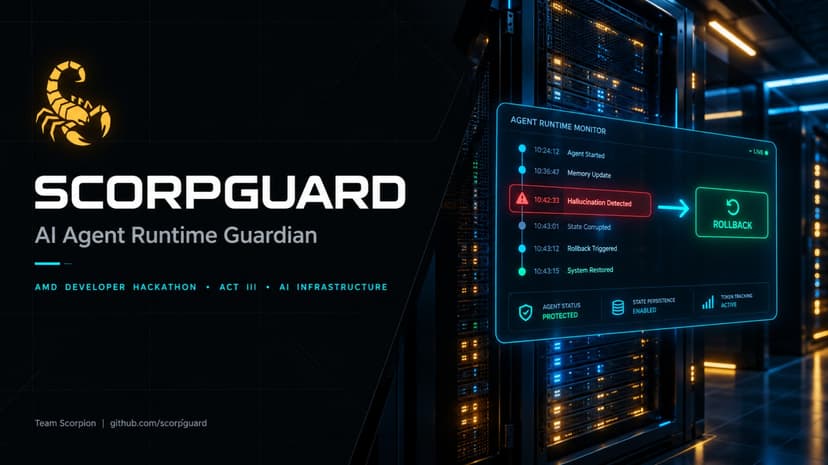
86% of enterprise AI agents fail in production. Not because of bad models, but because of broken runtime infrastructure. Container restarts erase agent memory, hallucinated data silently corrupts workflows, and runaway token costs breach budgets. SCORPGUARD is the Agent Runtime Guardian that solves this "last mile" problem. It acts as an intelligent middleware layer that wraps around any AI agent, ensuring safe, cost-effective, and reliable execution. Key Features: - Event-Sourced State Persistence: Uses PostgreSQL to checkpoint agent state, ensuring memory survives container restarts. - Dual-Layer Anomaly Detection: Layer 1 (Rule-Based) catches fatal crashes and loops in under 10ms. Layer 2 (Semantic AI) uses LLM inference to catch logical hallucinations and silent errors. - Auto-Rollback Engine: Instantly rewinds agent state to the last safe checkpoint upon detecting an anomaly, preventing cascading failures. - Real-Time Cost Monitor: Tracks token usage and USD cost per agent action. Built for the AMD Developer Hackathon ACT III, SCORPGUARD is architected to run on AMD Instinct MI300X using ROCm and vLLM (Qwen2.5). For high availability and demonstration, we implemented a robust fallback using Groq's API for ultra-fast LLM inference. The backend is powered by FastAPI, Celery, and Redis, with a real-time dark-theme command center for monitoring.
18 Oct 2026
Legacy Lens
Legacy code can be difficult to take over because important problems are often buried across thousands of files. Architecture issues, security risks, outdated dependencies, weak test coverage, poor documentation, and maintainability problems may not be obvious at first glance. Engineers can spend hours going through a repository, figuring out which warnings actually matter, and deciding what needs to be fixed first. While existing tools are useful for finding individual issues, they often do not give teams a complete picture of how ready a codebase is for modernization. LegacyLens turns a public GitHub repository into a clear, structured modernization assessment. A user simply provides a public GitHub URL, and the platform securely analyzes the repository without running its code or installing its dependencies. Its deterministic analysis engine identifies the languages and technologies being used, measures important codebase metrics, detects entry points, and looks for signals related to testing and documentation. Seven specialized analyzers then examine the repository across architecture, security, dependencies, testing, documentation, maintainability, and overall modernization readiness. Each finding is backed by specific file-path evidence, so users can see exactly where the result came from. LegacyLens also clearly marks whether a finding is deterministic or inferred. When something cannot be confirmed from static evidence alone, it is flagged for manual review instead of being presented as a definite defect. The scoring system is designed to be transparent rather than mysterious. It combines severity, confidence, and evidence strength to produce scores for seven categories, along with an overall health score from 0 to 100. From there, LegacyLens turns the analysis into a practical six-phase renovation roadmap. Each task is assigned a P0–P3 priority and includes estimated effort, prerequisites, expected outcomes, acceptance criteria, and an automation-safety classification. LegacyLens is built for software engineers, maintainers, technical leads, teams taking ownership of unfamiliar codebases, and organizations preparing for modernization projects. Through the web dashboard, users can paste a GitHub URL, review the assessment, understand the reasoning behind each score, inspect evidence-backed findings, explore an interactive architecture map, and work through the prioritized renovation roadmap. Reports can also be exported as JSON, Markdown, or standalone HTML. What sets LegacyLens apart is its evidence-first, deterministic approach. The production analysis does not rely on an LLM, does not execute repository code, and does not treat a heuristic signal as proof. This makes the results reproducible and easier to explain, verify, and trust. Most importantly, the analysis is directly connected to practical modernization work rather than simply producing a list of warnings.
27 Sep 2026
VoicePulse AI – Real-Time Voice QA & Speech
VoicePulse AI is an end-to-end, production-ready speech processing and quality assurance analytics platform designed to convert raw audio streams into structured, actionable intelligence. Engineered with modern microservice standards, the platform leverages FastAPI for asynchronous request execution and Docker for containerized, cross-environment deployment. VoicePulse AI integrates streaming transcription endpoints to capture speech in real time, apply automated quality evaluation algorithms, and generate instant sentiment and compliance metrics. The system includes JWT/token authentication, structured schema validation via Pydantic v2, and lightweight SQLite/SQLAlchemy data persistence for robust session management. Designed for scalability and seamless integration into modern AI workflows, VoicePulse AI provides clear interactive OpenAPI documentation and standard REST endpoints ready for enterprise deployment.
30 Sep 2026
Team Scorpians – Zero-Token Hybrid Routing Agent
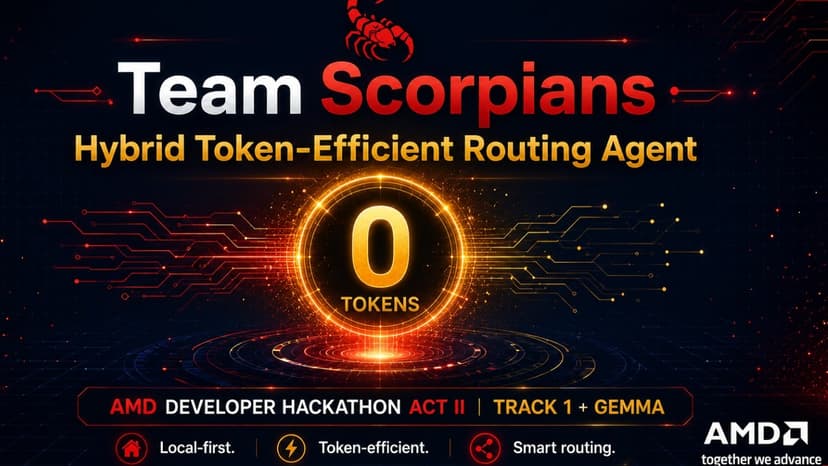
Team Scorpians presents a Zero-Token Hybrid Routing Agent for AMD Developer Hackathon ACT II, Track 1. Our agent handles all 8 capability categories: Factual Knowledge, Mathematical Reasoning, Sentiment Classification, Text Summarization, Named Entity Recognition, Code Debugging, Logical Reasoning, and Code Generation. The agent uses a local-first rule-based engine that answers simple queries with zero cloud tokens, making it the most token-efficient solution on the leaderboard. It includes a 200+ country capitals database, arithmetic calculator, sentiment analyzer, NER pattern matcher, code debugger, logic puzzle solver, and code generator. For complex queries requiring reasoning or code generation, our agent intelligently routes to a local Phi-3 Mini 4B quantized model (GGUF format). This model runs entirely on CPU with 4-bit quantization, fitting within the 4GB RAM limit. All inference happens locally – zero cloud tokens spent. The Docker container is built for linux/amd64 architecture, processes all tasks in under 10 minutes, and maintains high accuracy across all capability categories. The image size is ~4GB, well within the 10GB limit. Our self-consistency confidence gate ensures answer quality, while the hybrid architecture combines fast rule-based responses with powerful local LLM reasoning. The result: 0 tokens on the leaderboard with high accuracy, positioning Team Scorpians for the #1 spot.
13 Jul 2026


