

🤓 Latest Submissions
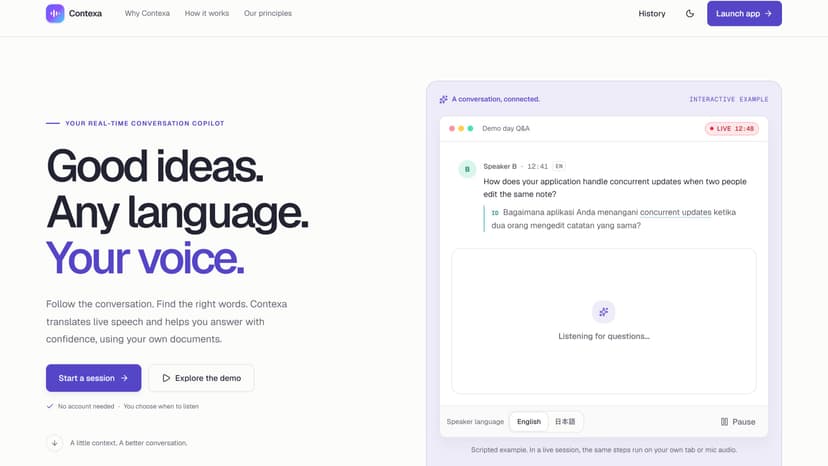
Contexa RealTime Multilingual Conversation Copilot
You understand the topic, but not the language it is discussed in. At an English webinar, a demo day in Japan, or a client call, live captions tell you what was said, but not what to say back in time, so you stay quiet. Contexa is a real-time conversation copilot for that moment. Contexa listens to a browser tab (Zoom, Meet, or a webinar), your microphone, or a recording, and streams the audio straight from the browser to AssemblyAI. Universal-3.5 Pro Realtime transcribes English, Japanese, and mixed-language speech with speaker labels, and Indonesian is routed to Whisper Streaming. Product names and technical terms from your documents are sent as keyterms, updated mid-stream when you add a document, so the transcript spells them right. Every finished turn is translated into Indonesian, English, or Japanese, and questions meant for you are detected. Contexa then searches your own documents (PDF, DOCX, Markdown, web pages, or a whole GitHub repository) with hybrid keyword and semantic retrieval, and drafts an answer in your language plus a ready-to-say version in the speaker's language. It cites the passages it used and says so when your documents don't cover the question. A Pop out window keeps the answer on top of your meeting. When you stop, Contexa writes a recap and saves the session to a history you can search by meaning, across languages. Contexa is built on AssemblyAI's Realtime Speech-to-Text API with its own orchestration: temporary streaming tokens keep the API key out of the browser, end-of-turn detection drives the pipeline, and every stream is terminated cleanly. On the deployed app, translations appear 1.0-1.7 s after a speaker finishes and grounded answers 1.5-1.9 s after a question is detected. Contexa is for students, professionals, and founders who have good ideas but join conversations in a second language. It is live on Vercel and Railway, and open source (MIT).
30 Sep 2026

Sherlock: AI Incident Response Co-pilot
Production incidents are expensive. The industry average Mean Time To Resolve (MTTR) sits at 4.4 hours — most of it spent manually parsing stack traces, digging through git history, reasoning about code logic, and writing postmortems. Existing tools summarize logs, but none of them can actually reason about your codebase. Sherlock fixes that. Powered by IBM Bob as its core reasoning engine, Sherlock is an AI incident-response co-pilot that takes a raw alert and walks the full on-call cycle automatically: triage the severity, run git forensics to find suspect commits, use Bob to reason over the actual repository and pinpoint the root cause, generate a unified-diff patch ready to open as a PR, and produce a publishable postmortem — all in under 12 seconds. IBM Bob is central to the two hardest steps. The Analyst agent gives Bob full repository context and asks it to reason through the code — not just the logs — to form a root-cause hypothesis with evidence. The Fix agent then uses Bob to generate a precise code patch and regression test grounded in the real codebase structure. This is what separates Sherlock from log-summarization tools. Sherlock ships in three surfaces: a cinematic, slash-command CLI shell for on-call engineers, a Next.js web dashboard with real-time agent visualization, and a FastAPI backend orchestrating a five-stage multi-agent pipeline. A mock mode lets the demo run without a live Bob quota. Key results: MTTR drops from 4.4 hours to ~12 seconds. Root cause identified in under 5 seconds. Fix patch generated in under 4 seconds. The pipeline runs as a background task, so results are always saved to the database even if the client disconnects. Built for the IBM Bob Hackathon 2026.
17 May 2026


