
🤝 Top Collaborators

🤓 Latest Submissions
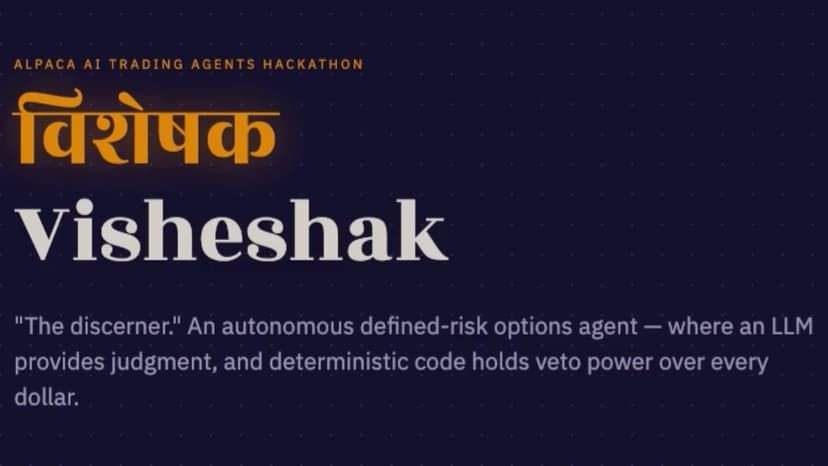
Visheshak
Visheshak — विशेषक, "the discerner" Most AI trading demos hand an LLM the keys and hope. Visheshak bets the opposite way: LLMs are good at reading a market regime and terrible at being trusted with order tickets. So it's built as a separation of powers: The Scout (code) builds a market brief from live Alpaca data and constructs a menu of fully-priced, defined-risk candidates from real option chains — credit spreads and iron condors on SPY/QQQ, momentum debit verticals on mega-caps. The Strategist (LLM) reads the brief plus a news digest and maps regime to playbook: uptrend → put credit spread, downtrend → call credit spread, rangebound → iron condor, unclear → abstain. It can only select candidate IDs from the menu — never invent a strike, price, or quantity. Bad output, API failure, or model overload (absorbed by a multi-model fallback chain) all resolve to: abstain. The Risk Officer (pure code, no LLM) holds absolute veto: 1% max loss per structure, 10% total open risk, position caps, daily-loss halt, an equity kill floor, macro-event blackouts, and a "news storm" gate. News is strictly subtractive — it can veto a trade, never create one. The Executor places atomic multi-leg limit orders; a 5-minute Monitor manages profit-takes, stops, pin-risk closes, and a hard flatten deadline. The design test for every prompt rule: "what if the LLM ignores this?" The answer must be "a worse trade inside the limits" or "no trade" — never "money at risk beyond limits." Every decision, veto, order, and exit is journaled append-only, fully auditable. A live indigo-and-saffron dashboard shows equity, day P&L, and active trades straight from the broker. The whole system runs on a free cloud VM with one-command deploys and rebuilds its position state from the broker after any restart — it never trades blind. Raw REST + pydantic, gated by 28 offline failure-injection checks and a synthetic end-to-end test.
4 Sep 2026

Divine Agent
Track 1: Github link: https://github.com/nhegde610/track1-divine-router AI Agent Router is a hybrid inference framework that routes user queries to fine-tuned (using amd rcom notebook) local quantized models (Gemma-4-e2b) or external API fallbacks. Key Operations: Routing: Analyzes prompts using regex to classify them into one of 8 task categories. Inference: Queries the local LLM first to minimize external dependencies and API costs. Double-Gate Validation: Inspects outputs for gibberish and category-specific formatting rules (e.g., Python compiling, math syntax). Fallback & Escalation: If validation fails, it triggers local algorithms (TextRank/TextBlob) or escalates to cloud endpoints (Fireworks API) with a retry loop. Atomic Writing: Ensures result persistence via temporary file-rename operations within a 9-minute budget. Track 2: Github link: https://github.com/nhegde610/track2-amd-hackathon AI Video Captioning Agent that automates descriptive captioning across multiple stylistic tones (Formal, Sarcastic, Humorous Tech, and Humorous Non-Tech). The pipeline operates as follows: Ingests video tasks from an input JSON. Resolves video URL redirections and verifies file container format support. Automatically transcodes unsupported video container formats (e.g., WebM, AVI) to H.264/AAC MP4 via FFmpeg. Uploads media files to the Gemini Files API and polls until the status is ACTIVE. Employs a rate-limiting mechanism (max 10 calls/min) to prevent API quota failures. Queries the gemini-3.1-flash-lite model using styled tone prompts. Employs a three-tier resilient parser (Strict JSON -> Markdown Block Stripping -> Regex Fallback) to clean responses. Writes final outputs to JSON and deletes remote media assets. The agent runs inside a Docker container configured with FFmpeg and the google-genai SDK.
13 Jul 2026


