
🤓 Latest Submissions
CarePulse
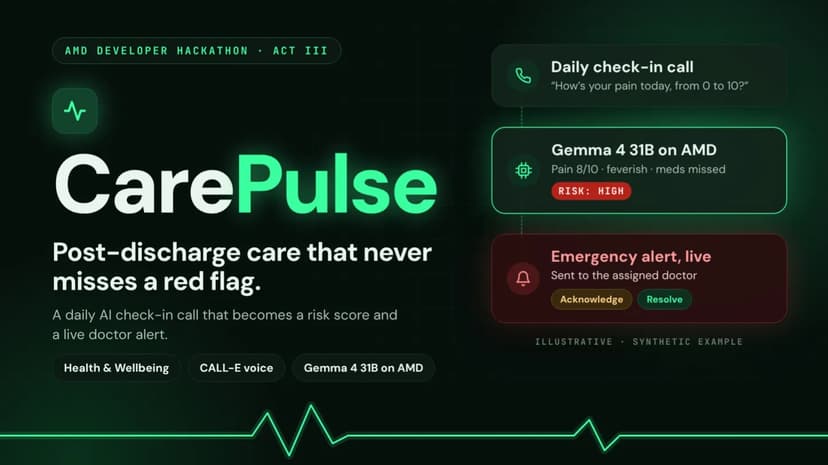
CarePulse is an autonomous post-discharge and chronic disease monitoring platform that bridges the critical care gap between hospital discharge and recovery at home. Preventable readmissions often occur because patients fail to identify worsening symptoms early, while clinical teams lack the time to manually check in on every patient. CarePulse solves this by uniting autonomous conversational voice agents with precision clinical AI. Key Features: Autonomous Voice Check-Ins: Powered by CALL-E, CarePulse dials patients directly on their phones. It conducts warm, conversational, and personalized interviews tailored to each patient's surgery, diagnosis, and recovery timeline—not rigid scripts. AMD-Powered ODPARA Triage: Call transcripts are analyzed by Gemma 4 31B-IT hosted on the AMD Radeon Cloud Token Factory. Gemma extracts structured clinical signals using the gold-standard ODPARA framework (Onset, Duration, Progression, Aggravating, Relieving, and Associated symptoms) with defensive safety thresholds. Real-Time Emergency Alerts: If severe pain (>=7/10), high fever (>=101°F), or red-flag symptoms like shortness of breath are reported, CarePulse streams an instant emergency alert over live WebSockets directly to the assigned doctor's dashboard. Discharge Care Planning: Clinicians and patients manage digital prescriptions, dietary guidelines, medical reports, and scheduled appointments in a zero-trust, role-isolated portal. Tech Stack: Clinical AI: Gemma 4 31B-IT on AMD Radeon Cloud Token Factory Voice Engine: CALL-E outbound voice API Backend: Django REST Framework + Channels (Daphne WebSockets) + Celery Frontend: React + Vite + Tailwind CSS + Framer Motion Database: Supabase (PostgreSQL) CarePulse catches complications early, reduces hospital readmissions, and ensures continuous clinical safety.
18 Oct 2026
Pocketful By Band
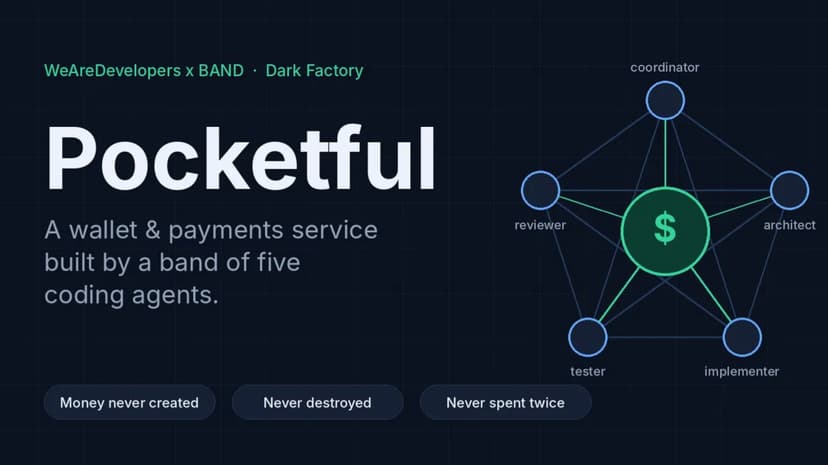
Pocketful is our entry for the Dark Factory hackathon, pocketful track. It is a wallet and payments service where people hold money, pay each other by handle, request money, split bills and settle up, and where money is never created, destroyed or spent twice, even with concurrent requests, retries and rounding. The factory. Five distinct coding-agent seats work together in one BAND Desktop room, running open-source models through Featherless and OpenCode: Coordinator splits each stage into scoped tasks and assigns work by @handle with the full task in every handoff. Architect designs the data model, invariants and concurrency plan before code is written. Implementer builds one scoped change at a time and commits it. Tester runs the checks independently and posts reproducible evidence. Reviewer judges the work against the written specification and sends weak work back with concrete fixes. The mandates are deliberately generic. They describe how a seat works (what it owns, how it hands off, when it rejects), not what is being built, so another team could point the same band at a different problem. FACTORY.md and the mandates folder describe how to stand it up. What it built. Four cumulative stage folders, each a complete service with its own Dockerfile and RUN.md, copied forward and extended so earlier behaviour is preserved: Stage 1: a JSON API with signup and login, payments, requests, splits and net settlements, idempotency keys on write paths, exact integer minor-unit arithmetic, and state export/import. Stage 2: a browser UI served by the same service (balance and pay, activity feed, requests and splits), plus holds and partial captures. Stage 3: payment corrections with revision history, as-of balance views and statements. Stage 4: refunds and batch corrections.
6 Oct 2026
Codebox AI
Codebox AI is built for blind, low-vision, and motor-impaired developers who are left behind by modern coding tools that assume you can see a screen and use a mouse. Using AssemblyAI's real-time speech-to-text API, Codebox AI listens to your voice and understands your coding requests instantly. It indexes your entire project locally, searches across all files and symbols, and sends only the relevant context to Google Gemini to generate answers or propose code changes. Every proposed change is spoken out loud in plain language before anything is touched. The developer stays in full control — nothing is written to a file until they say "apply". If they change their mind, they can say "undo" and everything is restored. Key features: 1. Real-time voice control powered by AssemblyAI streaming STT. 2. Searches your whole project by file, symbol, and content. 3. Google Gemini proposes answers and exact code edits. 4. Every change is previewed, backed up, and reversible. 5. Works with any project folder on Windows, macOS, and Linux. 6. Typed chat mode available for testing without a microphone. Future plan: bring Codebox AI into VS Code as a full extension, so every disabled developer can work comfortably inside the editor the world already uses.
30 Sep 2026
SwiftCap
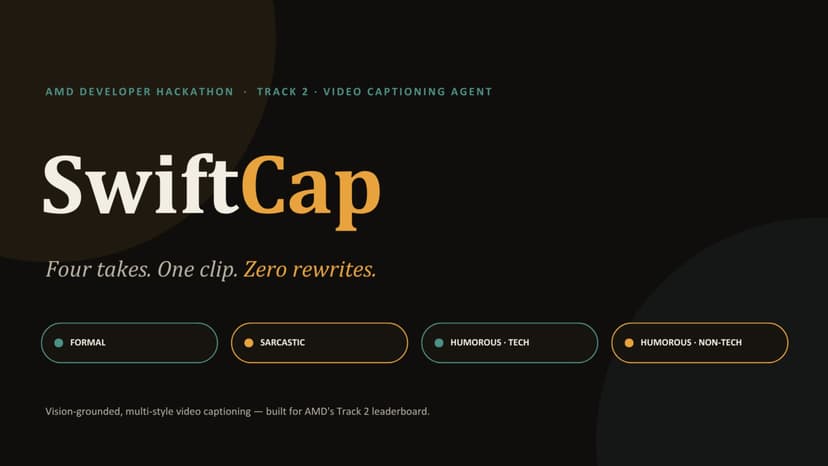
SwiftCap is a video captioning agent built for Track 2 of the AMD Developer Hackathon. Given a video URL or upload, it generates four distinct captions per clip: formal, sarcastic, humorous-tech, and humorous-non-tech, all grounded in the same sampled frames so every style stays faithful to what is actually on screen. The pipeline streams video on the fly with OpenCV and yt-dlp instead of downloading full files, samples one frame per second, filters out corrupted or blank frames, and resizes for token efficiency. A single multimodal request to MiniMax M3 on Fireworks AI then returns all four styles at once, with strict JSON validation and an automatic stricter retry if parsing fails. Reliability was treated as a first-class feature: every clip is processed in isolation so one bad video cannot zero out an entire submission, and a wall-clock budget guard keeps every run safely under the ten-minute limit. The product itself is a full-stack app: FastAPI and PostgreSQL on the backend with JWT authentication, and a React and Vite frontend where users submit clips and watch captions arrive in real time.
13 Jul 2026


