🤝 Top Collaborators



🤓 Latest Submissions
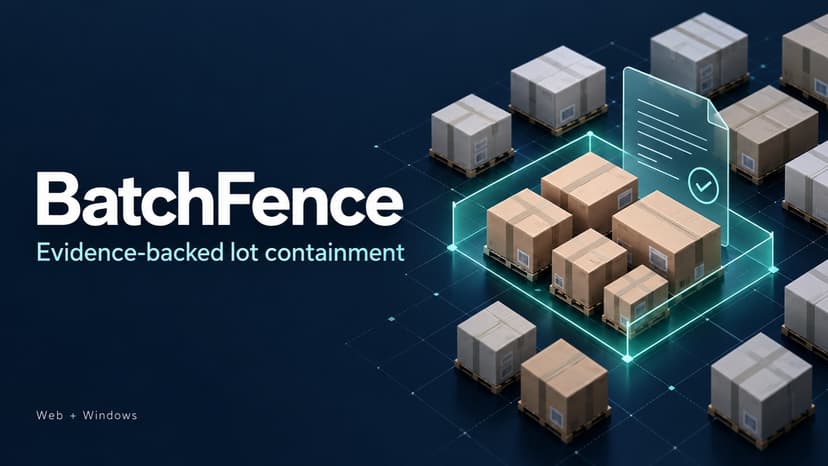
BatchFence: Evidence to Containment
A revised supplier notice can change which stock is affected, while critical facts remain scattered across documents and receiving records. BatchFence helps quality teams connect that evidence to a defensible containment decision. Available as a web application and an installed Windows client, BatchFence combines AMD-hosted Gemma document interpretation with Evolus agent workflows and retrieval from an isolated approved procedure library. Reviewers compare proposals with retained originals, classify affected, excluded and unresolved lots, then trace recorded relationships through an exposure graph. Deterministic calculations produce a plan; explicit approval precedes sandbox inventory changes and immutable receipts. The key innovation is the separation of AI suggestions from decision authority. Independent recorded-identity checks surface omissions. Incomplete scope remains unresolved, changed evidence invalidates stale approvals, and a narrower proposal cannot silently release existing holds. Procedure references are verified by the application against identified indexed chunks and complete, versioned approved originals. Six connected extensions support daily work: Next Useful Evidence, release-readiness conditions, label verification, document-change impact, multilingual review and shift handover. Exported packets preserve historical evidence for offline, read-only inspection. Verified scenarios include expansion from 500 to 800 held units, two receipts, stale-action rejection and genuine Evolus-mediated Gemma retrieval. The release passed 491 automated tests and 30 domain cases, with web and installed Windows checks. Validation uses fictional inventory and sandbox actions; human review remains required, and production enterprise acceptance is pending.
18 Oct 2026
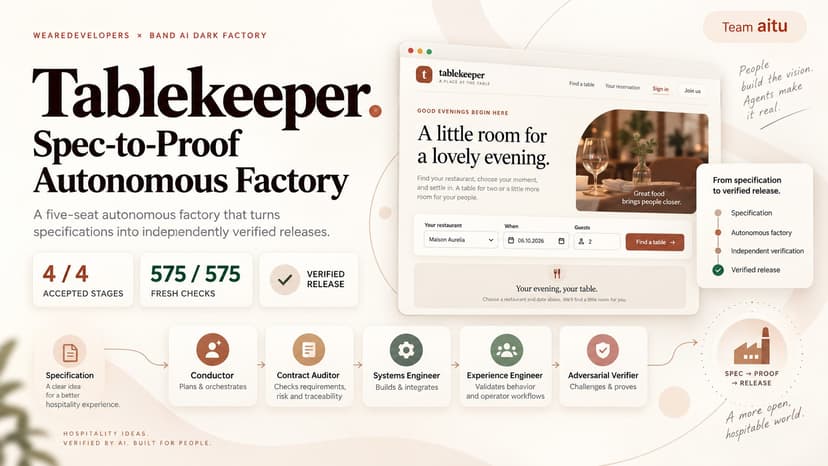
Tablekeeper: Spec-to-Proof Autonomous Factory
Tablekeeper is the result of a Spec-to-Proof autonomous software factory built in BAND AI. Instead of using one coding agent to generate an application, we designed five specialized seats with deliberately separated responsibilities: Conductor, Contract Auditor, Systems Engineer, Experience Engineer, and Adversarial Verifier. The factory converts a specification into atomic requirements, coordinates implementation through complete agent-to-agent handoffs, freezes exact production revisions, independently verifies them, and either accepts the result or routes defects back to the production owner for repair and re-verification. In the submitted run, a single human dispatch initiated the entire four-stage workflow. No clarification, approval, debugging hint, “continue” message, or manual rerun was provided afterward. The agents autonomously progressed through all four Tablekeeper stages. The verification process was not cosmetic. Stage 1 initially passed the shipped checks but was independently rejected after the factory discovered two specification-level edge cases involving valid JSON numeric handling and terminal calendar boundaries. The Systems Engineer repaired the defects in a new commit, and the Adversarial Verifier independently re-tested the replacement revision before acceptance. The final result achieved all 4 independently accepted stages and 575/575 applicable cumulative checks, with all populated upgrade paths passing. Every accepted stage is bound to an exact Git revision and preserved evidence. The factory also produced a polished responsive Tablekeeper browser application for restaurant discovery, availability search, booking, confirmation, reservation lookup, accepted terms, and history. Beyond this challenge, the core factory is intentionally reusable: its mandates describe generic engineering, auditing, orchestration, UX, and adversarial-verification responsibilities rather than Tablekeeper-specific endpoints or fields.
6 Oct 2026
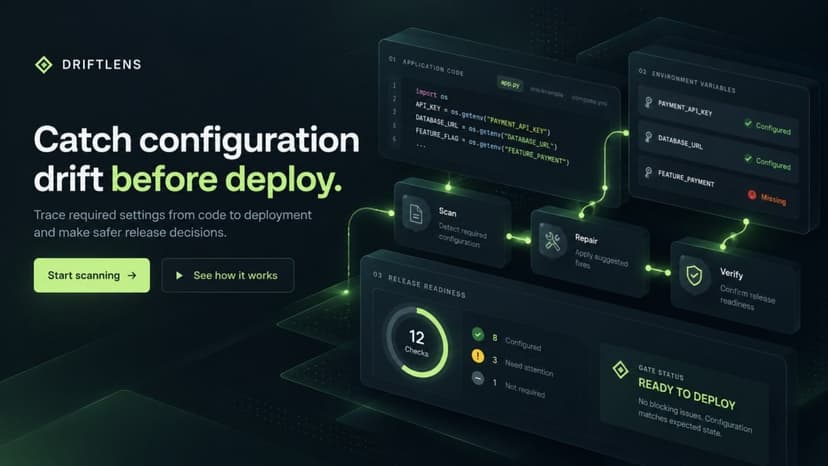
DriftLens — From Incident to Release Gate
A service can work on one developer’s machine and still fail at release because a required environment variable is missing from setup instructions or deployment configuration. Finding the cause often means manually comparing source code, configuration files, and error logs. The same mistake can then recur in the next release. DriftLens is a prototype for developers and small teams who need a clear release decision. It compares required settings across a contract, application source, `.env.example`, and `compose.yaml`. In our sample checkout service, the code requires `PAYMENT_API_KEY`, but both developer setup and deployment omit it. DriftLens identifies the two exact gaps and returns HOLD RELEASE with actionable findings. The workflow goes beyond detection. The team can connect an incident to the missing setting, inspect the affected files, preview a suggested repair, and run the check again. In the demo, two static blockers become zero and the verdict changes to READY TO PROCEED. A command-line gate and CI integration make the same analysis repeatable before later releases. The creative element is the complete path from an observed failure to a persistent guard: investigate the incident, trace the configuration, repair the gaps, and prevent the same static mismatch from passing unnoticed again. The prototype reduces manual cross-file comparison and makes the release decision visible and reproducible. DriftLens checks static configuration consistency. A READY verdict does not verify secret values, running services, or the success of an actual deployment.
27 Sep 2026

SlotPilot — AI Voice Booking Assistant
Booking a car service appointment often involves phone calls, repeated questions, and manually matching services to available staff and workshop capacity. SlotPilot brings these steps into one conversational workflow. Customers speak English to an AI assistant, describe their vehicle and required services, and specify preferences such as time and budget. The assistant uses server-side tools to check availability and suggest suitable appointments. Customers review the details and explicitly confirm before a booking is saved. The service also supports rescheduling and cancellation with confirmation and conflict protection. The web application uses Next.js, TypeScript, Supabase PostgreSQL, and the AssemblyAI Voice Agent API. Provider credentials remain on the server, while authentication and permission checks control access to booking and administrative actions. SlotPilot also includes an Electron desktop client with a public Windows x64 release, available as an installer or portable executable. The desktop builds are unsigned and connect to the existing online SlotPilot service. The project demonstrates how a voice agent can turn a natural-language request into a structured booking workflow. Workshop data and prices are demonstrative.
30 Sep 2026


