🤓 Latest Submissions
Saadhak — the calibrated options agent
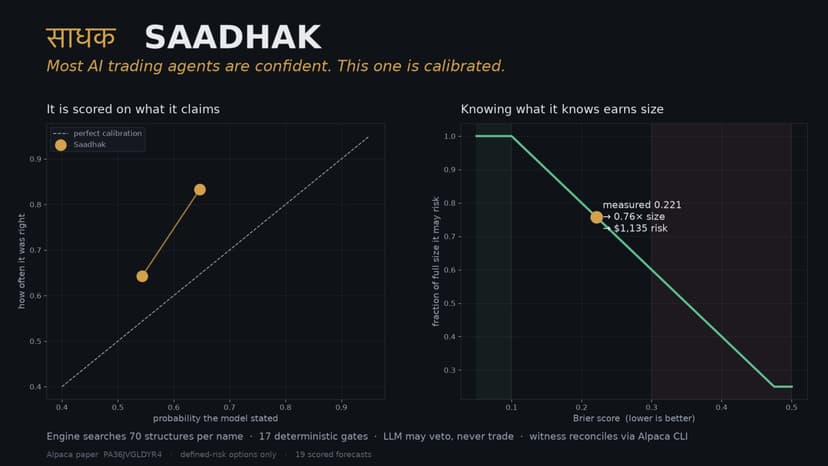
Most AI trading agents are confident. Saadhak is calibrated: it decides how much to risk based on how accurate it has actually been. It trades defined-risk options on liquid index products, one day to expiry. Never naked, never a market order; the maximum loss is known before the order goes in. Niyama, deterministic code, searches 70 structures per name and is the only thing that can create an order. Saadhaka, a language model over Alpaca's MCP server, loads research tools only, so none of the 33 it reaches can mutate anything: it may veto a trade, never start one. Saakshya scores every probability the model states and reconciles the broker through the Alpaca CLI. Nineteen gates stand between a candidate and an order, each explaining itself. The central one is derived: take-profit at half the credit against a 2x stop means breakeven needs a 2-in-3 win rate. Over 40 scored forecasts the model says 48% and is right 57%, earning 0.70x of full size.
4 Sep 2026
ZeroCredits
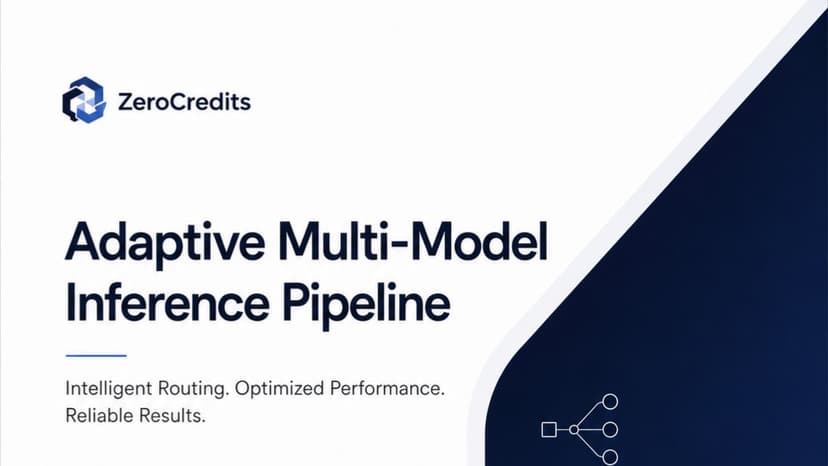
ZeroCredits implements an adaptive inference layer that assigns each request to the most suitable local or remote model based on task type, complexity, latency, and expected output. Inspired by recent research on LLM routing and cascading, it combines lightweight local execution, specialized model selection, bounded concurrency, fallback controls, and response validation. The architecture reduces unnecessary compute while preserving quality for reasoning, extraction, summarization, and code workloads. Its modular routing policy can be calibrated as models, costs, and service objectives evolve, creating a resilient AI delivery layer optimized for speed, efficiency, governance, and consistent production performance across diverse workloads.
13 Jul 2026


