
🤝 Top Collaborators

🤓 Latest Submissions
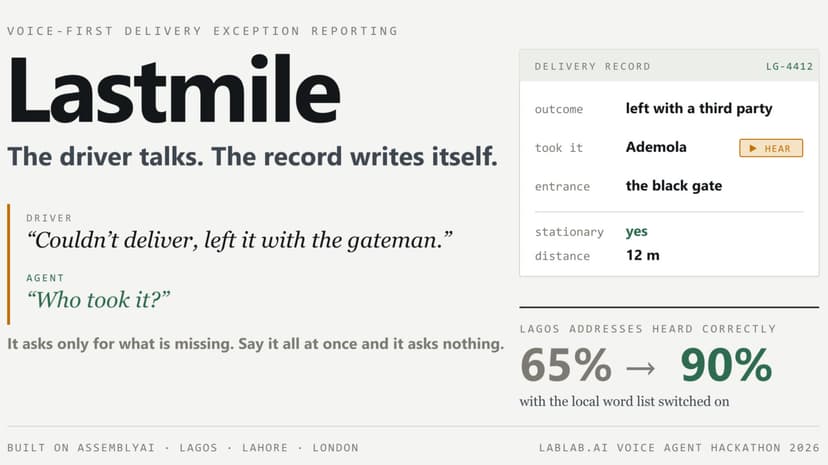
Lastmile: Voice Reports for Failed Deliveries
When a delivery fails, the scanner records the outcome but never the story: which gate, who took the parcel, why it failed. Three weeks later, that story is what settles the dispute, and nobody typed it. Lastmile lets the driver just talk. The microphone stays shut while the vehicle is moving. Once stopped, the driver presses one button and says what happened. The AssemblyAI Voice Agent API listens, and our code tells the agent which fields are still empty on every turn, so it asks only for what is missing. Say everything at once, and it asks nothing. It reads the record back and closes. Each field keeps a link to the turn of audio it came from, so a dispatcher can press play and hear the driver say it. Names the recogniser is unsure of are flagged for review instead of trusted. One app, three cities: Lagos, Lahore and London. Only a small word list of local place names changes per city. We measured it on 80 recordings, each transcribed twice: Lagos went from 65% of addresses right to 90%, Lahore 75% to 85%, and London in a Nigerian voice 40% to 55%. A British voice on London streets gained nothing, and we kept that row, because it shows where the word list helps and where it does not. Lastmile is not proof of delivery. It is the clear record beside it, built for the operations manager who loses money on failed deliveries and disputes.
30 Sep 2026
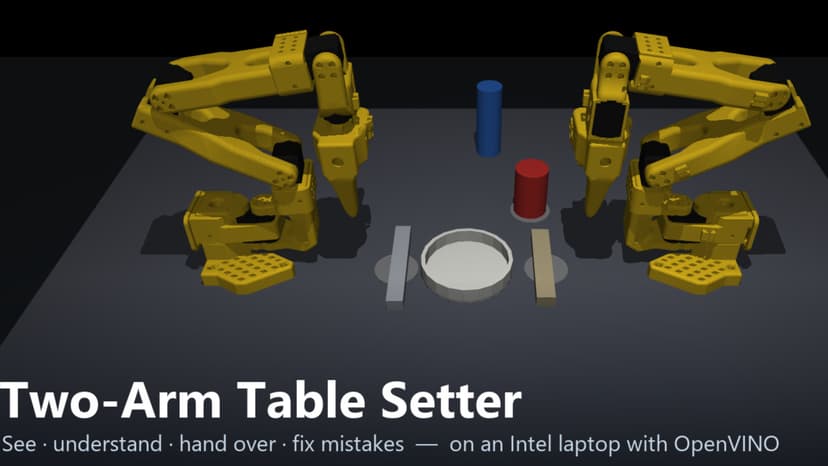
Two-Arm Table Setter
Say "set the table" - or "put the red thing top left of the plate and the grey utensil on the right" - and two SO-101 arms in MuJoCo do it. HOW IT WORKS. An overhead colour-and-depth camera finds every object from its height and shape (0.5 mm average error over 20 random tables); the simulator's true positions are never used to act. Qwen3-VL-4B, running locally as Intel's INT4 OpenVINO build, reads the command together with the camera image, so it knows "the red thing" is the mug. A planner decides which arm does what: cutlery starting on the wrong side is passed hand to hand, and round items are set down where both arms can reach. After every item the robot looks again, and anything knocked out of place is put back first. LEARNING. Our scripted skills became the teacher, recording 1,219 successful demonstrations automatically. A LeRobot ACT policy trained on a laptop CPU learned the mug skill - 19/20 within 1.5 cm on tables it had never seen. It took seven versions; the write-up covers what failed and why. INTEL OPTIMISATION, on a Core Ultra 7 155H across all three chips. OpenVINO runs the policy 2.9x faster than PyTorch on the CPU (0.72 ms vs 2.07 ms) with no loss of task success. The same policy runs on the AI Boost NPU at 0.90 ms and places 10/10 mugs, freeing the CPU and iGPU. The Arc iGPU reads a command in 1.3 s, 2.8x faster than the CPU. An honest negative result too: OpenVINO 2026.3's NPU compiler cannot build Qwen3-VL's vision tower, so the language model falls back to the iGPU automatically. RESULTS. 30/30 random tables set correctly, 29/30 on harder ones, 9/10 on the Core Ultra. Every number is checked against simulator truth, reproducible from one command, and the raw logs ship in the repo. Not included, said plainly: the drawer and pouring, and most skills are scripted rather than learned.
16 Sep 2026
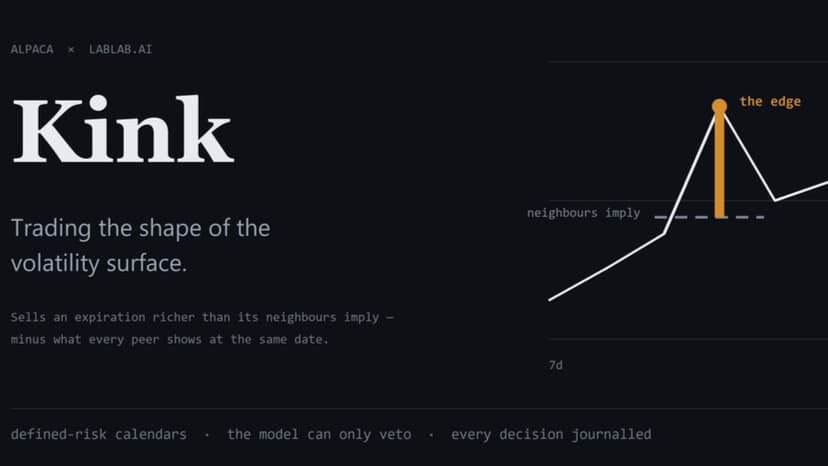
Kink — an autonomous options trading agent
WHAT THIS PROGRAM LEARNED ABOUT ITSELF Three habits in this options program apply beyond trading. 1. CHECK IF EVERYONE MOVED BEFORE JUDGING ONE. Our first scan found 77 things that looked wrong. All the same thing: prices were high that week because of one Fed meeting, not any single mispricing. Fix: subtract what similar stocks did that day first. IWM kept a real 6.3% signal; QQQ dropped to 1.9% and was refused. 2. LEARN FROM WHAT YOU SAID NO TO. Most programs only learn from choices made. We score every refused trade too: 9,500 guesses checked, not 7. That's how we caught our own idea being wrong: bigger gaps were supposed to mean better bets, but small gaps closed 81% back to normal, huge gaps only 10%. Reported honestly, not quietly moved. 3. GIVE THE AI A JOB IT CAN ONLY SAY NO WITH. It can block a trade, never start one. Any failure defaults to no; there is no code path to place an order. WHAT IT TRADES An option is insurance on a stock with many end dates; longer cover costs more, so prices form a smooth rising line. Sometimes one date is priced too high. Kink sells that date, buys a cheaper nearby one as backup, so the most it can lose is what it paid up front. Most bet on direction; this bets on the relationship between two dates. SAFETY RULES (fixed code, not AI judgment): capped price gap, matched against similar stocks, buy/sell spread capped, no earnings inside the window, legs matched on stock and price, dollar caps per trade and account, practice account only. BUILT ON ALPACA: two-part option orders, tested live before real money. Every order logged as text anyone can re-run. WHAT WE CLAIM: a program that catches its own mistakes and refuses trades it can't justify. Every mistake found and published. 153 tests passing, no account needed. FINAL RESULT: -5.48% over 3 trading days ($100k to $94,524). SLV alone was over half the loss, a known and documented limitation.
4 Sep 2026


