

🤝 Top Collaborators




🤓 Latest Submissions
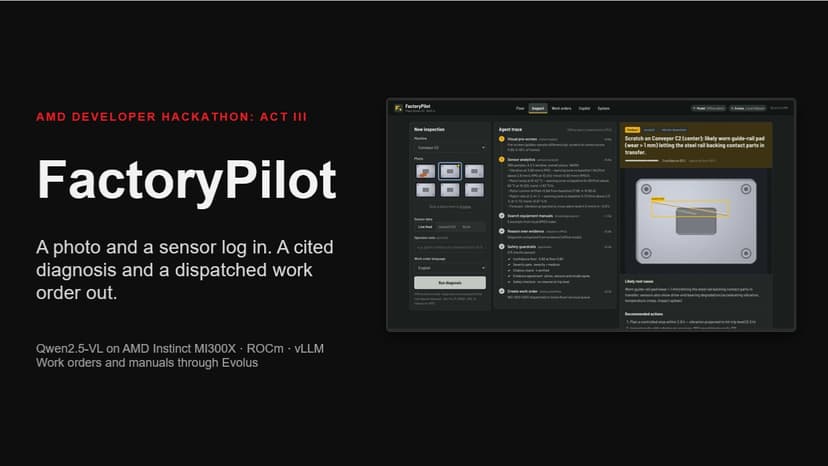
FactoryPilot: AI Maintenance Agent on AMD MI300X
When a production line starts making bad parts, the shift supervisor has to connect a photo, a sensor dashboard and a long PDF manual by hand while scrap piles up and an early bearing fault turns into an unplanned stop. FactoryPilot does that in seconds. A technician uploads one photo. The agent runs a golden-sample visual pre-screen, analyses the live sensor log (drift, spikes, ISO 10816 vibration zones and a forecast of hours until alarm), and pulls the relevant manual pages from an Evolus knowledge library. It then sends everything to Qwen2.5-VL, served by vLLM on an AMD Instinct MI300X with ROCm, which returns a schema-checked diagnosis: root cause, severity, calibrated confidence, ordered actions with real manual values (8 Nm, 6 g of grease), safety steps and page-level citations. Five deterministic guardrails then check confidence, severity, citations, evidence agreement and trip-level sensors. Made-up citations are removed. Safe calls are dispatched to the right technician through an Evolus workflow. Critical ones, like a cracked press die, are held for one-click supervisor approval. A live floor view, a work-order queue and a copilot that answers in Italian complete the product. One MI300X (192 GB HBM3) serves the whole plant on an open model, so photos and process data stay on infrastructure the factory controls. Every model call reports time to first token and tokens per second in the app.
18 Oct 2026

Legacy Bridge: Bob modernizes, Bob's tests decide
Problem: every company runs legacy code that nobody fully understands. Modernizing it is risky because the code's real behaviour is undocumented, and AI refactors can change that behaviour while making the code look cleaner. Reviewers cannot check a 300-line diff for every edge case, so teams either leave old code alone or ship regressions. Solution: Legacy Bridge makes IBM Bob prove its work before any change ships. 1. Bob reads a legacy class and writes characterization tests that pin down what the code does today, including odd behaviour and old bugs. If a test is wrong about the original code, Bob corrects it. 2. We check the tests are strong with mutation testing: the code is broken on purpose, one real behaviour at a time. If a break slips through, Bob hardens its own suite. 3. Bob modernizes the class from a normal developer ticket. 4. The gate re-runs Bob's tests. All pass: VERIFIED and applied. Any fail: BLOCKED, nothing is applied, the exact differences are reported, and the failures go back to Bob to repair. The repair must pass the same gate. Target users: teams modernizing Java codebases (banks, insurers, public sector, any company with 10 to 20 year old services) who want AI speed without silent regressions. They run one command per step, or replay recorded runs, and review a standalone HTML report showing tests, mutation score, verdict, diff and failing values. Results on real open-source legacy code (Apache Commons Codec 1.3, 2005): - Base64, ticket "reimplement on top of java.util.Base64": Bob's version changed behaviour (dropped the CRLF ending chunked output, changed bad-input handling) and was BLOCKED in 2 of 2 runs. In one run even Bob's repair missed a 57-byte edge case, and the gate refused it too; the other repair was verified. - Metaphone, a 300-line refactor: Bob's 117 tests passed, and an independent differential check found 0 of 136,800 outputs changed. - A fabricated invoice example: asked to "simplify the branching logic", Bob changed a discount rule so 10 widgets cost $23.75 instead of $25.00. Blocked, then repaired. What makes it different: most AI modernization demos show the happy path. Legacy Bridge assumes the AI will sometimes be wrong and makes that safe: the same AI that changes the code must first write the proof, the proof is itself tested with mutants, and nothing ships without it, not even Bob's own fixes. Everything is evidence: all 19 Bob calls (2.54 Bob coins) are committed with prompt, answer and cost, and the whole pipeline replays from a fresh clone without a Bob account.
27 Sep 2026


