
🤝 Top Collaborators




🤓 Latest Submissions

Containment-First Agent Runtime on Vultr
Containment-First Agent Runtime is a web-based agent that performs real work while keeping every action inside an isolated execution environment on Vultr. How it works: the control layer accepts a natural-language task, plans it into steps, and dispatches each step to a short-lived Docker sandbox. Code runs with no network by default, a read-only root filesystem, dropped capabilities, a memory cap and a burst CPU quota. A second executor drives a real headless browser through Playwright, also inside the sandbox. What makes it different: the API does not merely claim isolation. Every response returns the flags that were actually applied (no_network, read_only_root, cap_drop, memory_limit, cpu_quota, non-root user), so a reviewer can verify the blast radius instead of trusting a README. Planning uses Vultr Serverless Inference; when no key is configured the system reports local-fallback explicitly instead of pretending to call a model. The repository ships a 74-second demo with three containment moments, an architecture document, a six-page deck and a one-command deployment script for Vultr Cloud Compute. The runtime is verified end to end: POST /tasks with print(6*7) returns ok=true, exit_code=0, stdout=42.
8 Nov 2026
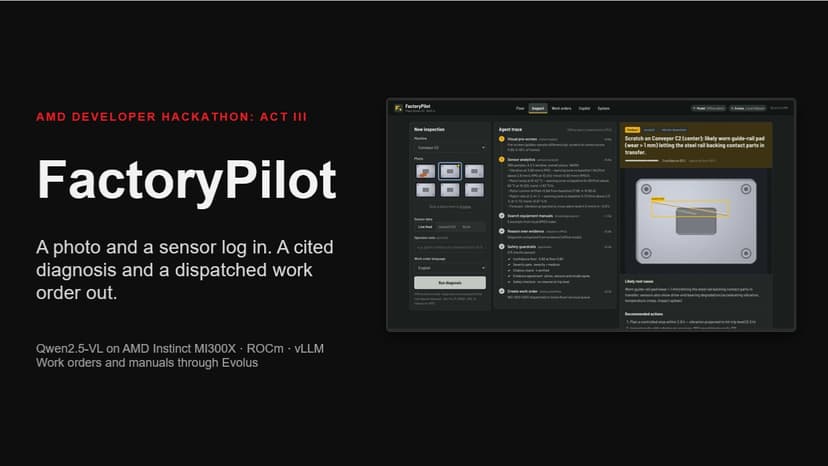
FactoryPilot: AI Maintenance Agent on AMD MI300X
When a production line starts making bad parts, the shift supervisor has to connect a photo, a sensor dashboard and a long PDF manual by hand while scrap piles up and an early bearing fault turns into an unplanned stop. FactoryPilot does that in seconds. A technician uploads one photo. The agent runs a golden-sample visual pre-screen, analyses the live sensor log (drift, spikes, ISO 10816 vibration zones and a forecast of hours until alarm), and pulls the relevant manual pages from an Evolus knowledge library. It then sends everything to Qwen2.5-VL, served by vLLM on an AMD Instinct MI300X with ROCm, which returns a schema-checked diagnosis: root cause, severity, calibrated confidence, ordered actions with real manual values (8 Nm, 6 g of grease), safety steps and page-level citations. Five deterministic guardrails then check confidence, severity, citations, evidence agreement and trip-level sensors. Made-up citations are removed. Safe calls are dispatched to the right technician through an Evolus workflow. Critical ones, like a cracked press die, are held for one-click supervisor approval. A live floor view, a work-order queue and a copilot that answers in Italian complete the product. One MI300X (192 GB HBM3) serves the whole plant on an open model, so photos and process data stay on infrastructure the factory controls. Every model call reports time to first token and tokens per second in the app.
18 Oct 2026
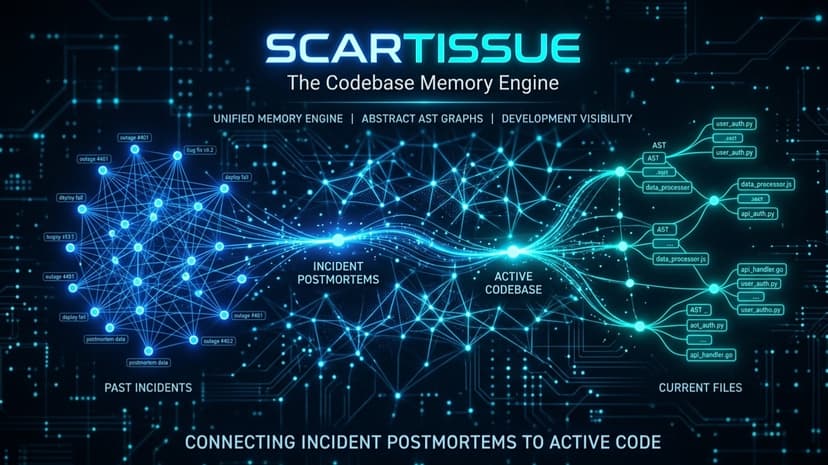
ScarTissue — The Codebase Memory Engine
### The Problem: Silent Recurrence & Knowledge Rot In software organizations, the same catastrophic failures—missing idempotency keys, unindexed N+1 database queries, and unhandled clock-skew token expirations—reappear in production every few months. Today, an organization’s hard-won lessons live in passive Confluence wikis or archived Slack threads that nobody rereads before committing new code. Furthermore, root cause analysis (RCA) restarts from scratch during 2 AM outages, forcing on-call engineers to spend hours re-diagnosing recurring failure families. Existing AI tools (like Copilot and CodeRabbit) only check code against generic best practices (OWASP, style guides); none check code against an organization’s own internal scar tissue because institutional knowledge was never structured into machine-checkable memory. ### The Solution: One Shared Signature Library, Four Workflow Touchpoints ScarTissue is a self-reinforcing codebase memory engine built on IBM Bob 2.0. It ingests unstructured incident postmortems once, extracts machine-enforceable failure signatures, and simultaneously projects that knowledge across four critical workflow tracks: 1. Developer Onboarding (Orientation): Generates an interactive "Landmine Map" for new hires, warning them of past outages and required architectural guards before they modify unfamiliar subsystems. 2. Intelligent Code Review (Prevention): The ScarTissue Sentinel scans pull requests using AST and pattern matching, blocking merge if an anti-pattern recurs and citing the exact historical incident and verified fix. 3. Debugging & Root Cause Analysis (Diagnosis): When a production alert fires, ScarTissue matches the error symptom against past incident signatures in under 0.5 seconds, delivering immediate root cause and runbooks. 4. Automated Testing Hub (Lock-In): Every confirmed scar compiles into a permanent pytest regression guard in CI, making it structurally impossible for a solved bug class to silently resurface. ### Target Users & Interaction ScarTissue is designed for software developers, on-call SREs, and engineering leaders. Developers interact with it natively inside IBM Bob IDE via custom modes (Sentinel, Archaeologist, Onboarding Guide), Model Context Protocol (MCP) tools, and the Bob terminal. ### What Makes It Creative and Unique Unlike generic AI code assistants that rely on ungrounded LLM advice, ScarTissue pairs deterministic AST triggers with semantic reasoning. Every review flag, RCA diagnosis, and CI guard is backed by a verifiable historical artifact, preventing recurring outages and eliminating knowledge loss across team turnover.
27 Sep 2026


