
🤝 Top Collaborators


🤓 Latest Submissions
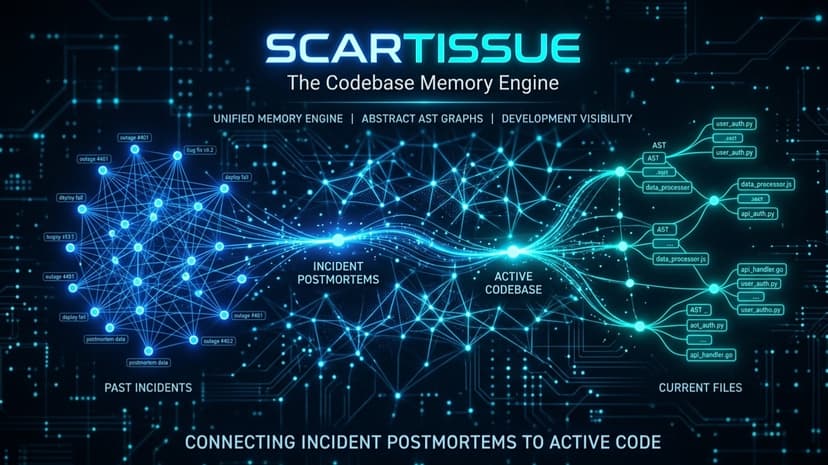
ScarTissue — The Codebase Memory Engine
### The Problem: Silent Recurrence & Knowledge Rot In software organizations, the same catastrophic failures—missing idempotency keys, unindexed N+1 database queries, and unhandled clock-skew token expirations—reappear in production every few months. Today, an organization’s hard-won lessons live in passive Confluence wikis or archived Slack threads that nobody rereads before committing new code. Furthermore, root cause analysis (RCA) restarts from scratch during 2 AM outages, forcing on-call engineers to spend hours re-diagnosing recurring failure families. Existing AI tools (like Copilot and CodeRabbit) only check code against generic best practices (OWASP, style guides); none check code against an organization’s own internal scar tissue because institutional knowledge was never structured into machine-checkable memory. ### The Solution: One Shared Signature Library, Four Workflow Touchpoints ScarTissue is a self-reinforcing codebase memory engine built on IBM Bob 2.0. It ingests unstructured incident postmortems once, extracts machine-enforceable failure signatures, and simultaneously projects that knowledge across four critical workflow tracks: 1. Developer Onboarding (Orientation): Generates an interactive "Landmine Map" for new hires, warning them of past outages and required architectural guards before they modify unfamiliar subsystems. 2. Intelligent Code Review (Prevention): The ScarTissue Sentinel scans pull requests using AST and pattern matching, blocking merge if an anti-pattern recurs and citing the exact historical incident and verified fix. 3. Debugging & Root Cause Analysis (Diagnosis): When a production alert fires, ScarTissue matches the error symptom against past incident signatures in under 0.5 seconds, delivering immediate root cause and runbooks. 4. Automated Testing Hub (Lock-In): Every confirmed scar compiles into a permanent pytest regression guard in CI, making it structurally impossible for a solved bug class to silently resurface. ### Target Users & Interaction ScarTissue is designed for software developers, on-call SREs, and engineering leaders. Developers interact with it natively inside IBM Bob IDE via custom modes (Sentinel, Archaeologist, Onboarding Guide), Model Context Protocol (MCP) tools, and the Bob terminal. ### What Makes It Creative and Unique Unlike generic AI code assistants that rely on ungrounded LLM advice, ScarTissue pairs deterministic AST triggers with semantic reasoning. Every review flag, RCA diagnosis, and CI guard is backed by a verifiable historical artifact, preventing recurring outages and eliminating knowledge loss across team turnover.
27 Sep 2026
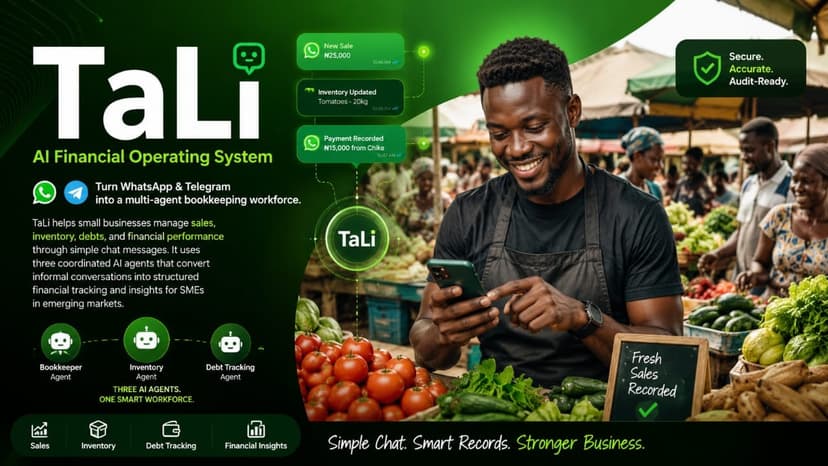
TaLi SmartBookkeeper AI
Small businesses across Africa, Europe and many emerging markets still manage sales, inventory, debts, and expenses through chat messages, notebooks, memory, and spreadsheets. This often leads to lost transactions, forgotten debts, inventory mistakes, poor financial visibility, and difficult tax or audit preparation. TaLi SmartBookkeeper solves this problem by turning WhatsApp and Telegram into a complete AI-powered Financial Operating System. Users simply send natural language messages such as: • "Sold rice 20k" • "Grace owes me 15k" • "Added 50 bottles of water" TaLi automatically records transactions, updates inventory, tracks receivables and payables, generates financial reports, and provides business insights in real time. The system is powered by a Band-based multi-agent architecture: • Intake Agent — understands, validates, and structures requests • Ledger Agent — executes financial operations and maintains accurate records • CFO Agent — analyzes business performance, detects risks, and generates alerts The agents collaborate through Band event channels using structured task handoffs, shared context, traceable workflows, and distributed decision-making. By combining AI automation with everyday messaging platforms, TaLi helps small businesses reduce manual bookkeeping, improve financial visibility, maintain audit-ready records, and make smarter business decisions without accounting expertise.
19 Jun 2026


