
🤝 Top Collaborators

🤓 Latest Submissions
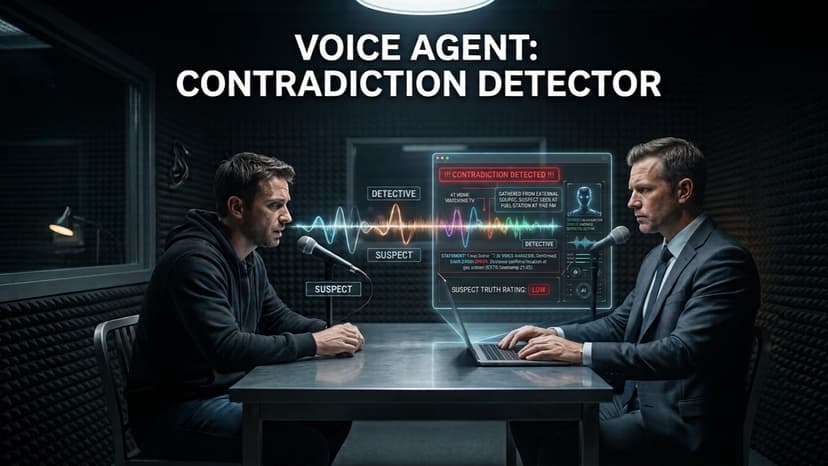
The Interrogation Room-Voice ContradictionDetector
The Interrogation Room is a real-time voice analysis app built for live two-person interrogation scenarios. One microphone, two people: a detective and a suspect. AssemblyAI's Realtime Speech-to-Text API listens to the full conversation, transcribes both speakers, and uses speaker diarization to automatically separate detective turns from suspect turns. The AI works silently in the background as an analyst. It logs every claim the suspect makes — times, locations, people, objects — into a structured claim ledger. On each new suspect statement, it runs a contradiction check against everything said before. When a contradiction is detected, the detective's dashboard fires instantly: the screen flashes, the two conflicting quotes appear side by side with their timestamps, and a contradiction card is permanently added to the evidence board. The detective sees a live noir-styled dashboard with a two-voiced scrolling transcript, a suspicion gauge rising in real time, a pulse chart tracking the suspect's speech rate, and a contradiction board filling up as the interrogation unfolds. Action buttons let the detective flag evidence, manually raise suspicion, or call for a pause. At the end of the session, a full case report is generated: a suspicion timeline, a skill radar scoring consistency and composure, a talk ratio breakdown, a weak-spots chart by claim category, and a shareable cinematic verdict poster the detective can export and post. Built on AssemblyAI Realtime STT with speaker diarization, Next.js 14, Zustand, Recharts, and Framer Motion. Deployed on Vercel. Use cases include law enforcement training, legal cross-examination practice, debate coaching, and live game experiences.
30 Sep 2026

QASIX-Alpaca AI Trading Agent
Alpaca AI Trading Agent is an autonomous, explainable options trading agent built for the Alpaca AI Trading Agents Hackathon. It is designed around one core idea: the AI proposes, but it never has the final word. Each cycle, the agent pulls live market data and technical indicators from Alpaca's Trading and Market Data APIs, including live options chains with real strikes, expirations, implied volatility, and Greeks. Google Gemini evaluates this data and proposes a structured decision, buy, sell, hold, or opening a covered call or cash-secured put always with a confidence score and a written, data-grounded rationale. Gemini's proposal then passes through a fully deterministic risk manager that never simply trusts its claims. It independently re-verifies eligibility (does the account actually hold 100+ shares for a covered call, does it actually have enough cash for a cash-secured put), enforces position-sizing limits, caps open positions, and applies a daily loss circuit breaker. A separate, equally deterministic exit engine manages open positions with stop-loss and take-profit rules, so risk discipline covers both entries and exits. Every decision is logged, including the ones the risk manager blocks. Nothing is hidden after the fact. The live dashboard shows account state, open positions with full payoff and collateral detail, a full decision history, and closed-trade performance stats, so the reasoning behind every trade or every refusal to trade, is fully auditable. Technically, the project integrates Alpaca's official CLI for live order execution and account status alongside its Python SDK for market data, satisfying the hackathon's requirement to use Alpaca's MCP server or CLI tooling. It runs entirely on free infrastructure: Alpaca's paper trading environment and Google Gemini's free tier, with a Streamlit dashboard deployed publicly so anyone can watch the agent think in real time. Built by Team QASIX.
4 Sep 2026


