
wil low@draculess99
8
Events attended
6
Submissions made
United States
20+ years of experience
About me
Applied AI & Machine Learning Engineer with a background in enterprise software development, neural networks, forecasting, and intelligent systems. Building human-governed multi-agent AI applications across healthcare, logistics, and critical infrastructure. Experienced with Python, C#/.NET, AWS, machine learning, RAG, and agentic AI.
🤓 Latest Submissions
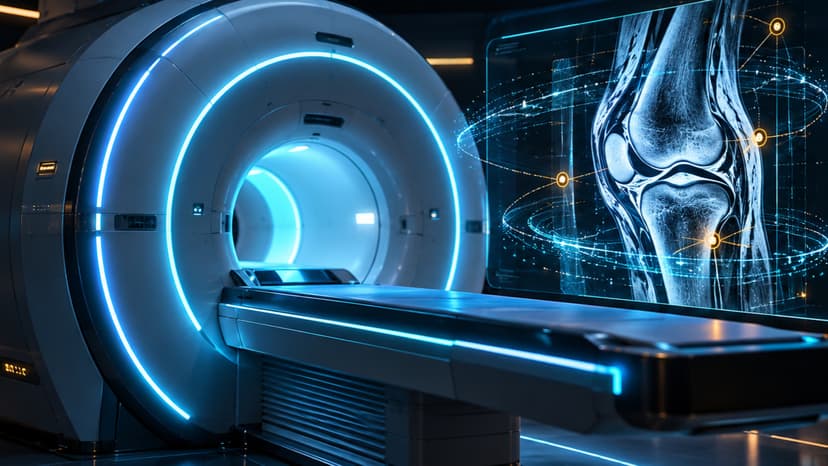
MRI Vision Core AMD: Evidence Review
MRI Vision Core AMD is a research and demo workflow for inspectable knee-MRI analysis. A bridged trained Attention-MIL checkpoint processes an available MRI study and produces twelve raw, uncalibrated research-model scores with provenance. Those scores are placed into a structured EvidenceBundle. The deterministic review sequence then runs Specialist, Critic, and Consensus stages. Specialist groups existing scores without changing them; Critic checks evidence structure, provenance, quality state, and other review conditions; Consensus sets the workflow status. Every case remains pending named human review, where a reviewer can approve, request more evidence, or escalate. An optional explanation layer supports AMD Token Factory, Groq, or a local deterministic provider. It receives allowlisted review evidence and returns four reviewer-facing summaries. It is advisory only: it cannot change model scores, deterministic workflow status, or human approval. The project includes a reproducible 22-study benchmark: 22 of 22 successful inference runs, 100 percent coverage, zero failures, macro ROC-AUC 0.599, macro PR-AUC 0.485, and mean latency 0.987 seconds. These are research results against competition reference labels, not clinical validation or diagnostic claims.
18 Oct 2026
TableKeeper: Reservation Safety Factory
TableKeeper is a clean-room restaurant reservation system built for the WeAreDevelopers x BAND Dark Factory Tablekeeper track. The product addresses the core reliability problem in restaurant booking: a table must not be booked by two parties for overlapping times. Our agent team used BAND Desktop roles to plan, implement, test, review, and integrate the solution. The resulting Flask application provides restaurant and table selection, party-size and capacity validation, start and end time validation, maximum-duration limits, a live reservation list, and deletion support. Its central safeguard is deterministic overlap detection: an attempted reservation on the same table and time window is rejected with a clear message rather than silently creating a double booking. The project includes a responsive browser UI, embedded SQLite storage, automated pytest coverage for the main success and failure paths, a Docker configuration, deployment notes, architecture documentation, and captured verification evidence. It is publicly deployed on Railway and the source is available on GitHub. TableKeeper demonstrates a practical software factory workflow: agents divide work, hand off evidence, and validate the delivered system before it is demonstrated.
6 Oct 2026
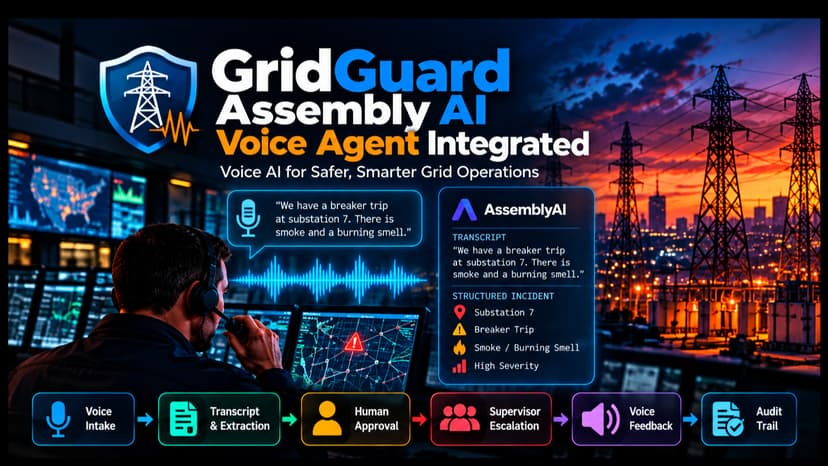
GridGuard Assembly AI Voice Agent Integrated
GridGuard Assembly AI Voice Agent Integrated is a human-governed voice AI system designed for critical power-grid incident response. It uses AssemblyAI as the speech-to-text intake layer, transforming spoken operator reports into transcripts that GridGuard converts into structured operational evidence. The system is designed around a core principle: AI can accelerate understanding and coordination, but consequential operational decisions remain under explicit human control. After voice intake and incident extraction, an operator reviews the evidence and must deliberately Approve, Hold, Reject, or Escalate the incident. Escalation introduces a second human approval gate before the system proceeds to a disclosed Call-E supervisor simulation. The workflow operates in dry-run mode: it does not place real calls, execute grid actions, or automatically authorize operational changes. Supervisor outcomes—including approval and denial—are captured alongside the original operator decision in an auditable record. GridGuard also provides voice feedback, deterministic Mock Mode for safe testing, operational forecasting and decision-support capabilities within the integrated application. The result is an end-to-end workflow connecting voice intake, transcription, structured evidence, human approval, supervisor escalation, voice feedback, and auditability. GridGuard demonstrates how voice AI can support high-stakes operational environments without removing human authority from the decision loop. AssemblyAI makes spoken incident information immediately actionable, while GridGuard adds the governance, escalation controls, and evidence trail required for responsible operational decision support.
30 Sep 2026
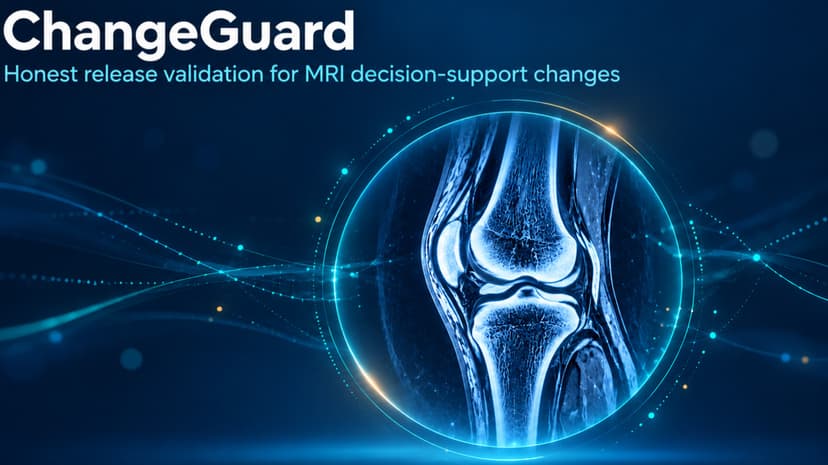
ChangeGuard: Honest Release Validation
ChangeGuard is an MRI comparison application with clinician-facing review information. Changes to thresholds, comparison rules, or UI wording can change what a user sees. Manual validation is therefore a risky developer workflow: someone can run a small test, forget the full suite, and incorrectly treat that limited result as a release decision. Using IBM Bob 2, I built ChangeGuard Release Check: a cross-platform Python CLI and documented validation workflow for these high-risk changes. The --quick command runs only the focused synthetic comparison tests. Its success message is deliberately honest: “TARGETED CHECK PASSED — full regression suite not run.” The --full command runs the complete repository regression suite and is the only mode that prints “FULL RELEASE CHECK PASSED.” Any non-zero test result is reported as failed, never as ready. The tool uses sys.executable and safe local subprocess execution without shell commands, network calls, LLM calls, package installation, or changes to the clinical decision logic. It reports the selected mode, elapsed time, exit code, and concise test output. The target users are developers maintaining ChangeGuard. Their workflow is now explicit and repeatable: make a scoped change, run focused tests, run the full regression check, visually verify the Streamlit interface, then commit and push. For this release, --quick passed all 26 comparison tests. The full check passed 443 tests with 9 optional tests skipped in 109 seconds. The clinical comparison logic remains deterministic, non-diagnostic, and unchanged. The innovation is not a new medical claim; it is an honest release gate that reduces false confidence, regression risk, and rework in a high-stakes developer workflow.
27 Sep 2026
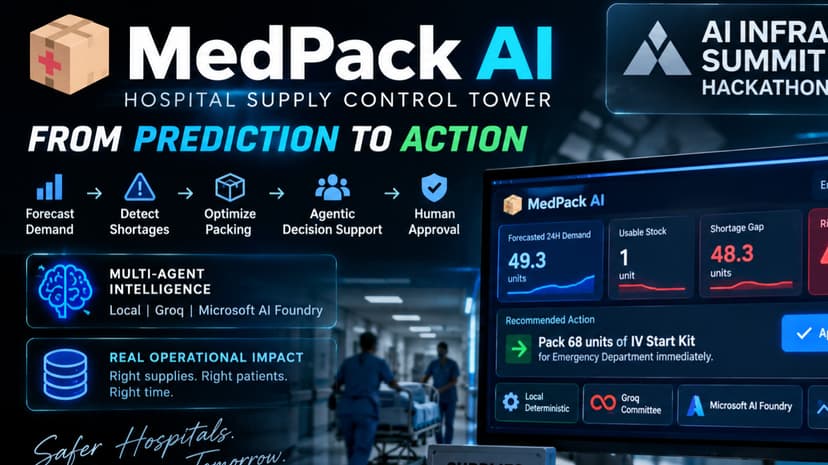
MedPack AI — Hospital Supply Control Tower
MedPack AI is an AI-powered hospital supply control tower that transforms operational signals into actionable, human-governed supply decisions. The system forecasts next-24-hour hospital supply demand using XGBoost, calculates true shortage risk against usable rather than total inventory, and converts shortages into prioritized packing, transfer, replenishment, and escalation actions. At its core is an authoritative deterministic decision snapshot. Once those operational facts are established, MedPack provides three parallel decision-support paths: zero-token Local/Deterministic reasoning, a Groq-powered agentic committee, and Microsoft AI Foundry. These paths can explain and support the decision, but they do not override the authoritative shortage calculation. A RAG knowledge layer provides supporting SOPs, supplier guidance, substitutions, recall information, and escalation playbooks. The Command Center converts decisions into priorities, owners, response windows, action cards, and operational handoffs. MedPack also includes a What-If Surge Simulator for safely testing scenarios such as flu-season demand, ED surges, supplier delays, and mass-casualty events without modifying the authoritative operational decision. Human review and approval remain the final control before operational execution. MedPack AI demonstrates how forecasting, deterministic safety logic, agentic AI, RAG, Groq, Microsoft AI Foundry, simulation, and human governance can work together as a practical hospital supply control tower.
16 Sep 2026
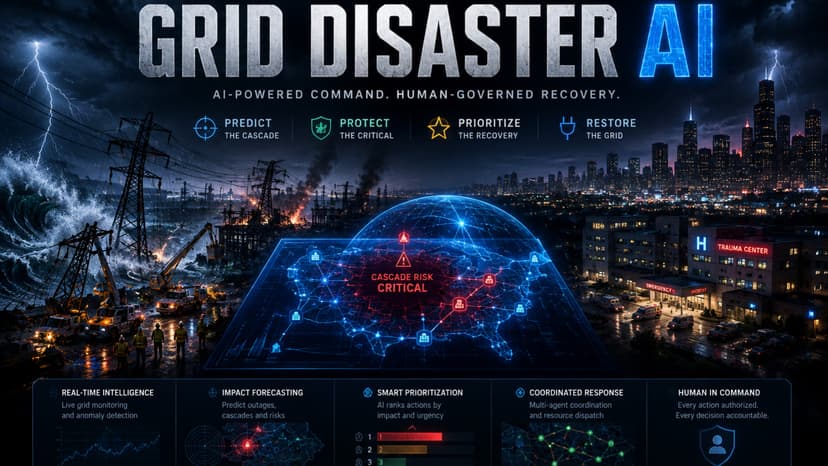
Grid Disaster AI
Grid Disaster AI is a human-governed AI command system designed to help operators respond to cascading power-grid failures and large-scale infrastructure emergencies. The platform combines real-time grid monitoring, risk forecasting, critical-facility prioritization, coordinated AI-agent recommendations, and recovery planning in one operational interface. During a simulated disaster, Grid Disaster AI identifies unstable substations, overloaded transmission corridors, hospitals and other critical facilities at risk, and potential cascade paths. Specialized AI agents evaluate competing priorities such as public impact, medical risk, grid stability, and restoration speed. A Recovery Commander Agent then synthesizes those findings into a recommended sequence of actions. The system does not autonomously execute high-impact recovery decisions. Instead, it presents the reasoning, tradeoffs, confidence levels, and recommended actions to a human operator for authorization. This human-in-the-loop design helps make AI-assisted infrastructure recovery more explainable, accountable, and operationally realistic. Grid Disaster AI demonstrates how agentic AI can support emergency decision-making when seconds matter: predict the cascade, protect the critical, prioritize the recovery, and restore the grid.
10 Aug 2026


