
🤓 Latest Submissions
Read-Along Coach
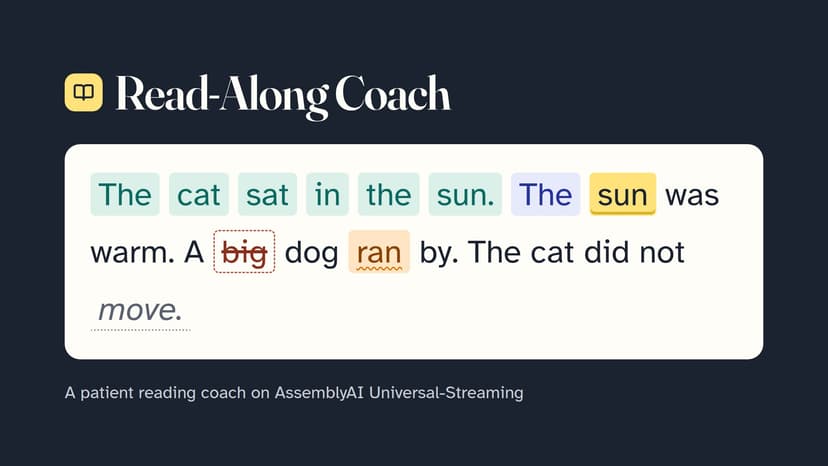
Children learn to read by reading aloud to someone who waits while they sound a word out, then helps at exactly the right moment. In a class of thirty, that one-to-one attention is the scarcest resource there is, and reading fluency is still measured by a teacher with a stopwatch, one child at a time. Read-Along Coach is that listener. The reader picks one of 12 leveled passages and reads it aloud. AssemblyAI Universal-Streaming returns every word with a timestamp and a confidence score, and we use those two signals as a measuring instrument rather than as input to a chatbot. Word-level timestamps drive a patience state machine that tells thinking apart from being stuck. Sounding-out fragments are read as effort and earn the reader more time, not a correction. Only after a genuine stall does the coach say a single word aloud, in a neural voice rendered at build time, and then get out of the way. Per-word confidence carries the ethical core. When AssemblyAI is not confident about a word, it is marked "couldn't hear" in grey italic and excluded from accuracy, from words-correct-per-minute, and from the practice list. A child is never marked wrong because the room was noisy. Position tracking is prefix sequence alignment against the known passage, the same family of algorithm used to compare DNA, so the app always knows exactly where the reader is and a partial read is never mistaken for skipped words. No language model sits anywhere in the scoring path, which makes every verdict reproducible and testable: 119 unit tests cover alignment, patience, scoring and playback. The session report gives words correct per minute, the fluency metric US schools already use, plus accuracy, words supplied, and the exact words to practise next time. Progress is kept on the reader's own device.
30 Sep 2026

