
Elijah Adeniji@eterniti_in_view
5
Events attended
5
Submissions made
Nigeria
1 year of experience
About me
I’m Elijah Adeniji — an AI Enthusiast, BI Developer, and Entry-Level Data Analyst passionate about leveraging Data and Artificial Intelligence to drive innovation in healthcare particularly Biochemistry, biotechnology, and sustainable development. I have gained hands on experience in medical laboratory research and bioinformatics principles with strong technical and analytical skills, bridging the gap between biological experimentation and digital insights. Currently, I serve as the Project Manager & Business Analyst for FACETRUST AI At my previous role, I managed a project focused on a mobile App Solution for Connecting Users to Solar Providers. To keep it short: I’m ready to be your Business Analyst and Project Manager. Let’s get started — send me a message!
🤝 Top Collaborators



🤓 Latest Submissions

Invictus Earth2 Keepers: Open-Model Dark Factory
Invictus Earth2 Keepers is a dark factory built in BAND with three coding-agent seats that turn a written specification into a working service with no human coordinating the process. A stage process and plan is implemented ONLY when the three keys have turned in the order of a requirement plan and ledger, a commit and an independent ACCEPT with evidence orDECLINE with review. The role of the Planner in the trio is to reads the specification, write a numbered requirements ledger, split the work into scoped items and own every decision; its mandate forbids writing product code. After which it then tags the Builder that to implements work items, verifies them and commits them but it's work is only done when both planner and reviewer confirms that. Reviewer tests each commit from its own separate copy of the repository, runs the checks for invalid input, retries, concurrency, boundaries and restarts. Every handoff carries the full requirement text, because a seat only sees messages that @mention it. The whole factory runs on open-weights models: headless OpenCode seats on GLM-5.2 through Featherless, connected to BAND with the SDK's OpenCode adapter, on one Windows laptop with generic mandate. On Tablekeeper it reached stage 1: 120 of 120 official tests passed and 170 numbered requirements verified, in about 2 h 50 min from one dispatch, for $13.83 of model spend. Review caught 6 real defects, including impossible dates and invalid time zones that were not returning 422. The factory also caught its own mistake: Reviewer accepted a stale commit, Planner refused to close the stage, and Reviewer re-verified the latest commit before the final ACCEPT. One limitation is the Planner's git identity ended up on three of the four commits, so our next step is enforcing the single-writer rule with tool permissions rather than mandate text alone. FACTORY.md documents the design, costs and every lesson from our development runs.
6 Oct 2026

Knight Eterniti: OCR + RAG on AMD ROCm
Knight Eterniti is a solo entry for the Lablab x AMD AI Academy Challenge, built and tested on an AMD Instinct MI300X with ROCm 10.0. Both images are built on the mandated rocm/pytorch base with the weights baked in, and run with no network. Each keeps a resident model server behind a unix socket, so every grader call is a standard-library client that starts in milliseconds and always writes a valid JSON file. Mini-Challenge 2 (OCR): Qwen3-VL-8B-Instruct (BF16) reads US and Chinese licence plates and road signs from PNG, JPEG and TIFF. The prompt and deterministic post-processing apply the transcription rules: drop state banners and slogans, keep Chinese province prefixes, join multi-line signs top to bottom, add no units. 10/10 public samples, 0.3-0.5 s per image, 18.8 GB VRAM, 45.7 GiB image. Mini-Challenge 3 (RAG): answers questions over a mixed corpus and cites the exact files each answer needs. Each file is parsed in an isolated worker process (PDF, DOCX with tables, multi-sheet XLSX, CSV, logs, code), so unreadable, encrypted or unknown files are skipped without stopping the walk. Images and scanned pages are transcribed by the same Qwen3-VL model. Withdrawn and superseded revisions are kept out of the model's context. Retrieval fuses identifier-aware BM25 with bge-small embeddings, and for multi-hop questions it follows rare identifiers such as ticket numbers and error codes across files. Citations are chosen by necessity: a file is kept only if it holds the value or supplied the identifier that leads to it, and an answer found in no document is refused. 10/10 public samples (200/200) with exact citation sets, 1-2 s per question, about 12 s startup, 20 GB VRAM, 45.8 GiB image.
1 Dec 2026

FundFlow AI — Scholarship Funding Intelligence
Students searching for scholarships and grants often face hundreds of opportunities without knowing which ones they actually qualify for. Eligibility requirements such as nationality, GPA, study level, field of study, and required documents are frequently buried in lengthy application pages, forcing students to manually evaluate opportunities one at a time. FundFlow AI solves this problem by turning funding discovery into an eligibility intelligence workflow. A student creates a funding profile, and FundFlow AI uses Bright Data to retrieve live scholarship and funding pages from the web. AI/ML API then extracts structured eligibility requirements from the retrieved content and evaluates them against the student's profile. Instead of presenting a black-box recommendation, FundFlow produces an explainable GO, MAYBE, or NO-GO decision. GO indicates that no known mandatory requirement has been failed, MAYBE identifies missing or uncertain information, and NO-GO identifies clear eligibility failures. The platform also explains why a student qualifies, highlights potential issues, identifies required documents, and provides a plain-language recommendation. The MVP was built end-to-end with native.builder, using Supabase for the database and Edge Functions powering the discovery, extraction, and matching pipeline. Bright Data provides live web retrieval, while AI/ML API powers structured extraction and eligibility reasoning. FundFlow AI is positioned Africa-first, beginning with students such as our Nigerian undergraduate demo profile, while the architecture supports students searching for funding opportunities globally.
10 Aug 2026
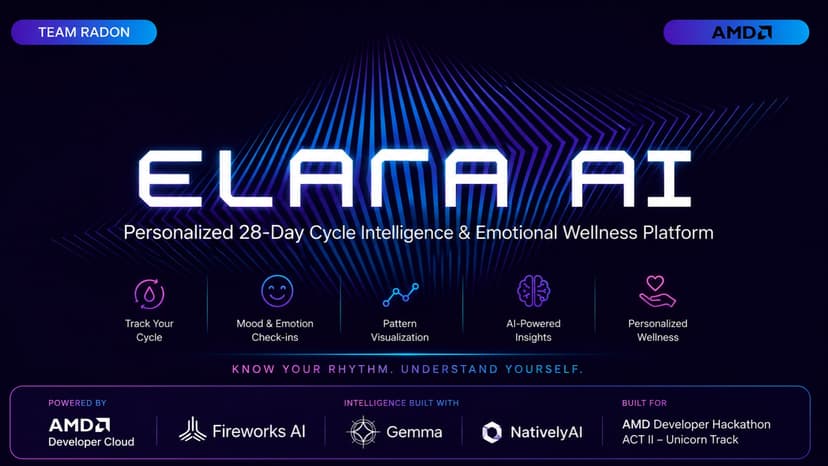
ELARA AI
Elara is a Cycle Intelligence & Emotional Wellness platform that connects two things most apps treat separately: menstrual cycle prediction and emotional support. Users log cycle and mood data; a statistical/ML model predicts their next period, fertile window, and PMS onset, deriving their current cycle phase in real time. That phase is then passed as context into a wellness agent (MiniMax M3 via Fireworks AI), which responds with warmth, connecting mood to phase only when genuinely relevant, never diagnosing, and flagging entries that suggest a need for professional support. The backend (FastAPI + SQLite) wires the prediction engine and wellness agent into one live API, tested end to end on a real clinical cycle dataset (Marquette NFP study data via Kaggle). As part of our AMD Developer Cloud usage, we're fine-tuning a LoRA adapter on curated wellness-response examples using ROCm-enabled MI300X GPUs, to lock in tone and boundaries beyond prompt engineering alone — this piece is in progress alongside the rest of the build.
13 Jul 2026

Guardian Agent
Edge-first architecture with NVIDIA Jetson achieves sub-50ms latency even in low-bandwidth rural regions. Offline-first design caches decisions locally and syncs when connectivity resumes. Guardian Agent scales horizontally—adding cities adds capacity, not complexity. The roadmap includes Phase 1 (5 current nodes), Phase 2 (15 cities by Q4 2026), and Phase 3 (54 nations by 2027). The Streamlit dashboard uses Plotly for guardrail breakdown donut charts and regional traffic volatility bar charts. Professional compliance reporting generates PDF binaries for daily SOC summaries, threat incident reports, and audits—compliant with NDPR, DPA, and POPIA. Guardian Agent combines Google Gemini with Veea security guardrails to protect Africa's critical infrastructure.
19 May 2026


