
🤓 Latest Submissions
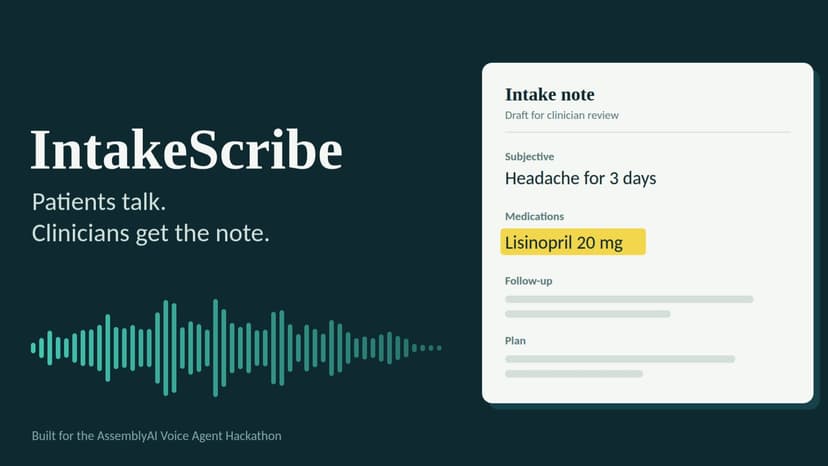
IntakeScribe: Voice-First Clinical Intake
Before a clinician ever sees a patient, someone has to ask the same questions: what brings you in, how long has this been going on, what are you taking? It's necessary work, it's repetitive, and it eats time that belongs to care. IntakeScribe hands that first conversation to a voice agent. Patients simply talk. Through a browser tab or an ordinary phone call, IntakeScribe greets them, asks natural follow-up questions, and listens the way a good intake nurse would. Built on the AssemblyAI Voice Agent API, it uses keyterm biasing so drug names like Lisinopril, Metformin and Ozempic are heard correctly instead of guessed at. While the conversation is still happening, the agent works with three tools: it flags medical entities such as symptoms and medications, adds follow-up items for the clinician, and, when the interview wraps up, generates a structured SOAP note ready for review. The second half of the project is a Session History dashboard, because a voice agent you can't audit is one you can't trust. Every call is listed, and any one can be opened to see the parsed transcript, a turn-by-turn timeline, the exact tool calls and their results, session metadata, and stereo audio playback with the patient on one channel and the agent on the other. Sessions can be deleted on demand. Under the hood it's deliberately lean: plain Node 18+, zero dependencies, the agent defined as a single JSON file, and a server that keeps the API key private and hands the browser only short-lived tokens. Phone calls route through a Twilio SIP trunk straight to AssemblyAI, and the whole app deploys to Render in one click. IntakeScribe isn't meant to replace clinical judgment. It's meant to give clinicians back their first few minutes, with the story already told, the medications already captured, and a draft note waiting.
30 Sep 2026
TripWire
The Problem: Coverage percentages only tell you what ran, not what matters. Teams chase a single number while the files that change most often, carry the most decision paths, or sit at the intersection of high complexity and low coverage keep slipping through untested. There's no clear answer to "what should I test next, given limited time?" The Solution: Trip Wire computes a transparent, file-level risk score for every file in a codebase: 40% normalized churn (from git log), 30% normalized complexity, and 30% statement coverage gap. It ranks every file by that score and hands the list to IBM Bob 2.0, which tests the highest-risk files first, in measurable batches, narrating its reasoning at every step so it can be checked against real command output rather than a post-hoc summary. Target Users & Interaction: Engineering teams and maintainers who inherit a codebase with an incomplete test suite. A developer runs npm run risk to generate the ranked report, opens the live dashboard to see tested versus pending risk, and directs Bob at the top of the list. The workflow is proven end-to-end on Chalk v5.4.1 (chalk/chalk): a prepared baseline of 66.66% statement coverage rose to 73.49% after Bob's first test batch on the highest-risk file (tools/risk-lib.js), 81.85% after batch two, and a final 82.08% after batch three, all backed by verbatim c8 output and screenshots, with 94 of 94 AVA tests passing. What Makes It Creative & Unique: Trip Wire doesn't just generate tests, it decides where testing effort belongs before a single test is written, and shows its work. Bob is explicitly asked to challenge the risk model rather than trust it, and in practice caught and fixed three real bugs in the scoring logic (statement-weighted coverage, rename-aware churn, deterministic tie-breaking, and crash-safety on empty repos) before writing any tests. Every stage, from baseline to final coverage, is reproducible from commands in the repo and backed by raw transcripts, not just summarized claims. Effectiveness & Efficiency: By combining churn, complexity, and coverage gaps into one visible formula instead of relying on coverage alone, Trip Wire directs limited testing time to the files most likely to break in production. The result is measurable: three prioritized batches, totaling 62 new tests, moved real statement coverage from 66.66% to 82.08% on a live, publicly verifiable codebase, with a dependency-free dashboard deployed at ibm-bob-risk-dashboard.onrender.com for anyone to inspect.
27 Sep 2026
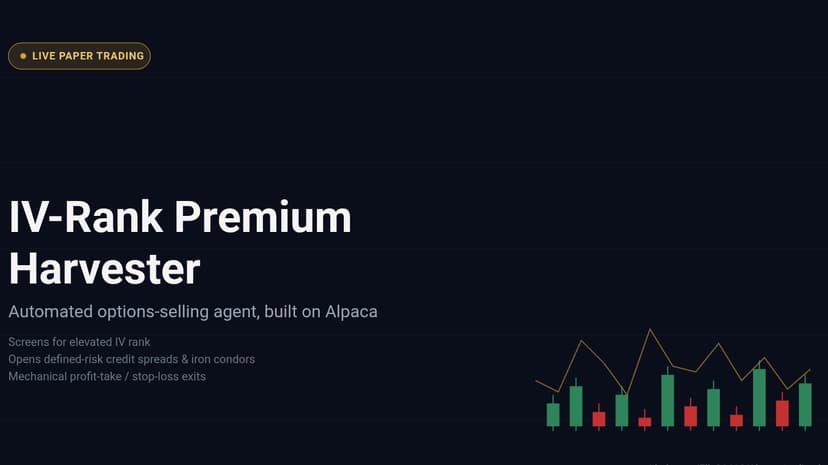
IV rank Premium Harvester
👋 Introducing: IV-Rank Premium Harvester What it is: An automated options-selling agent built on Alpaca's Trading API + Market Data API. It screens a watchlist for elevated implied volatility (relative to each symbol's own history) and, when it finds a good setup, opens defined-risk credit spreads or iron condors against it — with mechanical profit-take and stop-loss exits, no manual intervention. How it runs: The whole thing is driven by a scheduled GitHub Actions workflow that fires every 30 minutes during US market hours, Monday–Friday. Each run: 1. Checks Alpaca's live market clock (so it automatically respects holidays/early closes) 2. Screens the watchlist for IV-rank candidates 3. Sizes and proposes trades within portfolio risk limits 4. Logs the results to a live status dashboard Status: ✅ Fully deployed and running in paper-trading (dry-run) mode ✅ Live dashboard: https://elle31416.github.io/Alpaca-trading-bot/ — shows account equity, candidates screened, trades placed, and last run time, refreshed automatically ✅ End-to-end pipeline verified: market-hours gating, screening logic, and automated status commits all working What's next: - Tuning the watchlist so more candidates pass the IV-rank threshold - Building out the equity curve and trade history views as more runs accumulate - Eventually moving from dry-run to live paper-trade execution Happy to walk anyone through the repo or the dashboard — it's all open in Alpaca-trading-bot.
4 Sep 2026
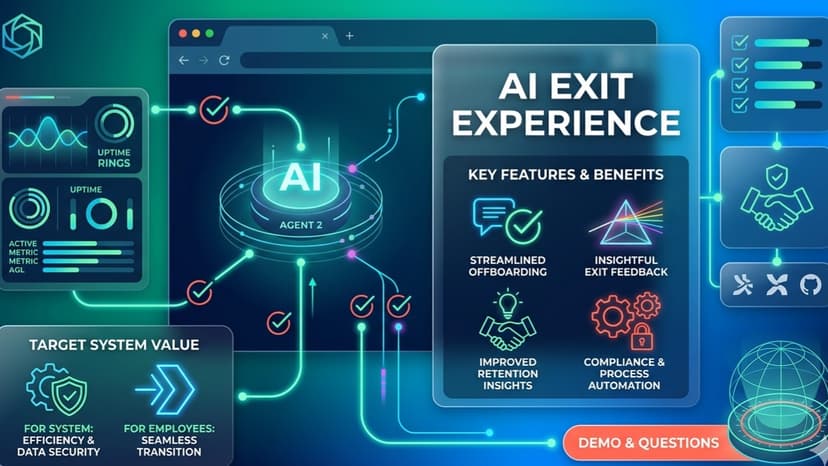
Knowledge Vault — Employee Knowledge Capture Agent
Every departure costs a company more than it admits — the undocumented fixes, the "call Sarah, she knows" workarounds, the vendor contact buried in someone's head. Knowledge Vault is a 4-agent system that stops this knowledge from walking out the door. Crawler mines Slack threads and handover docs for facts. Synthesizer structures them into a real knowledge base. Interviewer spots the gaps and grills the departing employee live, right inside Band. Curator makes it all searchable. Four agents, one shared Band room, zero notification spam — just agents actually working a problem together, powered by AI/ML API's GPT-4o-mini.
19 Jun 2026

AlphaLens: The Quant Engine Thinks While You Sleep
Quant hedge funds spend millions staffing teams to track alternative data signals — hiring velocity, pricing pressure, app sentiment, and regulatory filings — because the edge is in the data that doesn't appear in earnings calls. AlphaLens makes that edge accessible. It's a fully autonomous, continuously-learning signal engine powered by Bright Data, Claude, Cognee graph memory, and TriggerWare live-data triggers. Each night (or the moment an anomaly is detected intraday), AlphaLens wakes up, pulls live data across four alternative sources, runs each dataset through purpose-built Claude AI chains, and synthesizes everything into a composite earnings surprise score — from 0 to 100 — complete with analyst-style bullet points and a confidence interval. What makes v2 genuinely intelligent is its memory. Cognee replaces a flat signals database with a persistent knowledge graph: every signal event is linked to its company, its context, and its actual outcome. When AlphaLens analyzes NVIDIA this quarter, it recalls that the same GPU-validation hiring spike preceded a 16% beat three months ago — and weights the signal accordingly. The system gets sharper with every run. Built in six phases over ~48 hours on a $250 cloud budget, AlphaLens surfaces in a clean Next.js dashboard with watchlist rankings, sparkline trends, per-source evidence panels, and one-click CSV export for any backtesting platform.
31 May 2026


