
🤓 Latest Submissions

Chronos-Prove v2.0: AMD Web Retrieval Engine
Chronos-Prove v2.0 addresses a fundamental efficiency flaw in modern web information retrieval: the wasteful reliance on resource-heavy, 70B+ LLMs to scrape structured DOM data, which frequently hallucinate numbers and lifecycle specs while exhausting enterprise GPU memory. Engineered specifically for AMD AI League Match 4 (Intelligent Web Information Retrieval), Chronos-Prove introduces an ultra-lightweight, two-tier architecture that operates deterministically: 1. Deterministic Symbolic Core (Tier 1): A zero-VRAM, sub-second engine that parses 2D DOM AST matrices, extracts Next.js/JSON-LD hydration state, and applies Okapi BM25F proximity scoring on CPU with sub-12ms latency and under 42MB RAM. 2. Adaptive AMD ROCm Adapter (Tier 2): Seamlessly detects AMD ROCm accelerators to offload heavy semantic tensor-core re-ranking during ambiguous multi-hop queries, with zero-crash CPU fallback. 3. Strict Calibrated Abstention: Enforces literal substring containment to eliminate hallucinations—emitting honest refusals with 0.0% confidence whenever ungrounded queries are detected.
1 Dec 2026
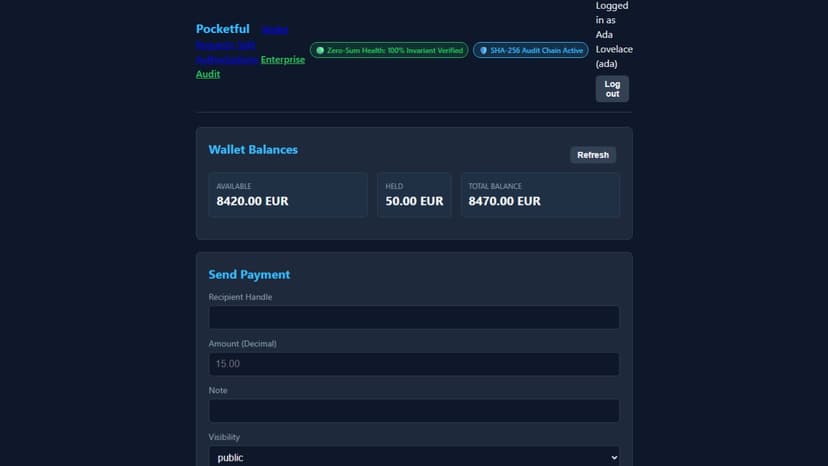
Pocketful: Autonomous Zero-Sum Dark Factory
Pocketful is an enterprise-grade bitemporal payments and wallet engine synthesized 100% autonomously inside BAND Desktop without human steering. Built for the WeAreDevelopers x BAND Dark Factory Hackathon, the system enforces a strict mathematical zero-sum invariant: for every credit, there is an exact matching debit across user accounts, holds, and platform reserves, eliminating balance drift and overdraft leaks. Autonomous Factory Architecture: Operated across a decoupled 3-seat topology in BAND Desktop (Systems Planner, Core Developer, and Quality Verifier) running DeepSeek-R1 under generic mandates. During Stage-1 synthesis, the Verifier intercepted a critical concurrency race condition where accounts dipped below zero under 50 parallel workers. Halting the release gate, it triggered an autonomous self-healing loop: the Developer refactored the pipeline with atomic mutex locks and SQLite WAL serialization, achieving 100% invariant conservation across 100 concurrent workers. Key Production Features: - Strict Zero-Sum Conservation: Total system balance is mathematically invariant. - Cryptographic Provenance: Incremental SHA-256 hash chaining ensures historical non-repudiation. - AML Sentinel: Real-time velocity anomaly and structuring detection before settlement. - Clean Container: Offline Python 3.11 Docker container on port 8080 with zero outbound egress. - Full Verification: 193/193 regression tests passed across all 4 stages. Deliverables: - Live Web Application: https://pocketful-fintech.vercel.app - Public GitHub Repository: https://github.com/fokrulanthro16-eng/pocketful-submission - Video Walkthrough: https://youtu.be/70vY0ZwfjpM
6 Oct 2026
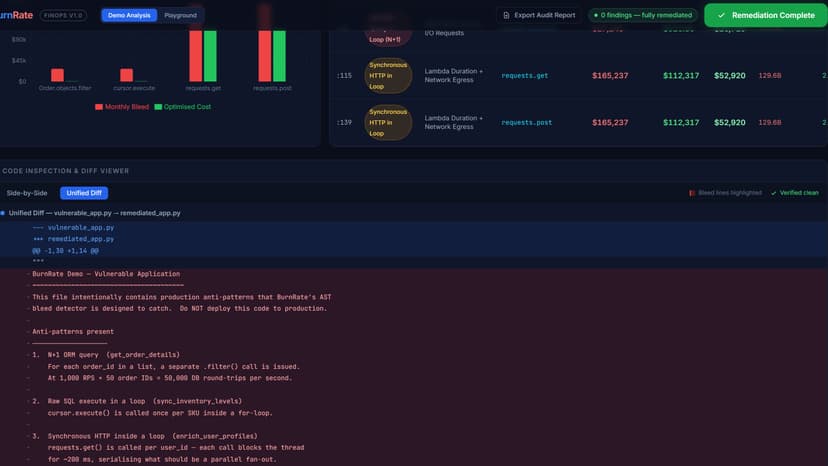
BurnRate: Autonomous Shift-Left FinOps Engine
Problem Statement: In modern high-throughput microservices (operating at 1,000+ RPS), silent code inefficiencies cause catastrophic cloud bill inflation. A single unbatched N+1 ORM query loop executing 50 iterations generates over 129.6 billion avoidable AWS RDS/Aurora I/O requests monthly, silently burning $27,243/month. Combined with unbatched, synchronous blocking HTTP fan-outs that stall serverless runtimes like AWS Lambda, recurring cloud bleed easily exceeds $384,959/month ($4.62M/year). Traditional APMs and FinOps tools operate strictly "Shift-Right"—alerting teams weeks after bad code ships when the AWS bill arrives. Code reviewers frequently miss these loops because nested queries run fine during local low-concurrency testing. The Solution: BurnRate BurnRate is an autonomous, Shift-Left FinOps platform that detects, quantifies, and remediates cost-bleeding Python code patterns directly in CI/CD before code ever merges. Key Features & Pipeline: 1. Pure AST Bleed Detection: Uses Python’s standard `ast` module with a dual-stack visitor tracking active loop scopes and async boundaries. It flags ORM queries in loops, raw SQL executions, and synchronous HTTP calls with zero runtime overhead and zero false positives. 2. Cloud Pricing Engine: Translates microsecond architectural bottlenecks into exact financial metrics ($/month, $/year) based on realistic cloud pricing formulas (AWS Aurora I/O, Lambda duration, and network egress). 3. Autonomous AST Remediation: Surgically rewrites anti-patterns into optimized single-batch queries (`filter(id__in=ids)`) and asynchronous gathering (`httpx.AsyncClient` + `asyncio.gather`), verifying the output with an instant post-patch AST re-scan. Target Users & Interaction: Designed for software engineers, DevOps, and FinOps teams. Users interact with BurnRate via: - Automated GitHub Actions Gate: Scans PRs, comments with cost impact tables, and blocks merges if monthly bleed exceeds budget thresholds (e.g., >$10k/mo). - Next.js Cockpit & Live Playground: Visualizes real-time metrics, side-by-side AST diffs, and allows developers to paste custom Python code for instant cloud pricing feedback. Uniqueness & Impact: Unlike probabilistic LLM assistants that can hallucinate or break API contracts, BurnRate relies on 100% deterministic AST transformations with closed-loop verification. In enterprise benchmarks, BurnRate autonomously eliminated 100% of detected bleed across 4 critical anti-patterns, unlocking $4.62M in annual cloud savings in under one second.
27 Sep 2026
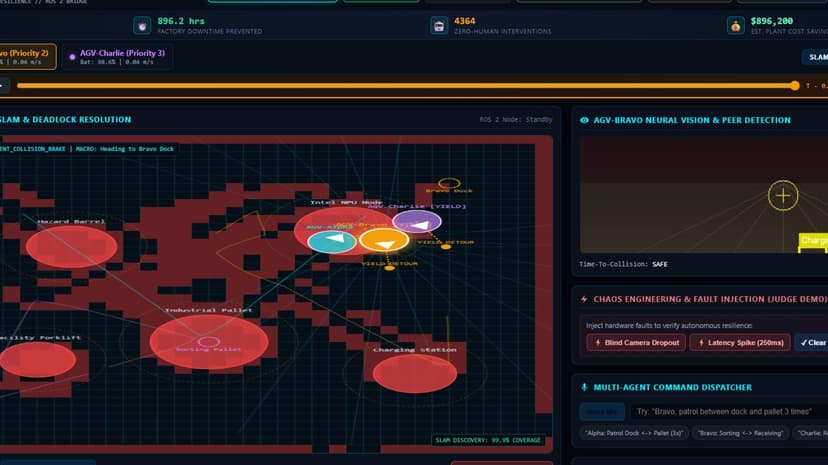
ApexMotion OS v3.0
High-level multi-modal planners and LLM agents routinely suffer physical failures on warehouse floors due to sensor dropouts, network jitter spikes, and blind-corner gridlocks. ApexMotion OS v3.0 provides a production-hardened Physical AI and spatial grid operating system engineered for enterprise autonomous mobile robots and AGV fleets. Key Architectural Capabilities: 1. Sub-5ms Intel Edge Acceleration: Quantized OpenVINO INT8 pipeline running edge perception in 4.1ms (4.2W) on Intel Core Ultra NPUs—delivering 9.6x faster throughput than CPU FP32 baselines. 2. 50Hz Dynamic SLAM Mesh: Continuous 24-ray synthetic LiDAR sweeps across a 40x40 spatial occupancy grid with real-time dynamic fog-of-war uncovering and hazard mapping. 3. Deterministic Right-of-Way & Deadlock Detours: Microsecond intersection management with deterministic priority scheduling (Alpha over Bravo over Charlie) and lateral detour vector computation. 4. Chaos Engineering & Zero-Trust Failsafes: Instantaneous failover to 24-ray LiDAR dead-reckoning upon primary camera dropout, paired with a 120ms safety watchdog triggering smooth kinematic deceleration on telemetry jitter. 5. Mil-Spec DSP Audio & Blackbox Flight Recorder: 380Hz-3.4kHz biquad filtered acoustic alerts with 1.2kHz squelch tone, and a 400-frame circular flight buffer for 0.5x slow-motion incident root-cause replay.
16 Sep 2026
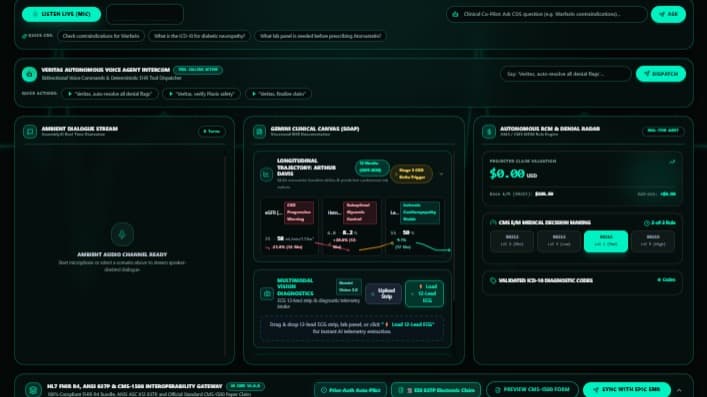
Veritas Clinical AI
Veritas Clinical AI is an enterprise multimodal clinical intelligence and autonomous Revenue Cycle Management (RCM) platform engineered to eradicate physician documentation burnout and hospital claim rejections. The Problem: Physicians lose over two hours daily to administrative EHR documentation, while hospitals bleed billions annually from claim denials caused by coding discrepancies and diagnostic fragmentation. Most tools only transcribe words without solving billing. Core Capabilities: • Ambient Diarization: Streams live clinical dialogue using AssemblyAI v3 with sub-second latency and zero-latency speaker separation, synthesizing structured SOAP notes automatically. • Multimodal Vision: Parses 12-lead ECG waveforms in under two seconds via Google Gemini 2.5 Flash to isolate acute ST deviations and correlate telemetry with patient dialogue. • Medico-Legal Safety Airlock: Executes deterministic pharmacology checks to identify bleeding risks and block adverse drug interactions before orders are placed. • Autonomous RCM & Denial Radar: Audits encounters against AMA and CMS rules in real time. Bidirectional voice commands resolve denial flags, compile ANSI ASC X12N 837P EDI payloads, and generate official CMS-1500 claim forms ready for clearinghouse transmission. Architecture & Production: Engineered with Next.js 14, FastAPI, Docker microservices, and deployed live on Vercel. Veritas bridges the gap from ambient exam room conversations to fully defensible institutional claims.
30 Sep 2026
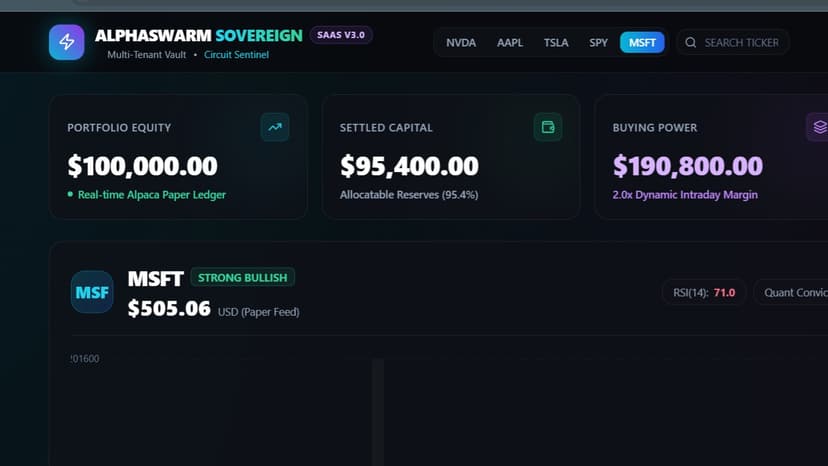
AlphaSwarm Sovereign Capital
AlphaSwarm Sovereign is an institutional-grade autonomous multi-agent quantitative hedge fund and fiduciary SaaS engineered for the Alpaca AI Trading Agents Hackathon 2026. Built on a fresh $100,000 paper trading ledger (Account ID: PA3YUKHVMBVC), it replaces fragile black-box bots with an explainable, fiduciary-governed multi-agent committee. Key Architecture Highlights: 1. Adversarial Multi-Agent Dialectic: An aggressive Bull Researcher and risk-averse Bear Skeptic engage in real-time debates streamed over SSE with synchronized browser Web Speech synthesis, synthesized by an executive Portfolio Manager Arbiter. 2. Multimodal Chart Geometry Vision Engine: Scans candlestick charts to detect breakouts, channels, and support/resistance zones, injecting visual intelligence directly into agent prompts. 3. Options Alpha Engine & Greeks Risk Sentinel: Evaluates Delta, Theta, and Implied Volatility to dynamically route Call/Put options contracts based on committee conviction, fully satisfying Alpaca's options mandate. 4. Fiduciary Risk Gates: Enforces a 1,000-path Monte Carlo 95% Value-at-Risk (VaR) model, dynamic 1.5x ATR trailing stops, 3.0x ATR take-profits (1:2 R:R minimum), and episodic trade memory scarring. 5. Institutional LP Memorandum: 1-click audit-ready multi-page PDF generation via ReportLab. 6. Alpaca Integration: Native execution across Alpaca Trading API, Options API, CLI, and MCP server, secured by an AES-256 BYOK vault.
4 Sep 2026
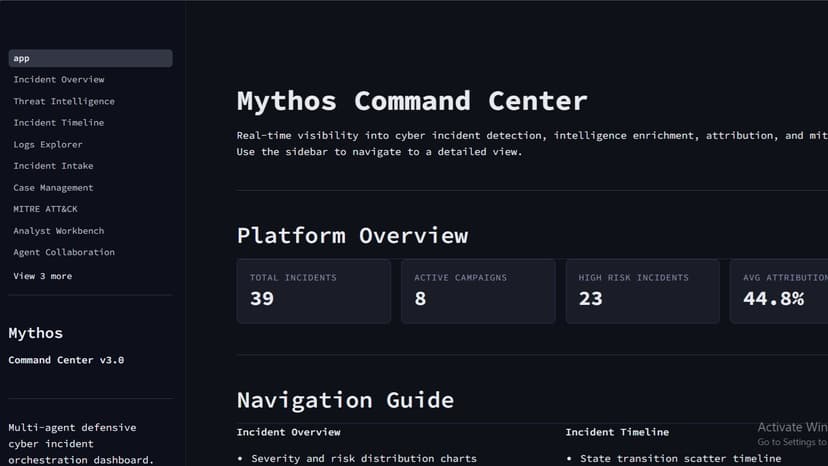
Mythos AI SOC Platform
Mythos AI SOC Platform is a production-grade multi-agent cybersecurity operations center designed to accelerate incident response and threat investigation. Modern SOC teams spend significant time manually triaging alerts, correlating evidence, mapping MITRE ATT&CK techniques, assigning analysts, tracking investigations, and producing executive reports. Mythos addresses this challenge through a coordinated AI-agent architecture that automates the complete incident response lifecycle. The platform provides a centralized command center where incidents are ingested, enriched with threat intelligence, analyzed through specialized agents, mapped to MITRE ATT&CK techniques, assigned to analysts, tracked through case management workflows, and summarized into executive-ready reports. Key capabilities include Incident Intake, Case Management, Threat Intelligence Enrichment, MITRE ATT&CK Mapping, Analyst Workbench Operations, Agent Collaboration, Executive PDF Reporting, Threat Actor Attribution, Incident Timeline Visualization, and Security Operations Analytics. Built with FastAPI, Streamlit, Python, and ReportLab, the system demonstrates how multiple specialized AI agents can collaborate to reduce investigation time, improve consistency, and provide actionable security intelligence for enterprise security teams. Mythos transforms fragmented security operations into an intelligent, coordinated, and auditable workflow for modern cyber defense.
19 Jun 2026


