🤓 Latest Submissions

Tablekeeper — Proofline Factory
Tablekeeper is a restaurant reservation service produced by the Proofline factory in BAND. Three distinct coding seats divide responsibility: the Coordinator transports the complete assignment, the Builder implements and preserves each stage, and the Verifier checks the exact revision independently. The four services extend the contract in order: atomic and idempotent API operations, a browser booking workflow, effective-dated policies and recurring reservations, and atomic series changes and closure replanning. Each stage includes its own Dockerfile and run instructions. The application needs no external model at runtime. Independent clean-clone public checks accepted all four stage claims at revision 96ab4b8. A substantive review caught a tampered imported closure plan that could violate booking consistency. The Builder repaired validation; the independent recheck confirmed rejection without changing the destination. The original room, generic mandates and exact-revision reports preserve the collaboration. Operator recovery occurred between stages and during stage four, including one administrative notice. The supervisor made no production-code edits or repeated stage dispatches. This intervention is disclosed; uninterrupted autonomy is not claimed. Public checks are partial, and private evaluation and the judges’ autonomy assessment remain unknown. The video combines actual application captures with fictitious data, original BAND history and a post-completion room inspection. Editing refers to the presentation, not changes to the accepted stage source. Narration uses Google Sulafat.
6 Oct 2026

MergeWitness
Merging two changes can be deceptively reassuring: each branch passes its own tests, the text merge is clean, and the existing suite stays green. Yet the two features can still interfere when they run together. That leaves maintainers with a hard-to-explain production defect and a costly manual investigation. MergeWitness is a developer workflow for making that interaction visible before release. It prepares four reproducible snapshots—base, change A, change B, and their combined version—and runs the same explicit behavior rule on each one. The measured demo uses a synthetic catalog. One change introduces tenant-specific prices; another introduces a product cache. Each works alone. In the combined version, a price cached for Alpha leaks to Beta. Existing tests exit with code 0 in all four snapshots, but the new rule fails: serving Alpha must not change Beta's price. Bob's original focused probe was independently rerun three times in each snapshot. It passed in Base, Change A, and Change B, then failed three times in the combined snapshot, where Beta should receive 100 but observed 90. An independently strengthened derivative probe found the same interaction and also compared Beta against a fresh catalog. IBM Bob authored a nested-Map repair. The repaired disposable candidate passed at commit 17ed2d8ca9997293383ad589119879c9eb59d94e: the ordinary suite exited with code 0, the strengthened frozen probe passed, and checks confirmed both tenant pricing and the cache remained active. The public laboratory lets a judge run the scenario, inspect the exact input sequence and expected versus observed result, and see the verified repair. The local CLI/MCP workflow evaluates trusted repositories using node --test and frozen probes; its public reports record this synthetic case. A passing probe means that no failure was found by that probe; it never certifies a merge as safe. A second synthetic priority/cursor case tests a different interaction: priority ordering and an ID-based page cursor each pass alone, but their clean combination skips an item. Bob authored that probe and two feature checks. Independent measurement found the probe passing 3/3 in Base/A/B and failing 3/3 in Combined, while ordinary tests stayed green. No repair is claimed for this second case.
27 Sep 2026
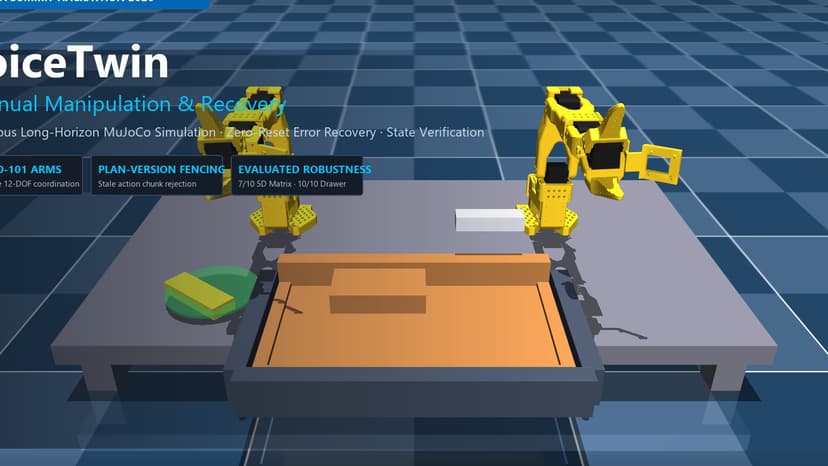
VoiceTwin: Bimanual Manipulation & Recovery
VoiceTwin is a versioned bimanual manipulation and recovery architecture for a dinner-table mission in MuJoCo with dual SO-101 arms. Its successful simulated manipulation is delivered by verified deterministic skills, not by a learned policy. In one continuous physics episode, the system performs cooperative drawer retrieval, clears the shared workspace, executes a bimanual plate handoff, places the objects, and verifies the final state. A deliberate receiver-arm fault demonstrates bounded recovery: MissionRegistry versions the mission plan, rejects the stale action, preserves completed drawer work, and retries the failed handoff without a global reset. Historical bounded acceptance passed 30/30 recorded episodes. The frozen multidimensional submission matrix passed 7/10 full missions and 10/10 drawer retrieval; shape/geometry variation is explicitly unsupported. Raw results and verifier failures are public. VoiceTwin integrates Intel Physical AI Runtime and OpenVINO. All reported local measurements were produced on an Intel Core 3 100U CPU; no Core Ultra, GPU, NPU, real-robot, or physical-deployment result is claimed. ACT, SmolVLA, and SmolVLM2 experiments were evaluated separately, did not pass the final dinner-table gates, and are not responsible for the successful mission. The public repository and Streamlit evidence room expose code, videos, benchmarks, limitations, provenance, hashes, and reproduction commands.
16 Sep 2026
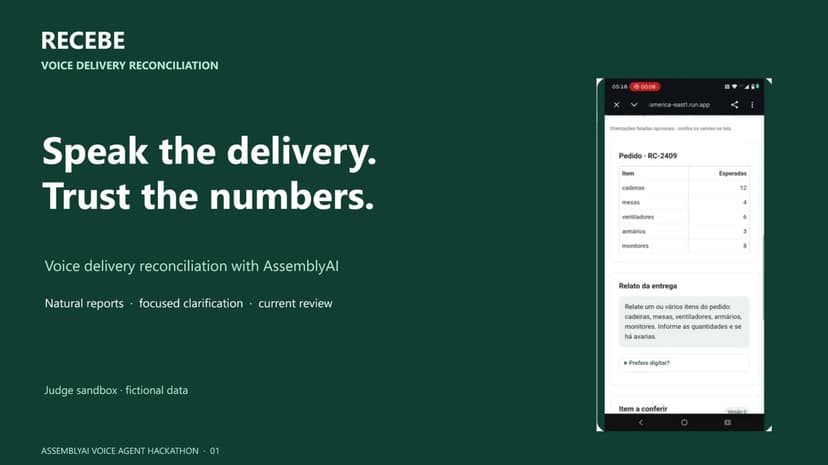
RECEBE — Voice Delivery Reconciliation
Receiving a shipment is physical work. Staff count boxes, inspect damage, and compare what arrived with an order while often away from a keyboard. “Four tables arrived, two damaged” is not enough to calculate trustworthy totals until we know whether the damaged tables are included in the four. RECEBE lets a worker speak naturally in Portuguese or English about a fictional order. It remembers multiple items across turns, accepts later corrections, and asks a targeted question when a critical relationship is unresolved. The app builds a structured review showing received, damaged, undamaged, and missing quantities. Confirmation is tied to the current version of that review; a stale answer cannot finalize a changed record. AssemblyAI Streaming STT transcribes microphone audio live. AssemblyAI LLM Gateway proposes structured meaning from the bounded conversation and order context. RECEBE then applies deterministic catalog, arithmetic, ambiguity, correction, and confirmation rules before preparing a receipt. Google Gemini TTS supplies a small set of fixed spoken prompts. Gemini Live is a private autonomous tester, not part of the product runtime. The judge can try the live sandbox with fictional data.
30 Sep 2026


