

Gulali Gulaliyev@gulalig
2
Events attended
2
Submissions made
Azerbaijan
5+ years of experience
About me
Software Engineer with 5+ years of experience building scalable web applications and AI-powered systems. I work primarily with Golang, JavaScript/TypeScript, React, Node.js, NestJS, and AWS, with hands-on experience in RAG, vector databases, AI agents, tool calling, and event-driven architectures. I enjoy turning complex problems into practical products, from production systems to experimental AI projects and hackathons. Currently focused on building intelligent, scalable products at the intersection of software engineering and AI.
🤓 Latest Submissions

Lumos AI — From Conversations to Action
Lumos AI is an intelligent meeting copilot designed to turn conversations into real, trackable work. Instead of ending a meeting with scattered notes and forgotten action items, Lumos listens to the conversation, understands the context, identifies speakers, extracts decisions and tasks, and organizes everything automatically. Users can interact with Lumos during and after meetings through a conversational AI assistant, asking questions about what was discussed, requesting summaries, or retrieving specific decisions and action items. Lumos is designed to fit into existing company workflows rather than becoming another isolated productivity tool. Through integrations such as Jira, extracted tasks can be transformed into structured work items and connected to the team’s existing projects and processes. The platform combines real-time meeting intelligence, speech processing, LLM-powered reasoning, tool calling, structured data extraction, and workflow integrations. Our goal is to reduce the gap between conversation and execution: people should be able to focus on the meeting while Lumos handles remembering, organizing, and turning discussions into action.
30 Sep 2026
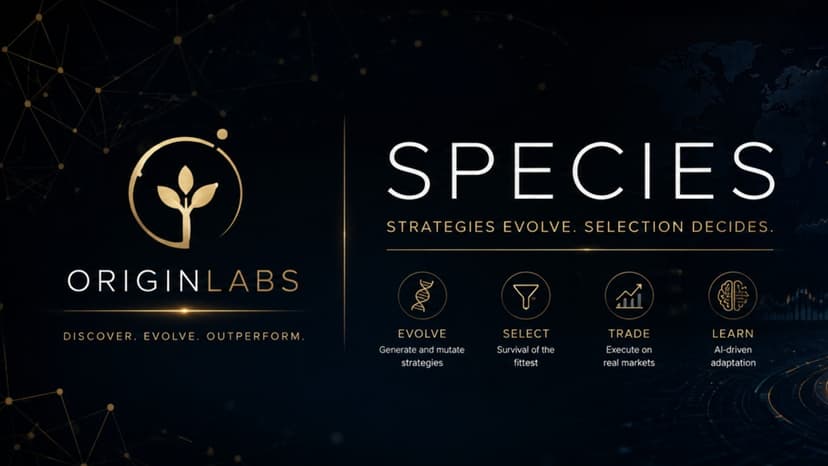
SPECIES - Evolutionary Quant Research
SPECIES is an evolutionary quantitative research platform designed to discover, evaluate, and validate trading strategies as populations rather than optimizing a single strategy in isolation. A research run begins with a configurable population of strategy genomes. Across multiple generations, SPECIES evaluates each candidate using historical market data, calculates deterministic fitness, applies selection pressure, and creates new descendants through bounded mutation and crossover. Every surviving strategy keeps a traceable lineage, making the evolutionary process inspectable rather than a black box. Evolution alone is not enough to qualify a strategy. Provisional champions must pass separate validation, walk-forward, regime-robustness, and qualification gates before they can move toward execution. Qualified strategies can be connected to Alpaca Paper Trading, but deployment never forces an order. Current market signals are evaluated deterministically, and execution remains protected by explicit approval and RiskGuard boundaries. SPECIES also includes an AI research copilot that explains persisted evidence, fitness, validation results, lineage, and experiment outcomes. The AI does not decide fitness, qualification, risk, or execution; those decisions remain owned by deterministic application logic. The goal is to make quantitative strategy discovery evolutionary, reproducible, explainable, and safer to move from research toward paper execution.
4 Sep 2026

