
Gulam Sakaria@gulamsakaria
3
Events attended
1
Submissions made
Bangladesh
1 year of experience
About me
Hi, I'm Gulam Sakaria, a Computer Science and Engineering student at Daffodil International University in Dhaka. I'm interested in AI, machine learning, and especially Bangla NLP, because I think our language deserves better tools than it currently has. I'm the founder of StratifyX Global, a tech news and research platform that I built myself as a full-stack developer, and I also serve as a Vice President at Volunteer Development Forum, Mymensingh. Alongside my studies, I work as a research assistant with Professor D. Shah J. Miah of Newcastle University. Most of my time goes into building things: CommentLens, which analyzes Bangla and Banglish comments, and ReliefX, a flood relief management system. I'm also working on research around factual Bangla news headline generation. My goal is to keep growing as a researcher and eventually pursue a master's in AI.
🔥 Own Projects


🤓 Latest Submissions
LegacyLift - Legacy PHP Modernizer
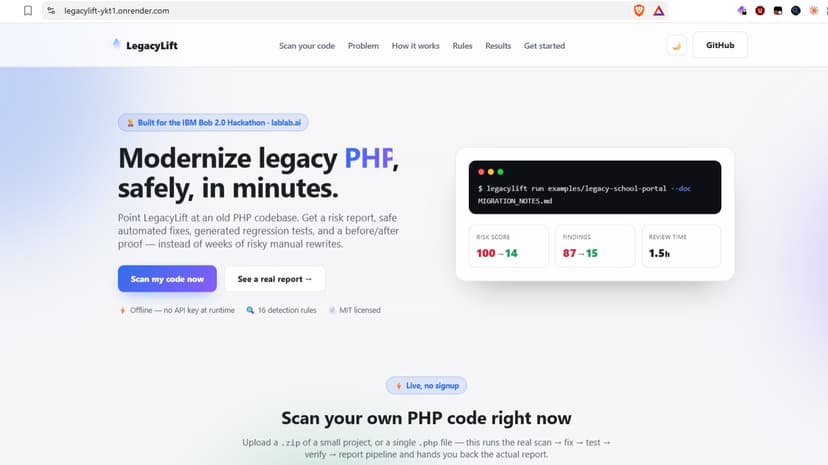
Problem: Thousands of small businesses, schools and news sites still run PHP 5.x-era code: mysql_* functions, string-concatenated SQL, register_globals-style extract() calls, MD5 passwords, no CSRF protection, unescaped output. Modernizing this by hand takes weeks, is risky on a codebase nobody fully remembers, and is usually skipped, leaving real institutions (schools, clinics, local news outlets) running code with known, exploitable weaknesses. Our own demo target is exactly this: a small school's student and news portal, built years ago, still running the site that indexes its Bangla-language news and holds guardian phone numbers for every enrolled student. Solution: LegacyLift is a pipeline of six deterministic stages: scan, plan, fix, generate tests, verify, report, built around 16 detection rules covering the most common PHP 5-to-8 modernization hazards (SQL injection, XSS, weak hashing, CSRF, object injection, deprecated functions, and more). Every fix is a human-reviewable unified diff before anything is written; nothing is changed silently. Run against our demo school portal, it found 92 real findings across all 16 rules in 21 files, safely fixed 75 of them automatically (mysql_* to PDO, SQL to parameterized queries, XSS escaping, weak hashing to password_hash() with a zero-downtime rehash-on-login path, CSRF tokens, secrets to .env), generated PHPUnit regression tests proving the SQL-injection payloads that worked against the legacy code no longer do, and dropped the project's risk score from 100/100 to 20/100, all in under a second, entirely offline, with zero network calls and no API key required at runtime. Target users interact with it two ways: a CLI (legacylift run <path> --doc MIGRATION_NOTES.md) for developers, and a live web dashboard where anyone can upload a .zip or a single .php file and get the same scan, fix, test and report pipeline back through the browser, no signup required. What makes it creative and unique: rather than a chatbot wrapper, LegacyLift is a deterministic, offline, dependency-light toolchain that treats an LLM agent (Bob) as the builder, not a runtime dependency. The shipped tool needs no API key and makes no network calls at runtime, which matters directly for the kind of organisation this is built for. It is also honest about its own limits: it discloses in its own report and docs the one class of SQL injection it cannot yet trace (through PHP's extract() function), rather than overclaiming coverage. Effectively and efficiently: the effort heuristic estimates 95.9 hours of manual fix time replaced by 1.6 hours of patch review on this one small site, and the same tool scales to every other PHP 5-era codebase a school, clinic or local newsroom is quietly still running. One command produces a single polished HTML report with before and after risk scores, filterable findings, and every diff.
27 Sep 2026


