
🤝 Top Collaborators



🤓 Latest Submissions
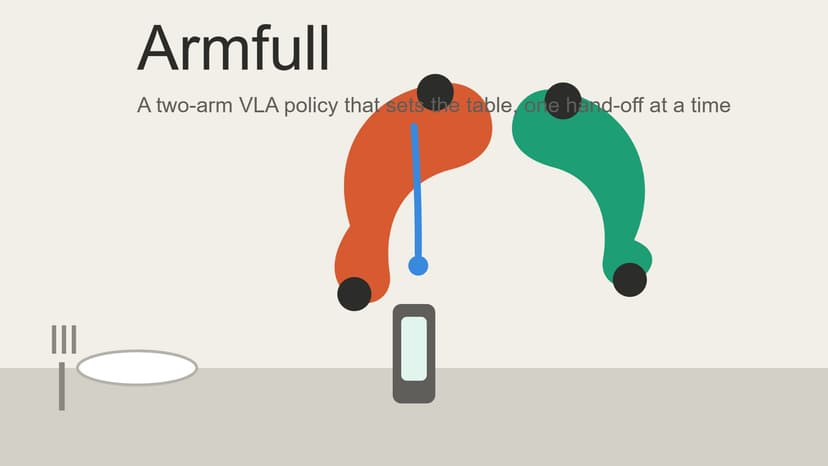
Armfull
Armfull — Bimanual VLA Manipulation with Multi-Modal Reasoning Armfull is a perception-to-action pipeline for dual-arm robotic manipulation, demonstrating how a Vision-Language-Action (VLA) policy can interpret natural-language instructions, reason over camera observations, and coordinate two SO-101 robotic arms in a simulated dinner-table environment. Architecture: The system has three layers: (1) SmolVLA Policy (`lerobot/smolvla_base`, 450M parameters), which processes three 256×256 camera images, a 6-dim robot state, and language instructions to generate 6-dim action chunks; (2) a Bimanual Coordination Planner that assigns each arm one of four roles—idle, active, holding, or coordinated—and manages multi-arm interactions; and (3) a MuJoCo Dinner-Table Environment containing two SO-101 arms, drawer, plate, mug, bottle, spoons, and forks. Object positions, friction, and lighting are randomized by seed for robustness testing. Intel Hardware: The pipeline runs entirely on an Intel Core 3rd Gen Ivy Bridge CPU. OpenVINO conversion of the SmolVLM2-500M backbone was attempted but failed because dynamic attention masking prevented static tracing, so the system falls back to PyTorch inference. It achieves 10.18 ms mean latency, 12.60 ms P95 latency, and 98.25 inferences/sec. Results: Across 10 deterministic seeds, 7/10 completed successfully, with a 100% success rate on completed runs; the remaining three were interrupted by a power outage. Each run produces a demonstration video. Reproducibility: Includes automated installation, `sanity_check.py`, `benchmark_intel.py`, and `run_demo_10seeds.py`, with all configurations in `configs/default.yaml`. Stack: Python 3.11, PyTorch 2.10, LeRobot 0.4.4, OpenVINO 2024.4, MuJoCo 3.2.3, Transformers 5.17, Gymnasium, NumPy, OpenCV, and imageio.
16 Sep 2026

PickFight Decision Maker
Choosing where to eat with friends sounds simple, but group decisions often become frustrating. Everyone has different schedules, budgets, dietary restrictions, and personal preferences, making it difficult to reach a decision that works for everyone. PickFight transforms this messy conversation into a structured and fun decision experience. A host creates a dinner room and invites friends with a simple room link. Each participant privately shares their availability, budget, food preferences, and dietary requirements. Personal answers remain private, while PickFight uses them to identify options that are feasible for the entire group. Instead of simply recommending popular restaurants, PickFight prioritizes compatibility. It first filters restaurants using safety requirements and hard constraints, then ranks remaining options based on group fit. The top candidates enter a tournament-style voting process where friends anonymously vote through head-to-head matchups until one winner emerges. By combining private preference collection, intelligent filtering, compatibility scoring, and social voting, PickFight helps groups stop debating and start deciding.
10 Aug 2026


