

🤝 Top Collaborators



🤓 Latest Submissions

Optiseek
Mini Challenge 2: OCR Image: b3panda3/optiseek:latest Optiseek extracts text from PNG/JPEG/TIFF license plates and traffic signs using Qwen2.5-VL-3B-Instruct on AMD ROCm, returning strict JSON with text and confidence. Categories: US/Chinese plates, stop signs, speed limits, advisory speeds, and work zone signs. Preserves relevant text while filtering US state names and slogans. Architecture: PIL adaptive preprocessing → Qwen2.5-VL (bf16) → rule-based postprocessing → JSON. Results: 10/10 samples passed (200/200 points); 17.2s/image average; ~8 GiB peak VRAM; ~25 GiB Docker image. Engineering: Patched Transformers caching_allocator_warmup for MI300X VF memory limits; used a 3B model for VF compatibility. Mini Challenge 3: RAG Image: b3panda3/optiseek-rag:latest Optiseek RAG indexes PDF, DOCX, XLSX, CSV, TXT, LOG, PY, PNG, and JPG files. It answers questions with exact citations and abstains when evidence is missing. VLM extraction handles text in diagrams, pinout charts, and asset labels. Robustly handles unreadable files, encrypted PDFs, empty directories, and unknown formats. Architecture: Resident Qwen2.5-7B daemon + Unix-socket client → multi-format parsers → BGE-small embeddings + hybrid semantic/keyword retrieval → LLM generation → post-hoc citation necessity verification. Results: 8/10 questions passed (160/200 points). Supports single-hop, multimodal, and refusal tasks. Multi-hop retrieval and one error-code extraction need improvement. Engineering: Daemon avoids model reloads; VLM unloads after indexing to free VRAM; citation verification tests necessity by removing sources and rerunning queries. Patched caching_allocator_warmup and pinned ROCm-compatible PyTorch to prevent CUDA replacement. ~50 GiB Docker image; ~14 GiB peak VRAM.
1 Dec 2026
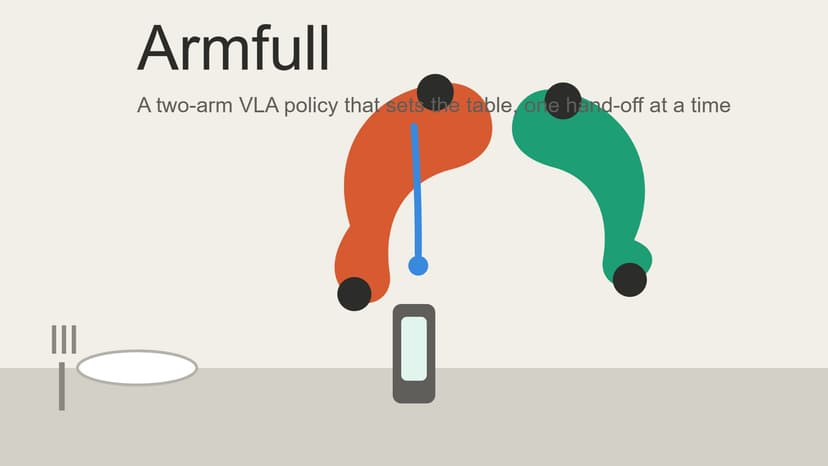
Armfull
Armfull — Bimanual VLA Manipulation with Multi-Modal Reasoning Armfull is a perception-to-action pipeline for dual-arm robotic manipulation, demonstrating how a Vision-Language-Action (VLA) policy can interpret natural-language instructions, reason over camera observations, and coordinate two SO-101 robotic arms in a simulated dinner-table environment. Architecture: The system has three layers: (1) SmolVLA Policy (`lerobot/smolvla_base`, 450M parameters), which processes three 256×256 camera images, a 6-dim robot state, and language instructions to generate 6-dim action chunks; (2) a Bimanual Coordination Planner that assigns each arm one of four roles—idle, active, holding, or coordinated—and manages multi-arm interactions; and (3) a MuJoCo Dinner-Table Environment containing two SO-101 arms, drawer, plate, mug, bottle, spoons, and forks. Object positions, friction, and lighting are randomized by seed for robustness testing. Intel Hardware: The pipeline runs entirely on an Intel Core 3rd Gen Ivy Bridge CPU. OpenVINO conversion of the SmolVLM2-500M backbone was attempted but failed because dynamic attention masking prevented static tracing, so the system falls back to PyTorch inference. It achieves 10.18 ms mean latency, 12.60 ms P95 latency, and 98.25 inferences/sec. Results: Across 10 deterministic seeds, 7/10 completed successfully, with a 100% success rate on completed runs; the remaining three were interrupted by a power outage. Each run produces a demonstration video. Reproducibility: Includes automated installation, `sanity_check.py`, `benchmark_intel.py`, and `run_demo_10seeds.py`, with all configurations in `configs/default.yaml`. Stack: Python 3.11, PyTorch 2.10, LeRobot 0.4.4, OpenVINO 2024.4, MuJoCo 3.2.3, Transformers 5.17, Gymnasium, NumPy, OpenCV, and imageio.
16 Sep 2026
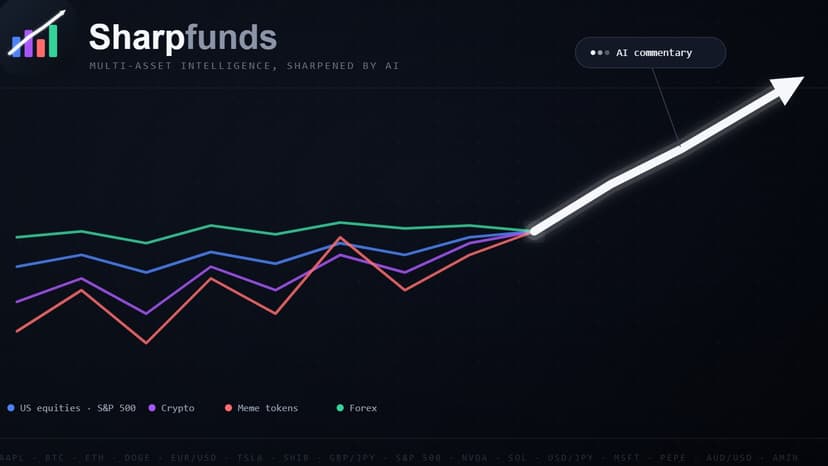
Sharpfunds — AI-Native Multi-Asset Smart Terminal
Sharpfunds reimagines the retail investing experience by consolidating fragmented financial data across six asset classes — stocks, crypto, meme coins, S&P 500 ETFs, forex, and commodities — into a single, AI-native intelligence terminal. Unlike traditional platforms that silo asset types, Sharpfunds presents a unified dashboard where Bitcoin trades alongside Apple and Gold Futures, each enriched with real-time pricing, interactive charts, key statistics, and fundamental data. At its core is a multi-layered AI engine that delivers per-asset market synthesis — breaking down performance drivers, risk headwinds, and forward-looking context — plus an interactive chat interface that lets users drill deeper into any asset with follow-up questions. The AI is fed live market context, ensuring responses are grounded in actual data rather than hallucinated figures. Built for the AI Factory × Native.builder Hackathon, Sharpfunds demonstrates how AI can transform raw market data from multiple free APIs (Binance, Finnhub, Alpha Vantage, GeckoTerminal) into cohesive, actionable financial intelligence. Every asset page features responsive Recharts visualizations, a fundamentals panel with market cap and supply metrics, curated news, and persistent watchlist tracking. The architecture gracefully degrades with static fallbacks so the dashboard remains functional even when external APIs are rate-limited or unavailable — a production-hardened approach rarely seen in hackathon projects.
10 Aug 2026
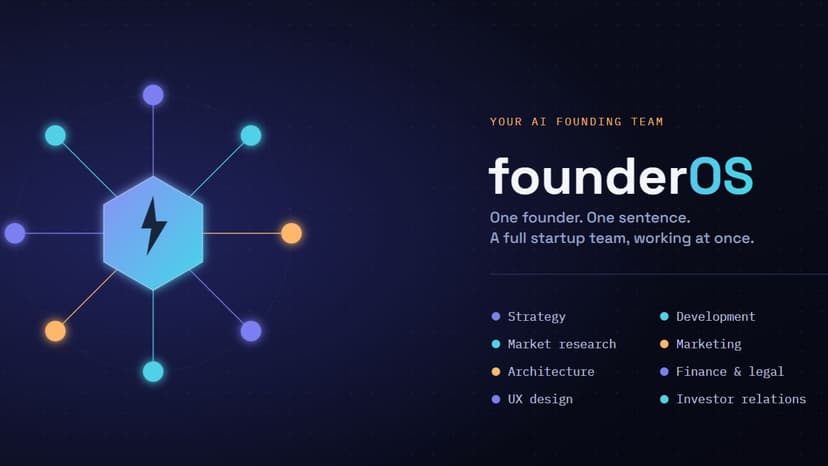
FounderOS
FounderOS reimagines how startup founders work by providing an AI-native operating system built around specialized multi-agent assistants. Each agent — Researcher, Writer, Strategist, and more — is purpose-built for a core startup task: competitive analysis, investor outreach, product documentation, or go-to-market planning. The platform runs entirely on AMD ROCm-powered GPUs, leveraging Fireworks AI's inference engine for fast, cost-effective LLM responses. A live GPU demo notebook validates full hardware utilization — from environment profiling and model loading to concurrent agent inference — proving the stack is production-ready on AMD silicon. FounderOS turns fragmented founder workflows into one intelligent, GPU-accelerated command center.
13 Jul 2026


