🤓 Latest Submissions
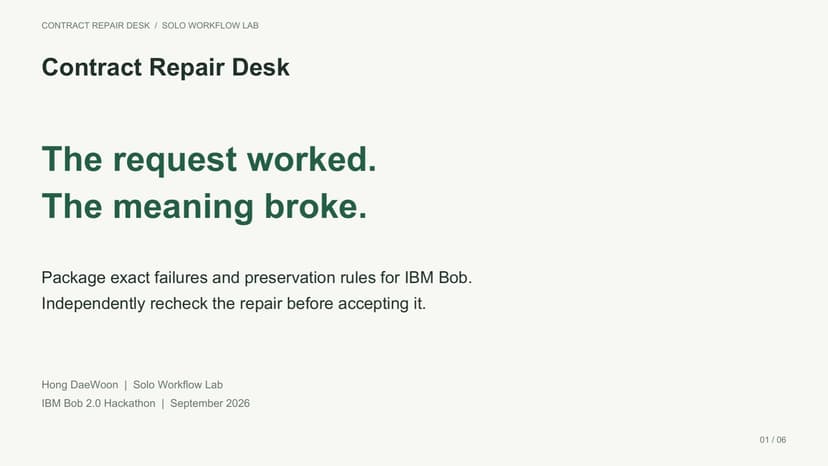
Contract Repair Desk
An API can return HTTP 200 while its consumer displays the wrong business meaning. Our warehouse example reports zero available units, yet the old adapter displays twenty. Contract Repair Desk is a local repair-and-review workflow for trusted TypeScript response adapters. A developer supplies migration, preservation and rejection expectations. The CLI pins the contract and baseline, creates an editable candidate, and guides IBM Bob through a project skill. Independent verification runs both versions against identical synthetic HTTP responses and records exact expected/actual results, source and hashes. The browser executes the saved Bob warehouse repair on editable JSON without an account or model call. Recorded warehouse, dispatch and booking jobs expose code and evidence separately. A local contract editor provides reusable job inputs. Regressions, changed expectations, stale results and incomplete execution cannot produce a verified repair. The project has 69 passing tests. A separate review command preserves original expectations and packages new failures into a precise Bob handoff. Six initially green comparison candidates exposed 21 failed assertions in later boundary review. A separate Bob booking follow-up preserved 7/7 original checks and improved added checks from 0/4 to 4/4. Who checks the checks? An anonymized record from one actual Bob run retains ten proposed checks, eight accepted by Codex and two excluded for unsupported quotations. The repair passed 3/3 original and 8/8 adopted checks; twelve evaluator cases withheld from both calls passed after freezing the candidate. Source and inputs remain private, so this run cannot be independently replayed from the public repository. Requirements and evaluation were authored by the same evaluator; this is not external validation. A separate, independently authored unit-counter fixture lets reviewers replay proposal adoption and seeded-error auditing. Its illustrative proposals are not attributed to Bob. Five deliberately faulty patches test check quality: initial checks detected 2/5, the reviewed draft 3/5. Two Codex checks added after inspecting survivors caught the same faults 5/5. A behavior-preserving control stayed green. Both the initial gaps and post-audit hardening remain visible; this is not a blind score or a production defect-detection rate. The contribution is a repair handoff: package exact failures and preservation rules for Bob, then independently recheck the candidate. Existing contract tests remain the foundation. Our earlier three-case plain/guided comparison showed no correctness advantage. No human time savings were measured. Synthetic cases do not establish production coverage. Hashes detect edits, not malicious replacement of both inputs and manifest. The verifier supports trusted adapters, not hostile code.
27 Sep 2026
Guard Line
Guard Line is a browser prototype that helps a listener notice risky requests during a Korean phone conversation. It streams audio through AssemblyAI, displays the live transcript, and shows the original words behind each detected signal. When isolation or a high combined risk score is detected, it displays a warning and attempts a spoken prompt to stop and verify independently. The prototype uses AssemblyAI Streaming for Korean speech recognition and AssemblyAI LLM Gateway for signal extraction. A Java layer validates quoted evidence, confirms high-impact signals with local rules, and calculates a reproducible heuristic score. Vue provides scenario playback and the live explanation interface. The demonstration uses synthetic calls. It does not verify caller identity or access the telephone network. Guardian notification is visibly simulated. The system can produce false positives and missed signals; a low score is not proof that a caller is legitimate. Our next validation step is a broader collection of adversarial and normal conversations, including family impersonation and unusual wording. Built by Hong DaeWoon as a solo project with AI coding assistance.
30 Sep 2026


