🤝 Top Collaborators


🤓 Latest Submissions
sipa-trace
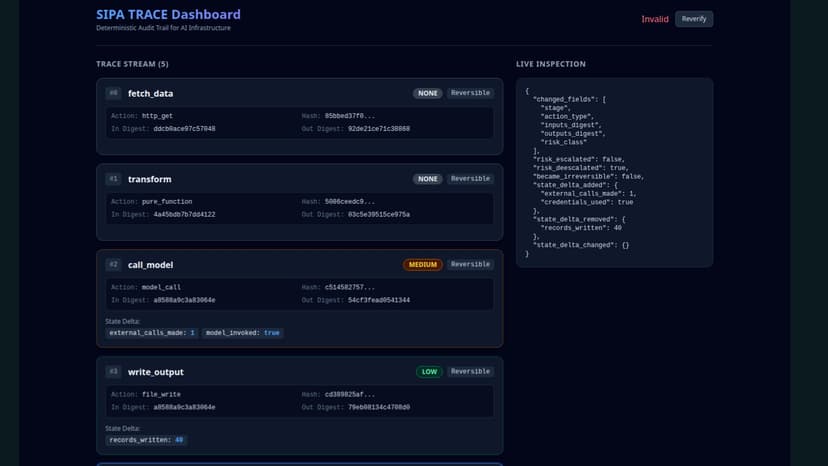
AI infra logs are prose. To notice that a pipeline's risk jumped between two steps, someone has to read both log lines in full and hold the first in working memory while reading the second — slow under time pressure, and structurally hostile to anyone who processes information mechanically rather than narratively. Worse: most "audit trails" just trust whatever the log says, with nothing stopping a tampered entry from looking valid. sipa-trace fixes the shape, not the content. Every pipeline event becomes a TraceCard with a locked schema (stage, action_type, risk_class, reversible, state_delta). Risk is assigned by a fixed rule table, not by asking a model to grade its own step. Two cards in a row diff field-by-field — the diff IS the alert, not a paragraph you have to parse. Every card is hash-chained, and a real verifier recomputes each entry's hash from its actual payload and compares it — so content tampering (not just chain-linkage) is caught. Core (sipa_trace/): TraceCard schema, RiskClassifier (NONE→CRITICAL), hash-chained TraceLog, diff_cards() with risk_escalated/became_irreversible flags, verify() — 29 tests green, runs with zero API keys. Instrumentation: a real MCP-server / FastAPI middleware wraps tool calls with @traced, classifying real actions (e.g. credential_access → CRITICAL) automatically as they happen. Dashboard: React + FastAPI live view polling the trace stream — trace feed, live diff panel, and a Verify badge that flips Verified → Invalid the moment a card is tampered on disk, re-checked on demand.
16 Sep 2026

Ai Learning Operating System
A real, production-ready AI Study Assistant — a browser-first, event-driven learning workspace for uploading real study documents, extracting their structure (text, headings, math, tables), building a knowledge graph from actual content, and chatting with a real AI provider grounded in your documents. Built with React 18, TypeScript, Vite 7, TailwindCSS v4, Zustand, React Router 7, react-markdown, KaTeX, pdfjs-dist, and d3-force / d3-zoom / d3-selection (interactive knowledge-graph visualization). All AI and web-fetching capabilities run through Supabase Edge Functions that proxy OpenRouter and Bright Data — provider credentials stay server-side, never in the client.
10 Aug 2026

AI Support Pipeline — Band Agents
AI Customer Support Pipeline is a multi-agent system built for the Band of Agents Hackathon. It uses 4 specialized AI agents that collaborate through Band to handle customer support queries end-to-end. How it works: A user types a support question. The Classifier Agent reads it and identifies the category (billing, technical, account, or general) and priority level. It posts this structured context to a Band chat room. The Resolver Agent picks up that context from Band, searches the knowledge base, and uses Groq LLaMA 3.1 to generate a factual answer. It posts the raw answer back to Band. The Responder Agent reads the answer from Band and formats it into a warm, professional customer support reply. Finally, the Escalation Agent checks if the issue needs human intervention based on category and priority, and flags it accordingly. Every agent communicates exclusively through Band — Band is the actual handoff layer, not just a wrapper. Each agent reads from and writes to a shared Band chat room, creating a true multi-agent collaboration pipeline. Tech Stack: - Band SDK for agent coordination - FastAPI for the backend API - Groq LLaMA 3.1 (free tier) for AI reasoning - HTML, CSS, JavaScript for the frontend chat UI - HuggingFace Spaces for backend deployment - Vercel for frontend deployment Use Case: This targets Track 1 — Internal Enterprise Workflows. Customer support automation is one of the most high-value enterprise applications, saving companies thousands of hours annually while improving response quality and consistency. The system is fully deployed and live, with a working demo showing real-time agent collaboration through Band.
19 Jun 2026


