
🤝 Top Collaborators


🤓 Latest Submissions

Voice Screen-AI
Screen-AI is a voice-controlled autonomous computer agent that enables users to interact with their computer naturally through speech. It combines real-time voice intelligence, screen perception, OCR, UI automation, and contextual computer-state awareness to understand applications, windows, files, browser tabs, contacts, and on-screen elements. Its Universal Target Resolution identifies the exact target behind natural commands, while the autonomous execution engine plans and performs tasks across the desktop. Every important action is observed and verified, with built-in recovery and self-healing mechanisms to handle failures and continue toward the user’s intended goal.
1 Dec 2026

Ai Learning Operating System
A real, production-ready AI Study Assistant — a browser-first, event-driven learning workspace for uploading real study documents, extracting their structure (text, headings, math, tables), building a knowledge graph from actual content, and chatting with a real AI provider grounded in your documents. Built with React 18, TypeScript, Vite 7, TailwindCSS v4, Zustand, React Router 7, react-markdown, KaTeX, pdfjs-dist, and d3-force / d3-zoom / d3-selection (interactive knowledge-graph visualization). All AI and web-fetching capabilities run through Supabase Edge Functions that proxy OpenRouter and Bright Data — provider credentials stay server-side, never in the client.
10 Aug 2026
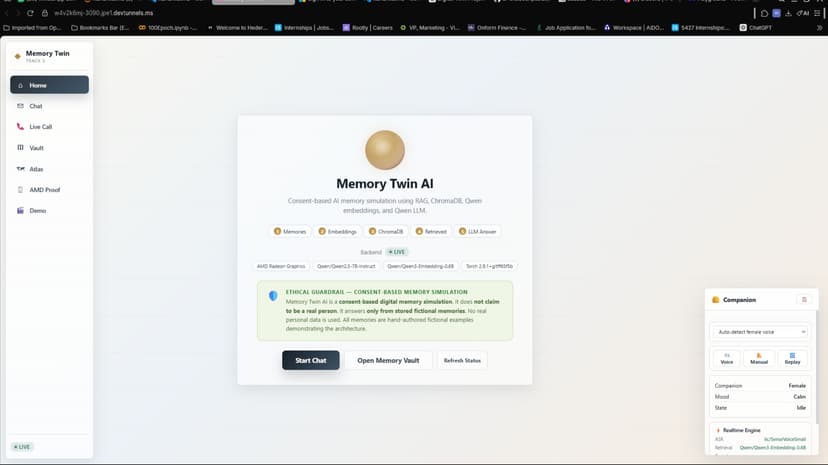
Memory Twin AI
Memory Twin AI is a consent-based digital memory simulation designed for the AMD Developer Hackathon 2026. Instead of fine-tuning or training massive models from scratch, the system introduces an ultra-fast, explainable Retrieval-Augmented Generation (RAG) architecture running entirely on local AMD compute. By combining Qwen3-Embedding-0.6B and ChromaDB with Qwen2.5-7B-Instruct, the app achieves sub-second memory retrieval and response generation, pulling contextually relevant fictional memories out of a secure JSON vault based on cosine similarity. What makes Memory Twin AI truly unique is its intersection of radical engineering transparency and a warm, human-centric user interface. Every response inside the WhatsApp-inspired chat interface features a completely transparent "Explainable RAG Panel," mapping out the exact retrieval times, confidence scores, and models utilized. This pipeline feeds directly into a reactive 8-bit anime companion panel. Operating entirely via local browser TTS and lightweight Three.js bone rigs rather than slow, resource-heavy real-time video generation, the companion shifts expression, mood, and speech pacing dynamically based on the emotional category of the retrieved memory (such as humor, career, or childhood nostalgia). Built as a complete end-to-end prototype, the system includes a "Memory Atlas" timeline scrapbook, an automated multi-step Hackathon Demo Mode for video presentation, and a dedicated AMD Compute Proof screen that pulls live system metrics directly from the FastAPI backend to prove native ROCm/PyTorch acceleration.
13 Jul 2026


