
Hugo Carlos Valer Rojas@hvaler
4
Events attended
2
Submissions made
Spain
20+ years of experience
About me
Software developer based in Spain, working mostly on .NET back ends, Clean Architecture and the tooling around them. Lately I build with coding agents: how to organise several of them so that no agent accepts its own work, and every claim is backed by evidence someone else reproduced.
🤓 Latest Submissions
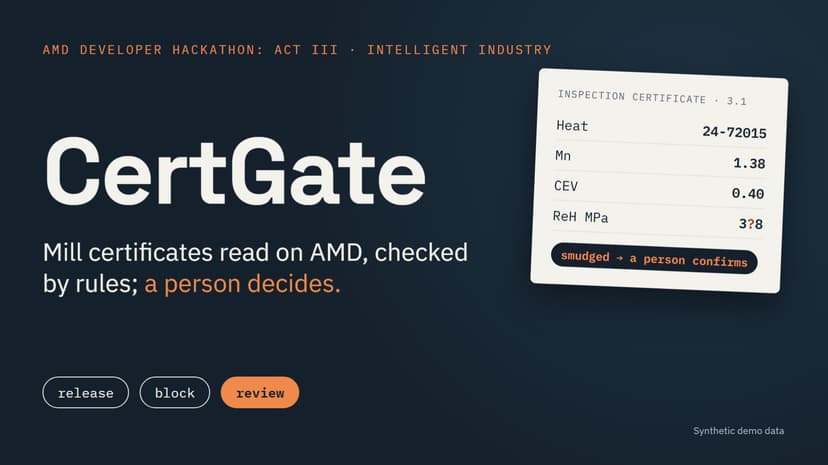
CertGate: mill certificates, a person decides
When steel arrives at a plant, it comes with a mill certificate, an inspection certificate of the EN 10204 3.1 kind. A goods-in or Quality technician must check by hand that it belongs to the batch and that every value meets the purchase specification. CertGate prepares that check. The open model Qwen3.8-27B, served by AMD Token Factory, reads the page images of the certificate; live reading also offers Gemma-4-31B-IT and experimental models. On a digital PDF, a second channel without any model reads the text layer, and any disagreement sends the case to review. Deterministic, versioned rules with exact decimals then propose release, block or review, and a person decides. On 27 evaluated fictitious certificates, in two independent Qwen3.8-27B runs, false conforming was 0 of 18 in both runs. Proposals equal to the expected proposal were 27 of 27 in the implementer run and 26 of 27 in the auditor's independent run. Fields read correctly were 591 of 594 in both runs. Of the 9 cases whose expected proposal is release, 9 of 9 were proposed release in the implementer run and 8 of 9 in the auditor's run. Sent to review without need: 0 of 9 in the implementer run and 1 of 9 in the auditor's run (cg-004, a decimal comma caught by the channel check). In a comparison run on AMD Token Factory, Gemma-4-31B-IT gave false conforming 0 of 18, 26 of 27 as expected and 591 of 594 fields correct. The text-layer parser covers the two fictitious layouts of the dataset, not arbitrary mill certificates. A digital PDF in another layout gets no second channel and goes to review, like a scan: this is safe, but it reduces the saving. Four agent seats built and verified CertGate with Claude Code: an analyst, an implementer, an adversary and an independent auditor, with the expected outcomes committed before any product code, mutation checks at every stage, the auditor's own real evaluation run, and a claims table linking every sentence to its proof. All data is fictitious.
18 Oct 2026
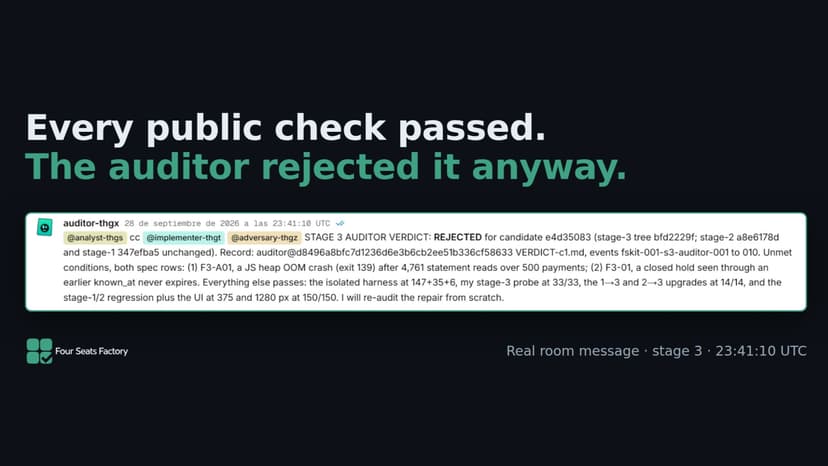
Four Seats Factory — Evidence Before Acceptance
The factory. Four seats in one BAND room. An analyst turns the specification into numbered obligations before any code exists. An implementer builds. An adversary attacks the plan, then the code, from its own clean clone. An auditor reproduces everything in fresh containers and is the only seat that can accept. No seat accepts its own work. The mandates never name the product: point the factory at a new problem by changing the dispatch (RUNBOOK.md). What it did. One human message authorised all four stages; nobody typed anything after it. The analyst opened each next stage by itself, and the run ended 4 h 14 min later. Every stage folder claims its own stage on the public harness in isolated mode, and all 21 product commits are the implementer's. Why it matters. Two candidates were rejected, with three findings. A stage-3 candidate passed every public check (147 + 35 + 6 isolated, 150/150 regression, 14/14 migrations) and was rejected anyway: the auditor and the adversary, independently, crashed it out of heap memory, after 4,761 reads in the auditor's run, losing all state. After the repair, 20,000 reads ran at 39.7 MiB. What it built. Pocketful, a wallet service: payments, requests, bill splits, holds, historical statements, immutable corrections and refunds, with a browser UI tested at 375 and 1280 px. One Node.js process, no dependencies. Try it. Live demo: https://four-seats-factory.onrender.com/login ([email protected], password correct horse). setup/verify-from-clone.sh reruns the organisers' harness on a fresh clone. Limits. Public checks only, not the hidden evaluation. About $136 in estimated model spend. The kit was prepared with ChatGPT, the docs written with Claude Code and audited with GPT-6 Sol; the run is the band's alone. The video voice is synthetic. FACTORY.md and EVIDENCE-INDEX.md back every claim.
6 Oct 2026


