🤓 Latest Submissions

Tripwire Sandbox
Finance teams want agents that write code to reconcile vendor bills against payments, but model-written code is untrusted. Tripwire Sandbox runs every piece of agent-generated code in a fresh Docker container with no network, no secrets or env, a read-only filesystem plus a small tmpfs, and memory, CPU, PID and time caps. The container is destroyed after each task. When the code fails, the agent feeds the error back to the model and retries. The reconciliation output (matches, short payments, duplicates, unknown-vendor payments, unpaid bills) becomes proposed payments, which pass a deterministic policy gate and then wait for a CFO's approval. Denied payments can't be approved, and no payment rail is connected, so approvals record intent only. The containment demo has the agent's code try DNS, TCP and HTTP exfiltration, read env secrets, write to the root filesystem, fork-bomb and spin forever. Every attempt is blocked and logged. LLM calls use an OpenAI-compatible client pointed at Vultr Serverless Inference, and deploy/deploy_vultr.sh targets a Vultr Cloud Compute Ubuntu VM with Docker Compose. HONEST STATUS: submitted in MOCK mode. The Vultr inference integration and the Vultr deploy script are implemented but were NOT run live, because no Vultr credit was available. The app is NOT deployed on Vultr. The demo uses a clearly labelled offline mock model. The public link is a free Vercel host with no Docker, so it replays sandbox results recorded from a real local Docker run (labelled SANDBOX: REPLAY). The video was recorded against a local run with real Docker containers.
8 Nov 2026
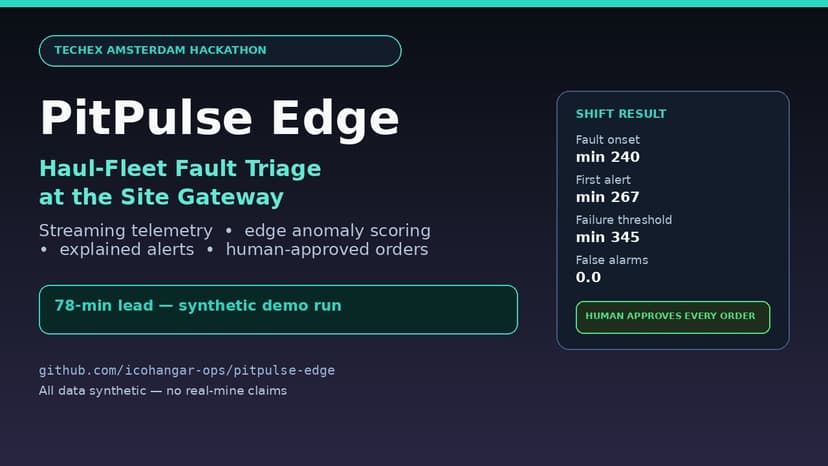
PitPulse Edge — Haul-Fleet Fault Triage
A single unplanned haul-truck failure can strand a loaded truck on a ramp and cost hours of ore movement, yet no one can watch dozens of signals across a whole fleet at once. PitPulse Edge is an edge-style triage board for a mine maintenance lead: a synthetic telemetry simulator streams six haul trucks over a 480-minute shift (temperatures, vibration, tyre pressure, hydraulic pressure, fuel and cycle times) with ground-truth fault injection, and lightweight CPU-only models that could run on a site gateway — per-signal calibrated z-scores plus an IsolationForest — score every truck every minute from 0 to 100. Each alert explains itself in plain language from the actual signal contributions (for example, vibration 6.0 sigma above normal), never from a free-text model, and a human dispatcher approves or dismisses a drafted work order (inspect or replace, urgency, parts hint) written to an append-only, hash-chained decision log. In the default synthetic bearing-overheat run the fault starts at minute 240, PitPulse first alerts at minute 267, the failure threshold is crossed at minute 345 — a 78-minute lead — with a 0.0 false-alarm rate on healthy trucks and an estimated $38,250 of avoided downtime from the shown formula (6.0h unplanned minus 1.5h planned, at an editable $8,500/hour). All data is synthetic with published generator assumptions; no real mine is claimed. The board replays the whole shift, ranks alerts by risk, and produces the shift report, so the value is measurable without sending raw telemetry to a cloud LLM. Buyer: the maintenance lead at a miner or mining contractor, priced per site gateway. Public MIT repo, 36 pytest tests, Streamlit demo.
19 Oct 2026
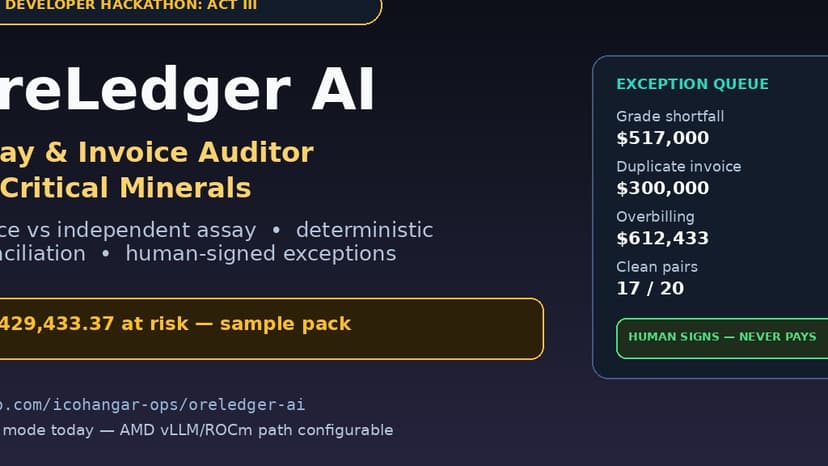
OreLedger AI — Assay & Invoice Auditor
A small critical-minerals buyer can pay for metal that was never delivered: a supplier invoice priced at a claimed 22% grade, while the independent assay certificate says 18%, is a $517,000 gap on one shipment, usually found weeks later in a spreadsheet. OreLedger AI ingests invoice and assay-certificate pairs, extracts supplier, invoice number, metal, weight, grade and price terms with an open model on the intended AMD path (vLLM/ROCm on AMD Developer Cloud, or the event TokenFactory API, both OpenAI-compatible and configured by environment variables), then recomputes the payable amount deterministically — payable = weight x assay grade x payable % x price — within ±0.5pp grade and ±1% amount tolerances, with duplicate-invoice detection. Clean pairs auto-match; only exceptions reach a human, who approves, rejects, or requests evidence, with every decision written to an append-only, hash-chained audit ledger. The agent never pays and never emails a supplier. In the committed synthetic 40-document pack (20 invoices + 20 assays, ground truth included), 17 pairs match clean and 3 exceptions carry $1,429,433.37 of cash at risk: grade shortfall $517,000, duplicate $300,000, overbilling $612,433.37 (sample data, not a customer claim). Honest status: the TokenFactory key is pending the organiser ("email not registered for API key distribution"), so the judge-ready demo runs in clearly badged fixture mode today, with the AMD endpoint and benchmark harness ready to point at AMD the moment the key is issued; no GPU benchmark numbers are claimed. Buyer: CFO/controller at a junior miner or metals trader, priced per reconciled shipment. Public MIT repo, 5 pytest tests passing, CLI and Streamlit demos.
18 Oct 2026
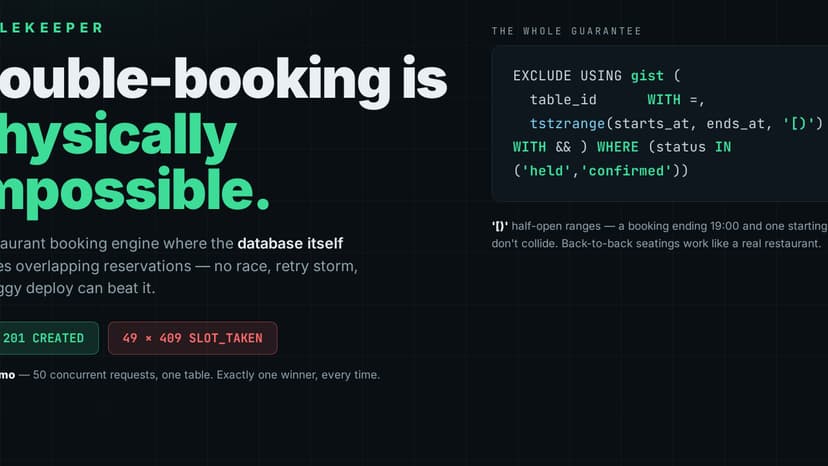
Tablekeeper: Double-Booking Is Impossible
Reservation systems double-book by accident — two guests, one table, an apology email. Tablekeeper moves the guarantee out of application code into the database: overlapping bookings on the same table cannot be committed, no matter what the app does. No retry storm, race, or buggy deploy can beat the storage engine's refusal. The whole guarantee is one partial exclusion constraint: EXCLUDE USING gist ( table_id WITH =, tstzrange(starts_at, ends_at, '[)') WITH && ) WHERE (status IN ('held','confirmed')) The half-open '[)' range keeps it honest: a booking ending 19:00 and one starting 19:00 don't overlap — back-to-back seatings work like a real restaurant. As strict as reality, not stricter. Proven live, not in slides: /kill-demo fires 50 real concurrent HTTP requests at one table. Verdict, every time: 1×201 CREATED, 49×409 SLOT_TAKEN. A 12-way stampede sharing one idempotency key yields one reservation; a reused key with a different payload is refused 422. Every push runs an adversarial suite: 50-way races, hold expiry, cancel-vs-confirm, DST boundaries, soak — 28/28 green on embedded Postgres and postgres:16. A separate 9-probe red team attacks the live HTTP surface: RED TEAM FAILED TO BREAK IT, zero 5xx. This is Dark Factory: a band of coding agents built the product, and the factory checks itself. ShipScore, our open-source gate, scores Design/Ship/Run/Secure/Test and blocks merges below threshold — 100/100 (A) from day one, after honestly failing our first run until we fixed the bug it caught. The product is real: TTL holds with countdown, idempotent-replay button in the UI, guest self-cancel that frees the slot instantly, DST-aware service hours, append-only audit trail. One dialect, two engines: PGlite (embedded Postgres 17) locally, serverless Postgres (Neon) in production. Next.js 16 + TypeScript + Vercel. Paste one connection string — double-booking becomes impossible for you too.
6 Oct 2026
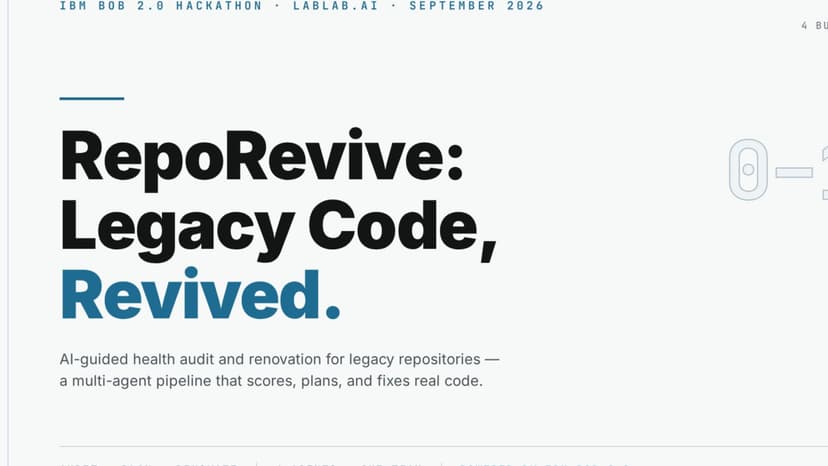
RepoRevive — AI Code Audit & Renovation Platform
THE PROBLEM Most of the world's software is legacy. Teams inherit repositories with outdated dependencies, hidden CVEs, near-zero test coverage, and architecture that exists only in the heads of developers who left long ago. Onboarding onto such a codebase takes weeks, and refactoring it is a gamble because nobody knows which files are safe to touch. Today's static-analysis tools flood you with raw linter warnings: they cannot prioritize, cannot explain, and cannot fix anything. OUR SOLUTION RepoRevive is an AI-guided code renovation platform built on IBM Bob 2.0 multi-agent orchestration. You paste a GitHub URL and RepoRevive runs three orchestrated phases: 1) AUDIT — The Inspector agent clones the repository, parses the code with tree-sitter AST analysis, scans dependencies, tests and coverage, and produces a 0–100 health score across six weighted dimensions, an auto-generated architecture diagram, and a risk heatmap that ranks files by churn × complexity × test gap. 2) RENOVATION PLAN — The Architect agent converts the audit into a prioritized, dependency-ordered backlog of small, verifiable tasks, each with rationale and acceptance criteria. 3) GUIDED RENOVATION — The Executor agent completes tasks one by one, a Validator agent reviews every change, and the health score refreshes live, so you watch the score climb with each fix. TARGET USERS & INTERACTION Maintenance teams, new hires inheriting unfamiliar repositories, open-source maintainers, and agencies taking over client codebases. They interact through a Next.js dashboard: paste a URL, watch the agent team work in a live activity feed, explore the score breakdown, architecture map and heatmap, approve or reorder the plan, then execute fixes with one click while the dashboard quantifies every improvement. WHAT MAKES IT CREATIVE & UNIQUE RepoRevive is not a chatbot bolted onto a linter. It coordinates a specialized agent team — Inspector, Architect, Executor, Validator — through Bob 2.0's agent mode, parallel subagents and full-repo context. Every finding is traceable to specific code evidence, and every outcome is measured by a transparent six-dimension score. The loop of audit → plan → fix → re-score turns an open-ended chore into a guided, measurable renovation track. WHY IT IS EFFECTIVE What normally takes weeks of manual archaeology becomes a minutes-long audit plus days of guided, verified fixes — with measurable, visible results and zero guesswork about where to start.
27 Sep 2026
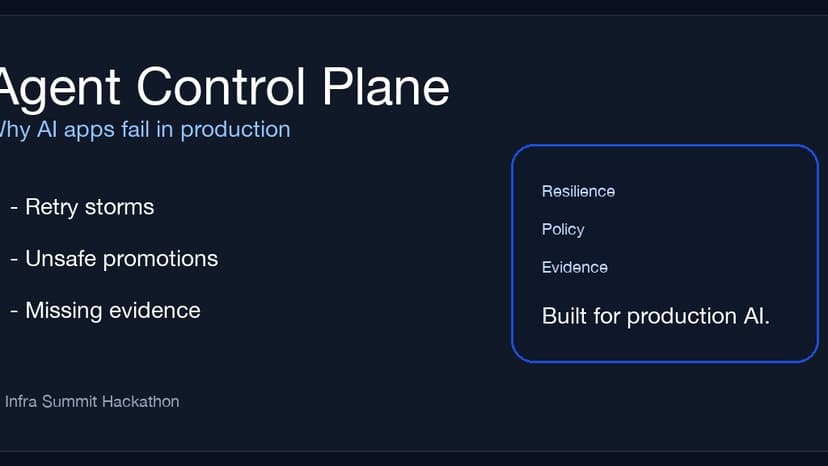
SovereignMesh: Agent Control Plane
SovereignMesh is an enterprise-grade agent control plane built for high-stakes AI operations. It applies zero-trust access control, adversarial consensus, and runtime policy checks to decisions made by autonomous agents before they can affect systems, finances, or infrastructure. The platform uses ReBAC-style authorization, a Consensus Hardening Protocol, and model-armor checks to evaluate proposals, challenge weak reasoning, and lock decisions only when confidence and evidence meet policy thresholds. The project includes a live runtime shield, auditable decision traces, and demo flows that show how agent actions can be governed instead of blindly executed. It is designed for teams that need AI agents to operate with the same controls, reviewability, and accountability as critical production systems. The result is a practical control layer for safe agentic workflows in regulated or mission-critical environments.
16 Sep 2026
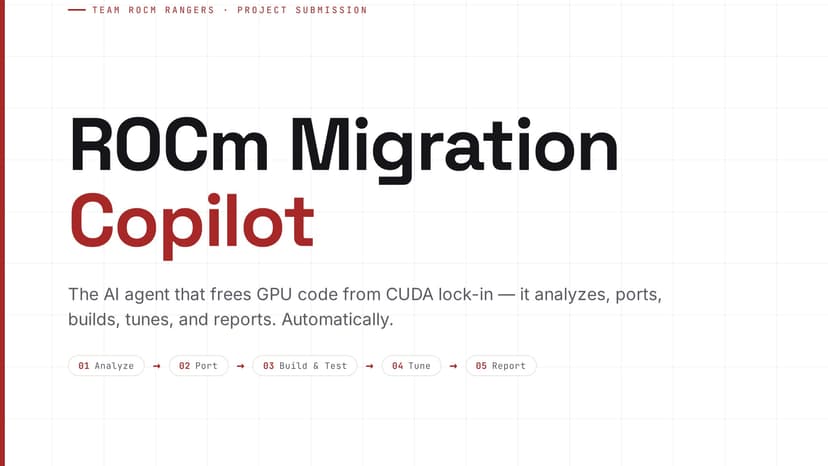
ROCm Migration Copilot: AI CUDA-to-HIP Agent
Millions of lines of production GPU code are locked inside CUDA — and as AI compute demand explodes, developers are looking for an escape hatch into AMD's open ROCm ecosystem. The blocker: porting CUDA to HIP by hand is slow, error-prone, and requires rare expertise in both platforms. ROCm Migration Copilot turns a multi-week manual port into an afternoon. Feed it a CUDA repository and it runs a five-stage agentic pipeline: (1) deep codebase analysis, building a kernel inventory and dependency graph with AST parsing; (2) AI-assisted porting that translates CUDA APIs, kernels, and memory management to HIP, intelligently handling the long tail that hipify-perl misses; (3) automated build and test on real AMD GPUs; (4) a performance-tuning advisor driven by Omniperf and Omnitrace insights; (5) a migration report with confidence scores for every change. The stack is AMD end to end — ROCm, HIP, and AMD Developer Cloud MI300X instances — powered by an agentic LLM core with tool calling, RAG over ROCm documentation, and self-healing fix loops, orchestrated in Python and LangGraph. Everything ships open source. This project is designed for the AI Academy Challenge's highest-weight XP categories head-on: built on AMD technology, a complete working project, open-sourced, with monthly milestone drops and public demos through December. The goal is not a demo — it is a developer tool the ROCm community can actually use.
1 Dec 2026
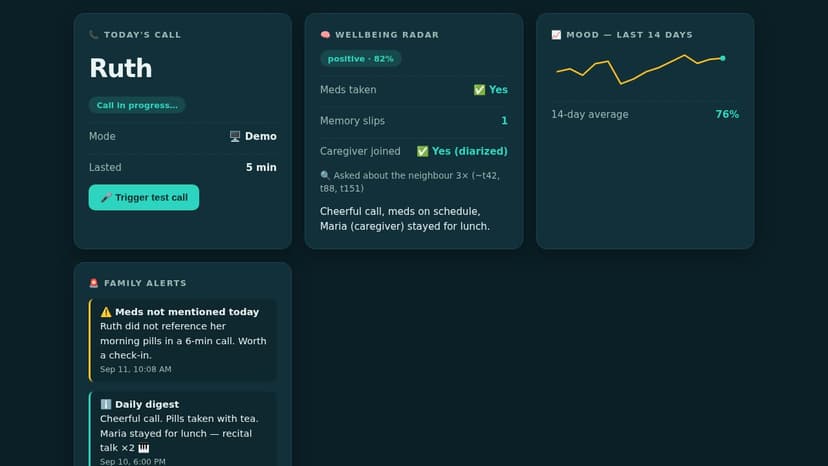
EverCall — Jarvis for Grandma
Half of adults over 65 report chronic loneliness, and the average adult child calls their aging parent less than once a week. When they do, one polite "I'm fine" hides everything that matters — missed medications, early cognitive decline, social isolation. The daily phone call is the single richest, cheapest health signal families are not capturing. EverCall is a voice agent that places a scheduled daily call to your elderly parent and holds a warm, natural conversation — how the grandkids are doing, the neighbor's cat, whether she took her pills. It uses AssemblyAI's Universal-3.5 Pro Realtime for streaming speech-to-text with endpointing tuned for slower, warmer speech patterns, then passes the full transcript to LeMUR for post-call analysis. The family dashboard — "the Radar" — surfaces a wellbeing report after every call: mood score via sentiment analysis, medication adherence tracking, memory slip detection (repeated questions), and caregiver presence via speaker diarization. When something feels off, an instant alert goes to the family. The demo runs entirely in the browser: press Trigger Test Call, a simulated "grandma" chats with the agent, and you watch the radar light up in real time. Built with Next.js 15, TypeScript, AssemblyAI (Realtime STT, LeMUR, Sentiment, Diarization), and a zero-dependency SVG sparkline for the 14-day mood trend.
30 Sep 2026
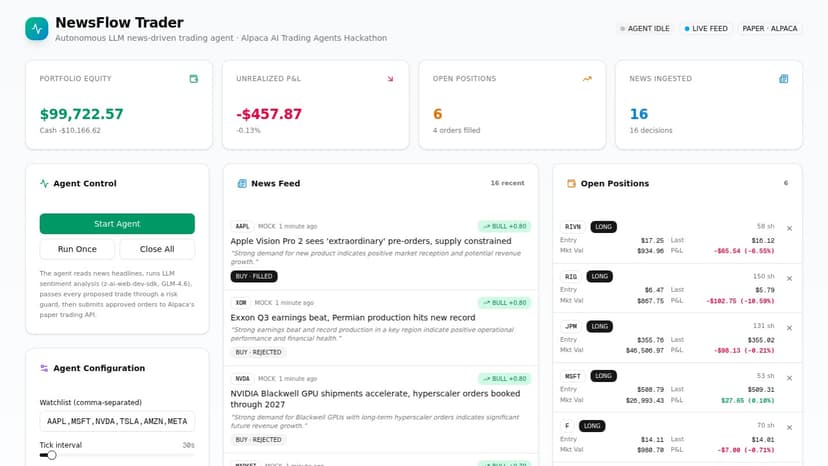
NewsFlow Trader
NewsFlow Trader is an autonomous LLM-driven trading agent built for the Alpaca AI Trading Agents Hackathon. It reads financial news headlines about a configurable watchlist of 10 tickers (AAPL, MSFT, NVDA, TSLA, AMZN, META, GOOGL, JPM, XOM, SPY), runs each through GLM-4.6 via z-ai-web-dev-sdk for structured JSON sentiment ({label, score, confidence, reasoning}), passes every proposed trade through a configurable risk guard (max positions, max position %, sentiment threshold, paper-only enforcement), and submits approved orders to Alpaca's Trading API in paper mode using @alpacahq/alpaca-trade-api v4. The pipeline runs in a Bun mini-service on port 3003 that streams every decision as a typed socket.io event to a live Next.js 16 dashboard. Judges watch TICK → NEWS → LLM → ORDER → FILL events arrive in real-time alongside the positions and P&L they generate. The dashboard ships with sliders to tune the watchlist, tick interval (15–300s), max positions (1–20), max position % (1–25%), and sentiment confidence threshold (0.30–0.95) live. The risk guard hard-refuses live orders and blocked 8 orders during our live run, including SELLs on positions the agent didn't hold and BUYs that would exceed the 5-position cap. We verified the agent end-to-end against a real Alpaca paper account during market hours on Aug 28, 2026. The agent autonomously submitted 13 paper orders that filled at real market prices (incl. 1 SELL that closed an NVDA long on bearish news), opened 6 concurrent positions, and generated a machine-readable proof artifact (download/live-trading-proof.json) with every filled order's order_id, filled_avg_price, created_at, and filled_at plus a full account snapshot. The build also includes a 2:43 demo video, 1280×720 thumbnail, 4-minute judge walkthrough script, and a live dashboard screenshot. Mock Alpaca + mock news fallbacks kick in when no API keys are set, so judges can clone and run with zero credentials — every other piece works out of the box.
4 Sep 2026


