🤓 Latest Submissions

PatchPilot — Dependency-Upgrade Autopilot
The problem. Automated dependency PRs (Dependabot, Renovate) only bump a version number — they don't fix the code the new version breaks. So those PRs pile up unmerged, security patches lag for weeks, and every major upgrade burns hours of manual, repetitive fixing. Detection is a solved problem; remediation is not. The solution. PatchPilot is an agentic dependency-upgrade autopilot. It runs the whole upgrade as a pipeline: it copies the repo, performs the naive upgrade, maps every place the dependency is used across the entire codebase, loads the migration rules, spawns one subagent per module to fix the breaking changes in parallel, verifies the result against the test suite, and produces a merge-ready pull request with migration notes and a before/after report. Target users & interaction. It's built for software teams and maintainers drowning in dependency PRs. They point PatchPilot at a repo (a sample project or a real monorepo) and hit Run in the web console; a live log streams the pipeline as it works, and the results panel shows before/after test counts, the per-module subagents, the dependency footprint, and every change it made — labelled "auto" (mechanical) or "Bob" (semantic). What makes it unique. Most tools stop at detection. PatchPilot does the remediation and proves it: every run ends on a green build, or an honest "needs_bob" flag for changes that can't be made safely by rule alone — it never fakes green. A config file adapts it to any repo layout and verify command (tests or type-check). Impact. On our demo (Express 4 → 5), a naive bump crashed all three services (0 tests passing). PatchPilot applied 6 fixes across 3 services and drove the suite to 11/11 passing — in seconds instead of hours. When IBM Bob performed the same migration end-to-end, it cost ~1.41 Bobcoins: a full major-version upgrade, verified, for a fraction of the manual effort.
27 Sep 2026
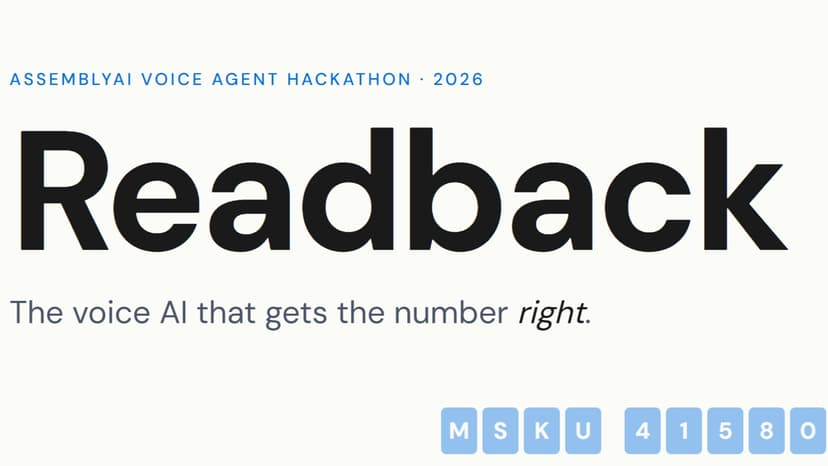
Readback — voice AI that gets the number right
Call centres, logistics dispatchers, insurance agents and hospital staff read reference numbers over the phone dozens of times a day. In noise, 5 sounds like 9, M like N, S like F. One wrong character means a container ships to the wrong port, a payment gets reversed, or medication reaches the wrong patient. People cope by asking "Bravo for B or Delta for D?" for every character — losing 15 to 20 seconds per number and 30 percent of operator throughput. Readback listens in the background and knows what shape a reference number must take. Container numbers satisfy the ISO 6346 check digit. IBANs give mod-97. Cards give Luhn. This constraint does not improve the microphone — it multiplies the error budget the system can tolerate by 15×, measured across 12 million simulated calls in eight accents. Two thirds of the time Readback silently corrects a misheard character and shows the difference on screen. When it cannot, it asks about one character — once — and goes quiet again. The transcript is not stored. What comes back is the confirmed number and a count of how many times the conversation was interrupted. Built solo in 24 days: FastAPI + PostgreSQL backend, React + TypeScript frontend with a live AudioWorklet-to-PCM16-to-WebSocket audio path, AssemblyAI Universal-3.5 Pro Streaming with keyterm biasing and LLM Gateway. Deployed with a full admin panel, immutable audit log, tri-lingual interface (English, Uzbek, Russian), and 180 automated tests. Live: https://readback-eight.vercel.app · Try the pipeline on shipped fixtures: /demo
30 Sep 2026

