
🤝 Top Collaborators


🤓 Latest Submissions
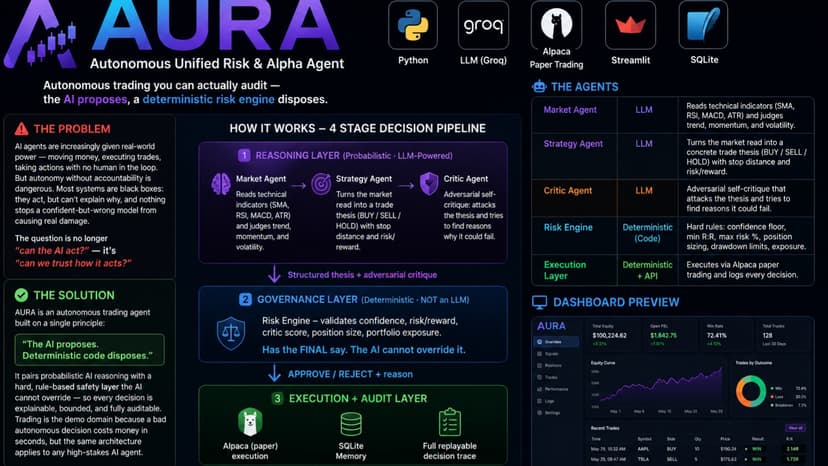
Autonomous Unified Risk & Alpha Agent
**AURA (Autonomous Unified Risk & Alpha Agent)** is an autonomous AI trading agent designed to make trading decisions that are explainable, bounded, and fully auditable. It combines probabilistic LLM-powered reasoning with a deterministic risk engine that the AI cannot override. For every trading opportunity, AURA uses a four-stage pipeline: the **Market Agent** analyzes technical indicators such as SMA, RSI, MACD, and ATR; the **Strategy Agent** develops a BUY, SELL, or HOLD trade thesis; the **Critic Agent** performs adversarial self-critique by actively attempting to identify weaknesses in the proposed trade; and finally, the **Deterministic Risk Engine** independently validates confidence, risk/reward, position size, and portfolio exposure before approving or rejecting the trade. Approved decisions can be executed through the **Alpaca paper-trading API**, while every decision—including rejected trades—is stored in SQLite as a replayable audit trail. Built with **Python, Groq LLMs, Alpaca, Pandas, SQLite, and Streamlit**, AURA also includes a dashboard for monitoring autonomous trading activity. The project is designed as a research prototype demonstrating how AI agents can operate safely in high-stakes environments by separating AI reasoning from deterministic governance.
4 Sep 2026

Noob_Router
Our project is a hybrid token-efficient AI agent designed to maximize accuracy while minimizing inference cost. Instead of sending every request to a large cloud model, the system intelligently routes each task through a multi-stage decision pipeline. Every request is first processed by a lightweight local LFM model running entirely inside the container, resulting in zero cloud token usage. The response is then evaluated using task-specific validation, confidence estimation, and self-consistency checks. If the local answer is considered reliable, it is returned immediately. Only low-confidence or complex tasks are escalated to the Fireworks AI API, where the router dynamically selects the most cost-effective model from the allowed runtime models. The agent supports a diverse set of capabilities, including factual question answering, mathematical reasoning, sentiment classification, text summarization, named entity recognition, code debugging, logical reasoning, and code generation. Each category uses specialized prompts and validation rules to improve accuracy while keeping responses concise. The system also minimizes token consumption through prompt compression, category-specific generation limits, and adaptive routing decisions.
13 Jul 2026


