
Hamna Munir@HamnaMunir
11
Events attended
10
Submissions made
1 year of experience
About me
I am an aspiring AI/ML Engineer and Software Engineering student with hands-on experience through an AI/ML internship. My skills span machine learning, deep learning, generative AI, data engineering, and MLOps. Passionate about solving real-world problems with AI, I am building a strong portfolio of projects while preparing to grow into industry-level roles. I value continuous learning, collaboration, and contributing to innovative technology solutions.
🤝 Top Collaborators



🤓 Latest Submissions

LampLighter
LampLighter is an AI-powered coding agent built with Streamlit and Groq that follows a structured Coordinator–Builder–Verifier workflow. The Coordinator analyzes a task and creates an implementation plan, the Builder generates the required code and tests, and the Verifier runs the solution again on a clean copy to validate its correctness before accepting or rejecting it. Designed as a lightweight and accessible developer tool, LampLighter can run locally or be deployed for free using Streamlit Community Cloud, while automatically handling retries for Groq's rate limits. It provides a practical approach to AI-assisted software development by combining planning, code generation, automated testing, and independent verification into a single workflow.
6 Oct 2026

EmergencyTwin Voice - 3D digital twin that talks
Most emergency evacuation decisions are made with a static floor plan and guesswork — nobody has a real-time view of which routes are actually safe, and there's no easy way for someone inside the building to ask for help hands-free during a crisis. EmergencyTwin AI turns a building into an interactive 3D digital twin, wired directly to a voice agent. Say what's happening, and the building responds — for real. Blocking an exit by voice actually blocks it in the route graph; every occupant near that exit gets a new route, live, in the 3D view. The whole app is one self-contained index.html (vanilla JavaScript + Three.js — no framework, no build step) plus a single Vercel serverless function that mints a short-lived AssemblyAI token, so the real API key never reaches the browser.
30 Sep 2026

Repo Onboarding & Risk Assistant
THE PROBLEM Unfamiliar codebases are slow and risky to understand. New developers can spend days reading code before contributing meaningfully. Heavily depended-on “load-bearing” files can be difficult to identify. Small changes to critical modules can affect unrelated parts of the system. Missing tests and documentation may remain unnoticed until something fails. Existing AI coding assistants mainly handle one question at a time rather than building a structural understanding of the repository. THE SOLUTION Repo Onboarding & Risk Assistant is a workflow tool built with IBM Bob that turns a GitHub repository into a structured understanding. Paste a GitHub repository URL. Click Scan Repo. Bob performs a multi-step analysis of the actual codebase. Maps the repository architecture and identifies high-dependency / blast-radius modules. Calculates codebase health metrics. Flags risky files before changes are made. Detects missing tests and documentation. Offers first drafts for missing documentation. Generates a concise 5-minute onboarding brief. TARGET USERS 👨💻 Software teams onboarding new engineers 🌐 Open-source maintainers 🔍 Developers inheriting unfamiliar codebases 🛠️ Developers auditing existing projects HOW IT WORKS Paste GitHub URL Scan Repo Architecture Summary Risk Flags Missing Docs & Tests Onboarding Brief WHAT MAKES IT UNIQUE Goes beyond a single AI Q&A interaction. Uses Bob as an embedded reasoning engine inside a developer workflow. Chains multiple repository-analysis tasks together. Reasons over the actual codebase, rather than using a generic template. Designed to mirror how a senior engineer approaches codebase onboarding. Not just a generic chatbot wrapper. EFFECTIVENESS Tested on a real repository: 12 Python modules 1,576 lines of code 51 functions 35/100 codebase health score 17% test coverage 33% docstring coverage 62% risk concentration Analysis generated within seconds IMPACT ⏱️ Reduces time spent understanding unfamiliar repositories. ⚠️ Surfaces risky areas before code changes. 🧪 Makes missing tests and documentation visible. 🚀 Helps new contributors understand where to start. 🛡️ Helps teams identify potential problems earlier.
27 Sep 2026
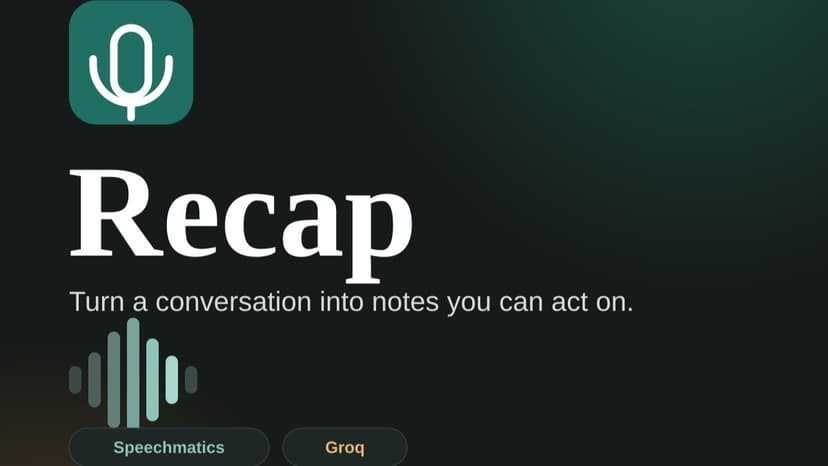
Recap - Turn a conversation into notes
Recap is a voice-driven notetaking assistant built for the AI Infra Summit Hackathon that turns any spoken conversation — a standup, an incident call, a planning session — into notes you can actually act on. Instead of asking someone to type furiously while everyone else talks, Recap listens. It streams live, real-time transcription of the conversation straight to the screen using Speechmatics' real-time speech-to-text API, showing partial words settle into a final transcript as people speak, so nothing has to be reconstructed from memory afterward. The moment the conversation ends — or at any point during it — a single click sends that transcript to Groq, which reasons over the raw text and returns a fully structured recap: a concise summary, the key points that were actually discussed, action items paired with their owners, decisions that were made, and any open questions that were left unresolved. Rather than leaving a team to skim a wall of transcript, Recap organizes it automatically into the exact shape a team actually needs after a call. Beyond the static recap, Recap also lets anyone query the conversation directly through a built-in ask box: instead of scrolling back through the whole transcript to find out what was decided about a rollout or who owns a follow-up, you can just ask, and Groq answers using only what was actually said in that conversation — grounded, not guessed. The entire experience lives in a single, dependency-light web page: no backend server to deploy, no database to maintain, just a browser tab that can record live audio or accept a pasted transcript, generate notes, and answer questions in real time. Built by Mirza Yasir Abdullah Baig, Hamna Munir, Tayyeba Saleem, Zainab Khan, and Sheikh Abdul Rehman, Recap demonstrates what's possible when a fast real-time transcription layer (Speechmatics) is paired with a fast structured-reasoning layer (Groq)
16 Sep 2026
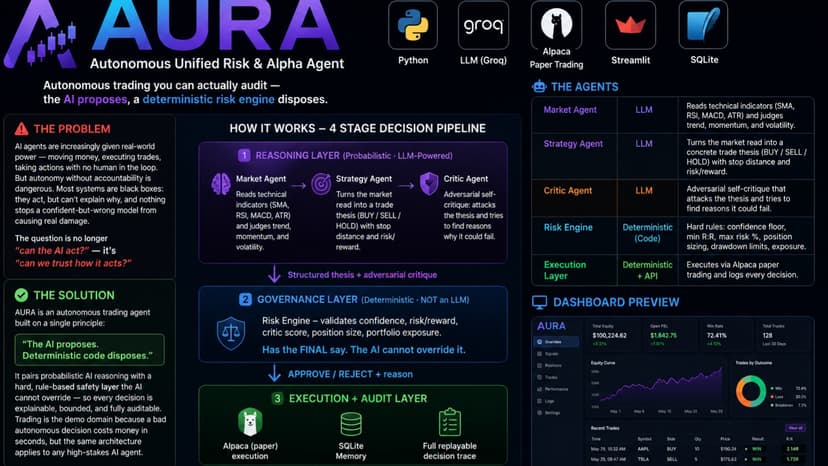
Autonomous Unified Risk & Alpha Agent
**AURA (Autonomous Unified Risk & Alpha Agent)** is an autonomous AI trading agent designed to make trading decisions that are explainable, bounded, and fully auditable. It combines probabilistic LLM-powered reasoning with a deterministic risk engine that the AI cannot override. For every trading opportunity, AURA uses a four-stage pipeline: the **Market Agent** analyzes technical indicators such as SMA, RSI, MACD, and ATR; the **Strategy Agent** develops a BUY, SELL, or HOLD trade thesis; the **Critic Agent** performs adversarial self-critique by actively attempting to identify weaknesses in the proposed trade; and finally, the **Deterministic Risk Engine** independently validates confidence, risk/reward, position size, and portfolio exposure before approving or rejecting the trade. Approved decisions can be executed through the **Alpaca paper-trading API**, while every decision—including rejected trades—is stored in SQLite as a replayable audit trail. Built with **Python, Groq LLMs, Alpaca, Pandas, SQLite, and Streamlit**, AURA also includes a dashboard for monitoring autonomous trading activity. The project is designed as a research prototype demonstrating how AI agents can operate safely in high-stakes environments by separating AI reasoning from deterministic governance.
4 Sep 2026
PayGuard - Know who you're invoicing
PayGuard Know who you're invoicing before you send the quote. PayGuard is a risk-assessment tool for freelancers and independent contractors. Type what you know about a prospective client — payment history, communication style, anything you've heard — and PayGuard analyzes it for concrete red flags, assigns a risk level, and, when the risk is real, drafts a protective email proposing safer payment terms before you start work. Built for AI Factory — Native.builder Hackathon (lablab.ai × NativelyAI), August 2026. The problem Freelancers and small agencies routinely take on clients who turn out to be slow payers, non-payers, or difficult to work with — and there's rarely a fast way to check a client's reputation before committing time and effort. PayGuard gives freelancers a quick, structured way to sanity-check a new client using whatever information they already have. Who it's for Freelancers, contractors, and small agencies (dev, design, writing, consulting) vetting a new client before signing on. How it works Enter a client name and describe what you know about them — a warning from another freelancer, notes from a call, anything relevant. A Supabase Edge Function sends this to an AI model (via Groq), which: Extracts only concrete red flags actually present in the text (never invents risk that isn't there) Assigns an overall risk level: Low / Medium / High / Insufficient Data Gives 2–4 practical recommendations If risk is Medium or High, automatically drafts a protective email proposing a deposit, milestone payments, or escrow Results are shown immediately — no login, no data saved, fully stateless. Tech stack native.builder — application platform, used to generate the UI, wire the Supabase backend, and deploy the app Groq — fast LLM inference for the risk-analysis step (llama-3.3-70b-versatile) Supabase Edge Functions — serverless backend that keeps API keys secure and off the client React + TypeScript + Tailwin Local development npm install npm run dev
10 Aug 2026
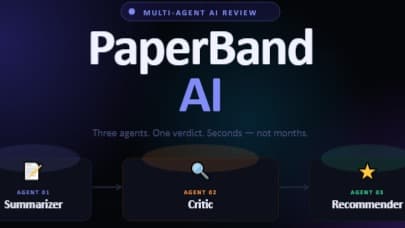
PaperBand AI
PaperBand AI is a multi-agent research paper review system built for academics, students, and conference organizers who need fast, structured feedback on academic work. Instead of waiting weeks for peer review, users simply upload any research PDF and three specialized AI agents go to work collaboratively. Agent 1 (Summarizer) reads the full paper and extracts the title, authors, research problem, methodology, key results, and conclusion into a clean structured format. Agent 2 (Critic) receives that summary through a shared Band Room message bus and performs a rigorous peer-review-style analysis — identifying strengths, weaknesses, missing experiments, and limitations. Agent 3 (Recommender) reads both the summary and critique, then scores the paper from 1 to 10 and issues a formal publication decision: Accept, Accept with Minor Revisions, Major Revisions Required, or Reject — with a written justification and future research suggestions. All three agents communicate through a custom BandRoom, a shared in-process message bus that simulates real agent collaboration. The entire pipeline runs on Groq's free LLaMA 3.3 70B model, making it blazing fast and completely free to use. The frontend is built in Streamlit with a custom dark academic UI, and the project is structured as a clean modular Python codebase with separate agent classes, a PDF reader utility, and secure API key management via dotenv. PaperBand AI was built in one day as a hackathon project by Team IDEA — a five-person team specializing in Data and Agentic AI.
19 Jun 2026
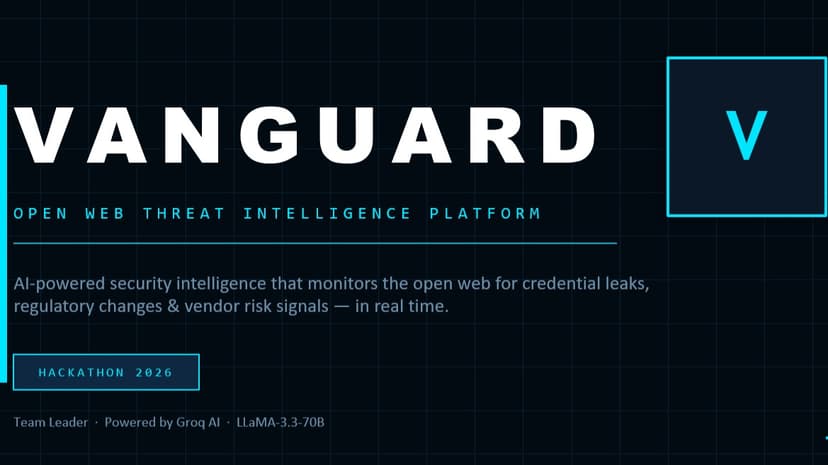
VanGuard - Open Web Theart Intelligence
VANGUARD is an AI-powered open web threat intelligence platform built to fill the blind spots that traditional security tools miss. While SIEMs and firewalls protect the perimeter, they can't see credential dumps on paste sites, silent regulatory updates, or vendor breaches spreading across the open web. VANGUARD solves this by running three parallel detection modules — a Threat Surface Monitor, a Regulatory Change Tracker, and a Vendor Risk Radar — that continuously scan the open web for signals relevant to your organization. All findings are fed into Groq's LLaMA-3.3-70B model, which classifies each alert by severity, extracts indicators of compromise, and generates actionable recommendations in under 30 seconds. Built with React and Vite on the frontend and deployed on Netlify, VANGUARD delivers a cinematic, real-time threat dashboard that turns raw open-web noise into a structured, severity-ranked intelligence report — giving security teams the early warning system they've always needed, powered entirely by AI.
31 May 2026

PromptGuard-AI
PromptGuard is an AI security platform built to protect LLM-based applications from adversarial prompts. It analyzes user inputs in real-time and classifies them as Safe, Suspicious, or Dangerous using Meta's llama-3.3-70b-versatile model running on Groq's ultra-fast inference API. What sets it apart is its RAG pipeline — organizations can upload their own security policies, which get chunked, embedded into 768-dimensional vectors using nomic-embed-text, and searched via cosine similarity at query time, so every verdict is grounded in your actual rules. It also includes a policy Q&A chatbot for natural language queries against your knowledge base. Built as a zero-dependency single HTML file and deployed on Netlify, PromptGuard requires no build step and goes live in under 60 seconds.
19 May 2026


