
🤝 Top Collaborators



🤓 Latest Submissions
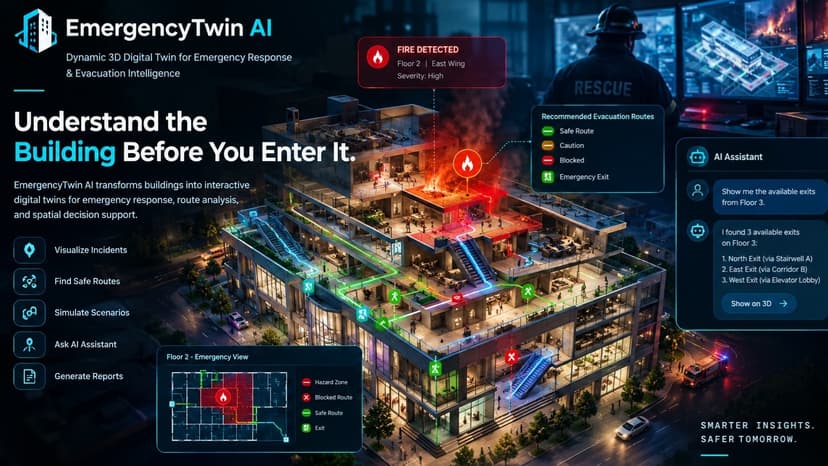
EmergencyTwin Voice - 3D digital twin that talks
Most emergency evacuation decisions are made with a static floor plan and guesswork — nobody has a real-time view of which routes are actually safe, and there's no easy way for someone inside the building to ask for help hands-free during a crisis. EmergencyTwin AI turns a building into an interactive 3D digital twin, wired directly to a voice agent. Say what's happening, and the building responds — for real. Blocking an exit by voice actually blocks it in the route graph; every occupant near that exit gets a new route, live, in the 3D view. The whole app is one self-contained index.html (vanilla JavaScript + Three.js — no framework, no build step) plus a single Vercel serverless function that mints a short-lived AssemblyAI token, so the real API key never reaches the browser.
30 Sep 2026
Recap - Turn a conversation into notes
Recap is a voice-driven notetaking assistant built for the AI Infra Summit Hackathon that turns any spoken conversation — a standup, an incident call, a planning session — into notes you can actually act on. Instead of asking someone to type furiously while everyone else talks, Recap listens. It streams live, real-time transcription of the conversation straight to the screen using Speechmatics' real-time speech-to-text API, showing partial words settle into a final transcript as people speak, so nothing has to be reconstructed from memory afterward. The moment the conversation ends — or at any point during it — a single click sends that transcript to Groq, which reasons over the raw text and returns a fully structured recap: a concise summary, the key points that were actually discussed, action items paired with their owners, decisions that were made, and any open questions that were left unresolved. Rather than leaving a team to skim a wall of transcript, Recap organizes it automatically into the exact shape a team actually needs after a call. Beyond the static recap, Recap also lets anyone query the conversation directly through a built-in ask box: instead of scrolling back through the whole transcript to find out what was decided about a rollout or who owns a follow-up, you can just ask, and Groq answers using only what was actually said in that conversation — grounded, not guessed. The entire experience lives in a single, dependency-light web page: no backend server to deploy, no database to maintain, just a browser tab that can record live audio or accept a pasted transcript, generate notes, and answer questions in real time. Built by Mirza Yasir Abdullah Baig, Hamna Munir, Tayyeba Saleem, Zainab Khan, and Sheikh Abdul Rehman, Recap demonstrates what's possible when a fast real-time transcription layer (Speechmatics) is paired with a fast structured-reasoning layer (Groq)
16 Sep 2026


