
🤝 Top Collaborators



🤓 Latest Submissions
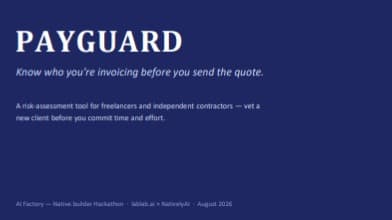
PayGuard - Know who you're invoicing
PayGuard Know who you're invoicing before you send the quote. PayGuard is a risk-assessment tool for freelancers and independent contractors. Type what you know about a prospective client — payment history, communication style, anything you've heard — and PayGuard analyzes it for concrete red flags, assigns a risk level, and, when the risk is real, drafts a protective email proposing safer payment terms before you start work. Built for AI Factory — Native.builder Hackathon (lablab.ai × NativelyAI), August 2026. The problem Freelancers and small agencies routinely take on clients who turn out to be slow payers, non-payers, or difficult to work with — and there's rarely a fast way to check a client's reputation before committing time and effort. PayGuard gives freelancers a quick, structured way to sanity-check a new client using whatever information they already have. Who it's for Freelancers, contractors, and small agencies (dev, design, writing, consulting) vetting a new client before signing on. How it works Enter a client name and describe what you know about them — a warning from another freelancer, notes from a call, anything relevant. A Supabase Edge Function sends this to an AI model (via Groq), which: Extracts only concrete red flags actually present in the text (never invents risk that isn't there) Assigns an overall risk level: Low / Medium / High / Insufficient Data Gives 2–4 practical recommendations If risk is Medium or High, automatically drafts a protective email proposing a deposit, milestone payments, or escrow Results are shown immediately — no login, no data saved, fully stateless. Tech stack native.builder — application platform, used to generate the UI, wire the Supabase backend, and deploy the app Groq — fast LLM inference for the risk-analysis step (llama-3.3-70b-versatile) Supabase Edge Functions — serverless backend that keeps API keys secure and off the client React + TypeScript + Tailwin Local development npm install npm run dev
10 Aug 2026
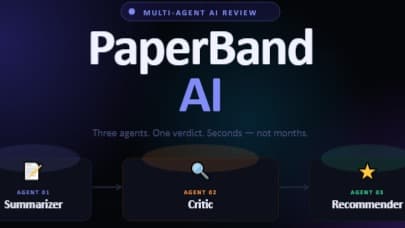
PaperBand AI
PaperBand AI is a multi-agent research paper review system built for academics, students, and conference organizers who need fast, structured feedback on academic work. Instead of waiting weeks for peer review, users simply upload any research PDF and three specialized AI agents go to work collaboratively. Agent 1 (Summarizer) reads the full paper and extracts the title, authors, research problem, methodology, key results, and conclusion into a clean structured format. Agent 2 (Critic) receives that summary through a shared Band Room message bus and performs a rigorous peer-review-style analysis — identifying strengths, weaknesses, missing experiments, and limitations. Agent 3 (Recommender) reads both the summary and critique, then scores the paper from 1 to 10 and issues a formal publication decision: Accept, Accept with Minor Revisions, Major Revisions Required, or Reject — with a written justification and future research suggestions. All three agents communicate through a custom BandRoom, a shared in-process message bus that simulates real agent collaboration. The entire pipeline runs on Groq's free LLaMA 3.3 70B model, making it blazing fast and completely free to use. The frontend is built in Streamlit with a custom dark academic UI, and the project is structured as a clean modular Python codebase with separate agent classes, a PDF reader utility, and secure API key management via dotenv. PaperBand AI was built in one day as a hackathon project by Team IDEA — a five-person team specializing in Data and Agentic AI.
19 Jun 2026

