🤓 Latest Submissions
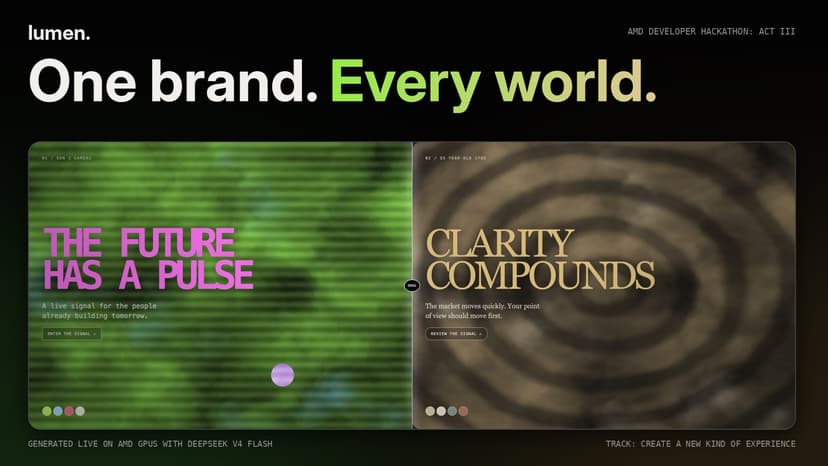
Lumen, One Brand, Every World
Every brand ships one website for everyone, but a gamer and a CFO do not want the same thing. Lumen fixes that. You enter a brand brief and two audiences, and Lumen generates a different cinematic web experience for each one, live. How it works: the brief goes to DeepSeek V4 Flash, served on AMD GPUs through the AMD Token Factory. The model returns a compact scene script that picks a palette, font pairing, layout, shader style, 3D hero object, motion style, corner style, grain, soundscape and copy for each audience. The response streams to the browser token by token, is validated against a strict schema, and is expanded into a full scene. If the model is busy, Lumen retries, switches to a fallback model, and finally replays a cached run from a real AMD generation. The frontend turns each script into its own world using Next.js, React Three Fiber, custom GLSL shaders, GSAP and WebAudio. A draggable seam lets you compare both worlds side by side, a diff strip shows exactly what changed (palette, type, layout, motion, tone, sound), and the audio crossfades as you drag. Each world also has a full screen player built from its generated scenes. Lumen measures real latency, tokens per second and cost from every response and shows them in a live AMD metrics panel. A generation costs a tiny fraction of a cent, so marketing teams can afford a tailored page for every audience segment instead of paying an agency for one. Built solo for the Create a New Kind of Experience track.
18 Oct 2026

Loudmouth Labs
Loudmouth Labs is a solo built voice agent that conducts first round interview screenings entirely through spoken conversation. Instead of a candidate filling out a form or answering fixed questions, they simply talk to the agent the way they would talk to a real interviewer. The agent listens in real time using AssemblyAI's Voice Agent API, asks adaptive follow up questions based on what the candidate actually says rather than a fixed script, and keeps the whole conversation inside a fixed time budget so it never drags on. Once the interview naturally wraps up, the agent calls a structured tool that records the outcome as a scored assessment, covering skills demonstrated, red flags noticed, notable quotes pulled directly from the conversation, an overall score out of ten, and a clear hire recommendation. The project is built with a React frontend that captures microphone audio and streams it directly to AssemblyAI, and a small serverless backend that mints short lived tokens so the API key never touches the browser. It is deployed on Vercel and works entirely in a normal web browser with no app install required. The goal was to explore how much signal a short, natural, spoken conversation can produce compared to a static form, and to show that AssemblyAI's Voice Agent API is capable of running a genuinely adaptive, multi turn interaction rather than a simple question and answer script.
30 Sep 2026
GhostWriter Court
Every day, creators have their work stolen; music producers, songwriters, developers, and artists who lack the time, money, or legal knowledge to fight back. GhostWriter Court changes that. GhostWriter Court is a Band-native multi-agent system where six specialist AI agents collaborate in a shared Band room to fully automate the IP dispute process from evidence gathering to legal brief. The six agents and their roles: 1. Investigator — Archives both URLs, extracts metadata, creator details, upload dates, and content summaries as structured evidence. 2. Similarity — Compares the original and infringing content, scores similarity 0-100, and identifies the top specific matches. 3. Policy — Applies DMCA rules and fair use doctrine to produce a legal verdict: Strong Case, Weak Case, or Fair Use Risk. 4. Negotiator — Drafts three settlement tiers: attribution request, revenue share offer, and full takedown demand. 5. Synthesizer — Reads all agent findings and produces a plain-English 3-sentence case summary with a recommended action. 6. BriefWriter — Writes a formal cease-and-desist letter with the infringement claim, creator rights, demanded action, and 14-day deadline. Band acts as the true coordination layer, agents communicate through a shared Band room, each picking up the previous agent's output as context for their own work. The entire workflow is visible, traceable, and auditable in the Band conversation history. Built with: Band SDK, AI/ML API (gpt-4o-mini), Featherless AI, Python httpx REST polling pattern. Track 1: Internal Enterprise Workflows, applicable to any platform with a creator base.
19 Jun 2026


