
OLUEBUBE CHUKWU@jennycruzy
5
Events attended
5
Submissions made
Nigeria
1 year of experience
About me
I am a Web3, AI builder and content creator focused on turning complex systems into real world tools. I design and ship products at the intersection of crypto, automation, and intelligent agents ranging from payment infrastructure to autonomous onchain workflows. I also create content around innovative projects, breaking down ideas, trends, and builds to make them more accessible and understandable.
🤓 Latest Submissions
ShowMe
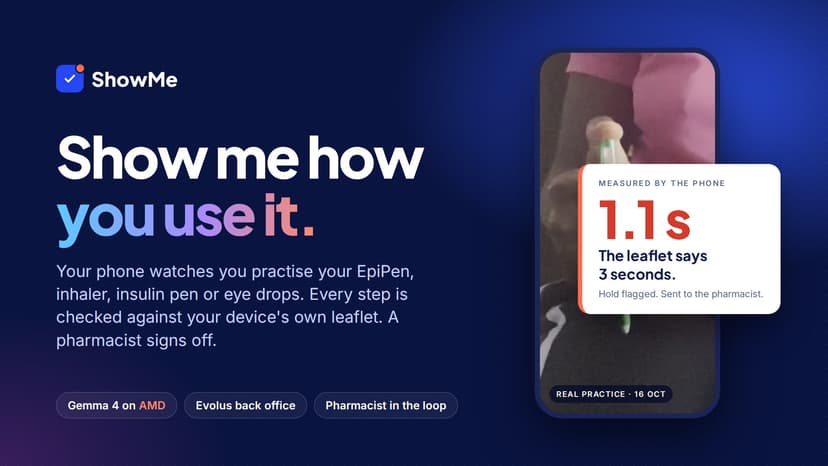
Most people who carry an EpiPen or an inhaler use it wrong. Only 31% of 59,584 observed inhaler uses were correct. Only 39% of allergy patients handled their adrenaline pen properly. Shown once at a counter, then left alone. The first time anyone notices can be the day it matters. A pharmacist fixes this with three words: "show me how." There is no time to ask every patient every month. ShowMe asks for them. How it works 1. Pick your device (EpiPen, inhaler, insulin pen or eye drops) and practise for 30 seconds on your phone, with a trainer or any pen standing in. 2. The phone measures: how long the pen stays on your thigh, your breath-hold, the framing. Faces are hidden. Video never leaves the phone. 3. Gemma 4 on the AMD token factory looks at small crops and judges what needs eyes: which end, the grip, the angle. It never guesses a time. 4. Code decides. Each step comes back green, red or "couldn't see", next to the leaflet line and a replay of the moment. 5. Every red goes to a pharmacist, who approves, edits or asks for a new video. The reply reaches the patient in English, Italian or Igbo. Your leaflet, not a generic one EpiPen UK says hold 3 seconds. Jext says 10. Xalatan says press the eye corner for 1 minute; UK latanoprost says 2. Gemma on AMD turned 12 official leaflets into step lists, code checks every quote word for word, and a pharmacist approves each list. Evolus runs the back office: a review workflow for flagged checks, reply translation, anonymized monthly reports, and a leaflet assistant that answers only with a quote or "ask your pharmacist". Honest numbers: asked six things at once, Gemma caught a wrong-end injection 1 time in 10. One narrow question, "which end is on the thigh?", now catches it 10 out of 10, with 20 of 20 correct practices passed. Every result is published, misses included. A practice aid supervised by a pharmacist, not a medical device. Free for patients and pharmacies.
18 Oct 2026
Pledgebook
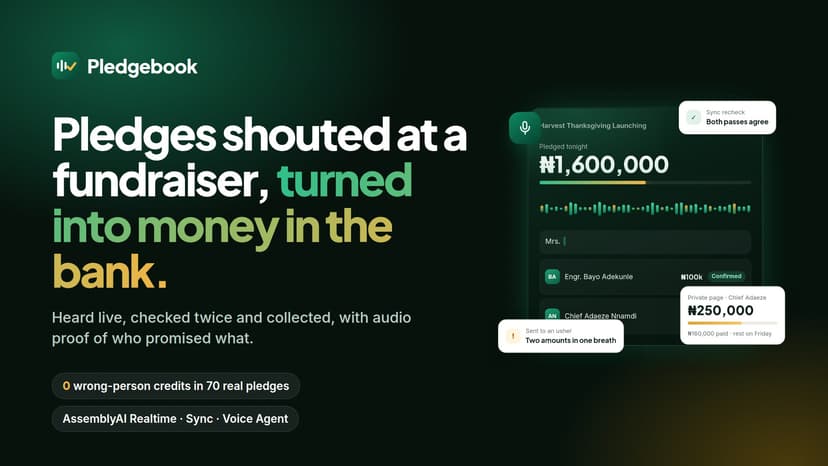
Pledgebook turns the pledges shouted at a fundraiser into money in the bank, with audio proof of who promised what. The problem: at Nigerian church launchings and school fundraisers, millions of naira are promised out loud in one evening. The MC calls names over music and applause, someone writes them on paper, names get misspelled, amounts get misheard, and months later nobody can prove who promised what, so the money is never collected. How it works: 1. Hears every pledge live. The MC's microphone streams to AssemblyAI Realtime, with the guest list sent as key terms. Each pledge appears within seconds, with its audio clip kept as evidence. 2. Checks it twice. AssemblyAI Sync re-transcribes every clip independently. If both passes agree, the pledge is confirmed. 3. Asks a person when unsure. An unknown name, two amounts in one breath or a bare number goes to an usher's phone. Nothing is guessed. 4. Collects it. Every guest gets a private page to hear the moment they pledged, pay all or part through Paystack, pick a date or report a mistake. Or they can simply talk to an AssemblyAI Voice Agent that confirms who they are before discussing money, then opens checkout. Proven on real voices: across 70 spoken pledges, zero were credited to the wrong person, zero wrong amounts were accepted and zero were missed. It is a working product, not a mock-up: organisation roles, a full event lifecycle, signed Paystack webhooks, settlement reports, an activity log and 76 automated tests. Live at pledgebook.isobars.xyz
30 Sep 2026
Heirloom: Legacy Knowledge You Can Prove
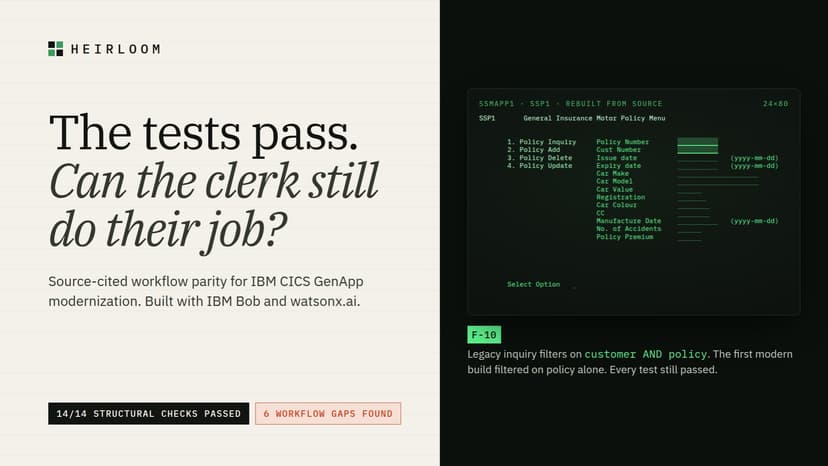
Critical legacy systems often outlive the people who fully understand them. Their behavior is scattered across screen maps, transaction handlers, business programs and database calls. A conventional rewrite can produce cleaner code while quietly changing the job the software was built to perform. Heirloom addresses that risk by making modernization traceable, reviewable, and honest. Heirloom begins with the legacy source itself: IBM's CICS GenApp BMS maps and COBOL programs at a pinned commit. It extracts a structured catalogue of screens, fields, actions, program links, constraints, and evidence references, then reconstructs the original 24-by-80 green screens so reviewers can see the workflow that existed before modernization. A focused modern web application implements the verified customer and motor-policy tasks using Python, SQLite, semantic HTML, CSS, and browser-native JavaScript. The key difference is the verification loop. Deterministic checks compare exact facts such as task availability, field names, maximum lengths, and input behavior. IBM Bob then reviews workflow meaning against cited COBOL lines, including who assigns identifiers, which fields identify a policy, and whether an update must retrieve a record before editing. Our first modern build passed 10/10 application tests and 14/14 structural checks, yet this review found six workflow gaps. Each became a targeted repair with a regression check that failed before and passes after, and Bob's independent final review returned READY. Uncertain behavior remains clearly labelled instead of being invented. Heirloom is designed for modernization teams, engineers, business analysts, auditors, and product owners responsible for high-value legacy applications. They can explore the reconstructed screens, inspect source-linked evidence, use the modern customer and policy workspace, and review machine-readable verification results; 118 checks run on every push. Judges can follow the same evidence trail at https://heirloom.54-154-121-30.sslip.io without needing access to a running mainframe. For this hackathon, the legacy application was read from source; no mainframe was run. The demonstration records are explicitly invented. The first modern implementation is preserved at a Git tag, and reports and screenshots record every check before and after repair. Heirloom does not pretend to modernize an entire enterprise system in one leap. It demonstrates a safer pattern: understand first, preserve evidence, modernize a bounded workflow, test exact facts, review meaning, and repair only what the source can prove.
27 Sep 2026
CONVEX
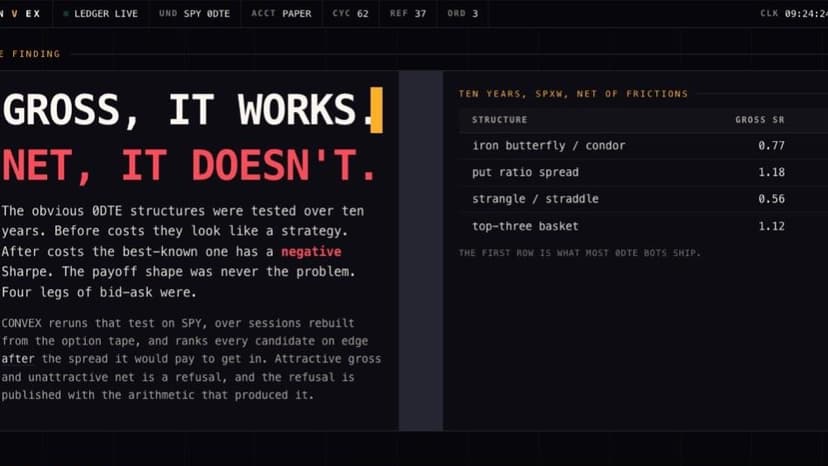
CONVEX is an autonomous SPY options agent on Alpaca's MCP server. It trades 0DTE. That is zero days to expiration: contracts that expire the same day they are traded, so a position opens and settles in one session. We built the obvious 0DTE trade, measured it honestly, and it failed. That result is the submission. On the 1 September SPY chain, 482 of 1,101 priced candidates, 43.8%, showed a profit before costs that the bid-ask spread then ate entirely. They never reached a risk check; the ranking dropped them first. That is the number this project exists to show. Our own model is published as a failure. Five structure families were tested over 509 rebuilt sessions against a simple benchmark. One beat it, the debit vertical, at 0.0512 against the 0.0470 needed, and it still lost $12.87 a session. On 2 September we re-tested all five on 54 sessions never used to choose anything. Four lost money after costs: put BWB −$349.55, call BWB −$330.95, debit vertical −$671.47, straddle −$559.54. The fifth made money on six trades, too few to mean anything. All five are switched off in config. The only thing that can still open a position is a one-lot vertical, entered on a fixed opening-gap rule, and only if it passes every check. Live result: three fills confirmed by broker records at −$1,026.62, the account itself reading −$1,029.05, or −1.03% of $100,000. Reported plainly, including one that should not have been placed. Six checks run each cycle and ten more on every surviving candidate. Standing down is a successful outcome, and every refusal is written to an append-only log with its arithmetic. The language model explains decisions. It cannot produce a price, size, or order. Verify the headline number yourself, offline, no credentials: git clone https://github.com/Jennycruzy/convex && cd convex uv venv && uv pip install -e ".[dev]" .venv/bin/python -m scripts.replay --session 2026-09-01 Full write-up: https://github.com/Jennycruzy/convex/blob/main/docs/WRITEUP.md
4 Sep 2026

Mirror
MIRROR is an adaptive AI trading system built for live competition. The core idea is simple: most agents stop at prediction, but MIRROR closes the loop from forecast to execution to evaluation to strategy improvement. Four Red agents trade through the official Kraken CLI using real market data, while Blue agents inspect calibration failures, identify weak patterns, and generate candidate improvements. Forecasting and operational reasoning run through Featherless via an OpenAI-compatible interface, and featherless is also used for strategy patching and crossover generation. What makes MIRROR different is that every proposed strategy change is tested through deterministic replay before promotion, so the system evolves from measured behavior rather than intuition. MIRROR tracks forecasts, fills, equity, realized and unrealized PnL, Brier score, trade lineage, patch history, and onchain job state in Postgres, then exposes that operating state through a live dashboard built with Next.js, Tailwind, SSE, and a FastAPI backend. Under the hood, the orchestration stack uses LangGraph, SQLAlchemy, APScheduler, and web3.py. For infra and deployment, MIRROR is designed to run on a VPS environment such as Vultr, with nginx in front of the frontend and backend services, PM2 managing long-running processes, and a live domain serving the system. Onchain identity and reputation are handled through ERC-8004 on Base Sepolia, with agent metadata pinned to IPFS and reputation feedback posted from measured calibration outcomes. The tournament stack is tuned for survival on net PnL, with trend gating, spread caps, position sizing, concurrent exposure limits, adaptive loser blocking, cooldowns after losses, profit lock, trailing exits, time-stop logic, and recovery take-profit behavior. MIRROR combines live trading, agent evaluation, self-improving strategy infrastructure, and onchain agent identity into one operating system for competitive AI traders.
19 May 2026


