🤓 Latest Submissions

MURPHY - fuzz the procedure, not the plant
Every plant runs the same ceremony: a hazard review in a meeting, a signature, a revision number, and then a tired person performs the procedure at three in the morning on equipment that has just had instrument work. Nobody ever tests the sequence. Software has had forty years of fuzzing; high-hazard operations have nothing. MURPHY compiles a controlled procedure into an executable model. Each step carries the cue an operator reads, a duration, the plant variables it moves, and a typed error surface: the specific ways a real crew goes wrong there, expressed as a state of the plant rather than as blame. Thousands of simulated crews - a new trainee at 3am, a relief operator on an eleventh hour, a crew reading a procedure not in their working language - run against a continuous-time physics twin: mass balance, pump dead-head, vapour-space overpressure and bund headroom. Human error probabilities come from three published reliability methods (SPAR-H, THERP, HEART) over one interface, so a ranking's method-dependence is measured rather than assumed. Every figure carries an order-of-magnitude band and a derivation sheet. A repair loop proposes controls as typed mutations and accepts only what a paired bootstrap, a cost test and a false-discovery correction can defend. On one 17-step transfer procedure, at the application's own default seed: 0.70% of shifts lost by a competent crew on a tank as designed, 42.88% for a night trainee two weeks after instrument work - EUR 5.8M a year - and 32.1% breach the tank roof on an uprated vessel, EUR 42.9M a year. The repair loop takes 42.88% to 2.05% stacked, a net EUR 5.76M a year, and rejects six of its own twelve ideas, reasons on screen. The other two methods read 83.7% and 97.6% with one top-three station in common, and the tool says so rather than quoting the flattering number. Against three published investigations it raises all 13 recorded causes from the text alone, 7 inside its own top ten against a 17% chance level.
18 Oct 2026
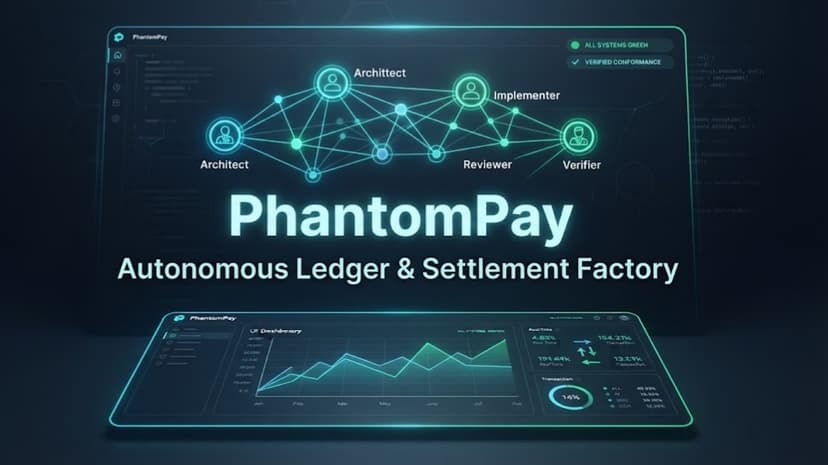
PhantomPay: Autonomous Ledger & Settlement Factory
PhantomPay is a production-grade multi-agent autonomous ledger and settlement processing system designed to handle complex double-entry accounting, deterministic state transitions, and strict safety invariants. The project is structured around a rigorous multi-stage architecture spanning core ledger operations, responsive dark-UI client rendering, advanced scheduling and audit logging, and payment lifecycle management with tamper-evident SHA-256 hash chains. To guarantee institutional-grade reliability, PhantomPay incorporates an autonomous multi-agent workflow comprising four specialized roles—Architect, Implementer, Reviewer, and Verifier. Every stage of development undergoes adversarial code review, concurrency storm testing, and cold-room conformance quality gates to ensure 100% test coverage and build stability. The final system bridges secure blockchain and microservice mechanisms with robust backend validation, delivering a fully verified, all-green settlement solution for decentralized and high-assurance financial environments.
6 Oct 2026

VoicePilot — Multilingual AI Voice Front Desk
Small businesses across Southeast Asia lose customers to clunky booking forms and phone lines nobody answers — and the people calling in rarely stick to one language. VoicePilot is a voice-first AI front desk, built entirely on AssemblyAI's Voice Agent API over a single WebSocket connection, that lets a real small business (our demo shop, Sunrise Car Wash) take phone bookings the way its customers actually talk: English, Mandarin, Cantonese and Malay, freely mixed, sometimes in the same sentence. The caller can ask about prices, hours or services (answered only from the business's own data, never invented), book an appointment, correct a misheard name mid-call, reschedule or cancel — and interrupt the agent at any point the way a real phone call works. Every write (booking, reschedule, cancellation) is re-read from the store immediately after it happens and reported back to the caller as "Verified in system," so nothing is ever silently lost or duplicated. An Owner View gives the business a live table of every booking and every tool call, and an auto-generated call summary closes out each conversation. Under the hood, one AssemblyAI WebSocket connection handles speech-to-text, the LLM reasoning, text-to-speech and turn-taking/barge-in — the frontend never touches interruption logic itself. Seven JSON-Schema tools (check availability, book, look up, reschedule, cancel, fetch business info, save call summary) are wired through the documented tool-calling flow, with session config, turn-detection tuning and tool-call traffic all inspectable live via a developer debug view. It's a small, honest demo of how a "boring" business problem — nobody answering the phone — can be solved with a genuinely multilingual voice agent instead of another form nobody fills in.
30 Sep 2026


