🤝 Top Collaborators


🤓 Latest Submissions
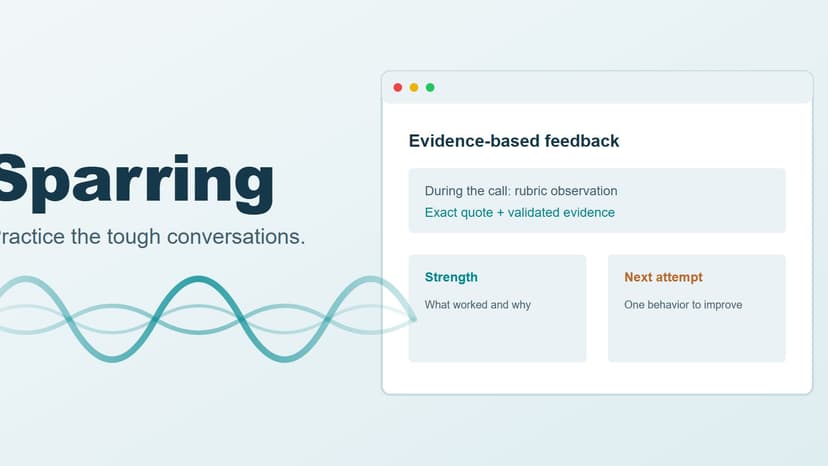
Sparring — Practice Tough Customer Conversations
Sales and support teams need a safe place to practice difficult conversations before a real customer is on the line. Sparring is a browser-based voice role-play for small Spanish-speaking teams. Choose a scenario such as a delayed delivery, a price objection, or a cancellation request, then speak with a simulated customer who asks follow-up questions and challenges vague answers. AssemblyAI's Voice Agent API handles the spoken interaction. Sparring checks each finalized trainee turn against the scenario rubric, validates exact quotes as evidence, and calculates a weighted score in real time. The interface shows how much of the rubric was observed and gives one focused next step to practice again. The scenarios use fictional customers and explicit policy limits, so the trainee can rehearse useful responses without making commitments to real people. Scores are formative guidance, not a certification. The public repository includes the specification, tests, architecture, and known limitations.
30 Sep 2026

Ouroboros
Every coding agent runs the same loop for everything. Ouroboros doesn't: a Band room of six agents designs the verification loop your specific task needs, checks, critics, a human gate, then executes it on your real repo, fixing the file until your real tests go green. "Loop engineering" is the 2026 shift (Addy Osmani & Boris Cherny): the unit of agentic coding is no longer the prompt, it's the loop — generate, check, revise, until a real exit condition holds. But everyone hand-builds those loops, and every coding-agent tool runs the SAME fixed pipeline for everything. A CSS tweak and a database migration get the identical loop. That's vibe-coding with extra steps. Ouroboros, the snake that eats its own tail, automates loop engineering as a band of agents. Six specialists collaborate THROUGH Band: @LoopArchitect reads the task and synthesizes the loop it needs (which checks gate it, which critics vote, whether a human must sign); @LoopCritic attacks the exit condition and recruits a specialist on demand (a SecurityCritic when the task touches auth) via band_add_participant; @LoopRunner drives it; @CodeAuthor patches the code; @QAEngineer runs the real tests; @RivalReviewer (a different model) bounces failures back. Every step is an @mention handoff on the Band transcript — the loop's design and its execution share one audit trail. It's real, not a story. Point it at your repo and your test command (python band_repo.py --repo ... --test "pytest -q" --file ...). @QAEngineer has a tool that runs your actual suite; @CodeAuthor has tools that read and patch your actual file. The loop runs until your real tests pass — or hands you a verified failure instead of a confident wrong answer. Verified end-to-end: the live room fixed a real pytest bug, patched the file, and only finalized once the suite went green. Cross-framework (Pydantic AI + LangGraph), AI/ML API for reasoning, Featherless for the rival reviewer.
19 Jun 2026


