

🤓 Latest Submissions
Cutover: Catch Lost Writes Before Merge
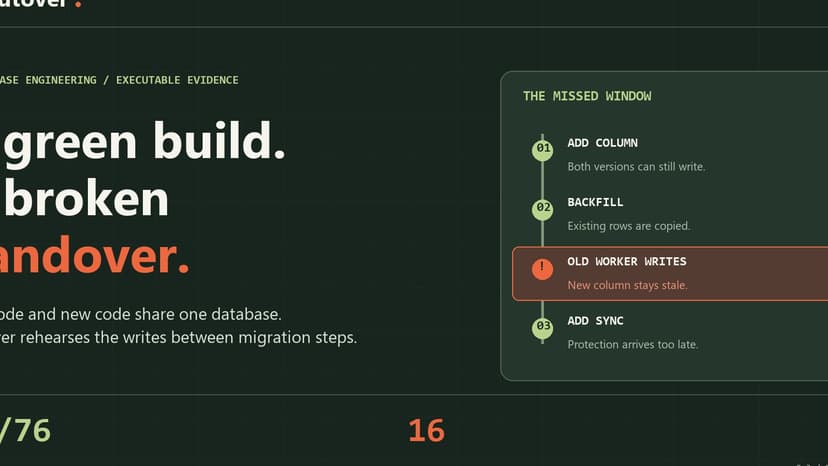
An old warehouse scanner accepts bin R-07. The migration succeeds, but the new application reads A-01. The schema exists and the completed-rollout tests pass; an acknowledged write was lost between deployment steps. Cutover gives backend and release engineers an executable counterexample before a schema-changing pull request merges. The missing test is the space between versions. Cutover executes old and new SQL adapters on fresh, disposable SQLite databases. After each completed migration statement, it interleaves old-worker updates and inserts, then checks readers against an independent ledger of acknowledged writes. Its unsafe Warehouse plan passes all 76 completed-rollout probes but fails 16 of 48 migration-window probes. The witness retains the SQL boundary, accepted operation, row, expected value and observed value. Press “Run unsafe → Bob repair” in the live demo: 108/124 blocked becomes 116/116 passed on the unchanged contract. Bob’s saved Warehouse repair protects writes before backfill, using one-way synchronization plus explicit dual writes. Different SQL sequences retain separate boundary schedules; Cutover does not claim matching step numbers are equivalent tests. IBM Bob IDE performed two event-period tasks. It saved distinct Parcel and Warehouse repairs, each independently verified at 116/116, and built the original GitHub Actions PR review gate. Its failed recursive-trigger attempt remains in the history. Both required task-session consumption PNGs, full histories, saved candidates and actual red/green/regressed-red PR evidence are public. The offline Bob proof pack includes both original task summaries and saved repairs for local replay. When queued jobs can still write the old column, bring existing schema, migration and worker query files to the local starter. No account, pip install, SQL upload or hand-edited JSON. Compare migration SQL from exact local commits without fetching or checking out code. Repair candidate queries through SQL files. Each review retains the original failure and SQL snapshots, writes an offline PR note, and exports a locked CI kit only after a pass. A blocked custom rehearsal can become a downloadable local Bob repair workspace: fixed evaluator, failing inputs, MCP setup and a repair task, without credentials, automatic approvals or bundled passing solutions. Independent verification refuses changed fixed inputs and retains each candidate attempt. This handoff was checked through the MCP SDK and saved-candidate replay; it is not a new Bob IDE task or proof of another user’s IDE setup. After repair, export a pinned PR-gate kit containing contract, adapters, migration SQL and workflow. The reviewed contract hash flags changed test records as unverified until the lock is deliberately updated. Actual repository controls exercised passing, SQL-only regression and missing-input cases on Windows and Ubuntu. Saved CI ZIPs can be independently replayed and reopened; altered evidence is rejected and editing SQL clears the verdict. The evaluator/browser began as pre-event Codex scaffolding. Bob’s repairs and original gate are the event IDE contribution; later packaging, browser features and controls are Codex extensions. These are synthetic repository controls, not customer adoption. Cutover provides bounded sequential SQLite evidence, not simultaneous transaction coverage, support for other engines or production approval.
27 Sep 2026

von-read: Exact OCR on AMD
von-read combines exact OCR and evidence-grounded RAG on AMD ROCm. Built solo by Joseph Ayanda with AI assistance. MC2 remains R16. It preserves the selected R12 weights/runtime and changes only the verified input decoder. A paired AMD source test recovered 5/5 authored format probes versus 0/5 previously, while the public development readings stayed unchanged. Its 40.24 GB image passed fresh anonymous delivery and container-interface checks. MC3 is now R61, a source-only hardening layer over the selected R35/R24 Qwen3-VL image. Model weights and the 27 R35 parent filesystem layers are preserved. R61 adds stricter condition/property grounding, premise-safe citation minimization, mixed current/withdrawn record handling, merged DOCX scope, bounded PDF parsing, Python literal authority, and exact-output guards. Fresh paired native evaluation on an AMD MI300X VF used the same pinned production reader/checkpoint and a predeclared 58-question suite: official 10 + stress 12 + transfer 36. R35 scored 34/58; R61 scored 58/58, rescuing 24 cases with zero regressions. Both were 10/10 on the official public MC3 sample. R61 also passed 426/426 software tests on Python 3.12 and 3.14. The exact R61 OCI image is manifest sha256:0205651ae7d2806d3286a22270b5d7e23f1ec3f8ac47ed7352a719feca2e6b07. A fresh anonymous production Docker pull verified 28 layers and 40.302 GB uncompressed. These are native source-path and transport/container checks, not a hidden grader score. Full-container AMD grader self-check remains a separate limitation. Video: https://josephmayo.site/research/von-read/walkthrough.html
1 Dec 2026
Recount: Finish the Stocktake
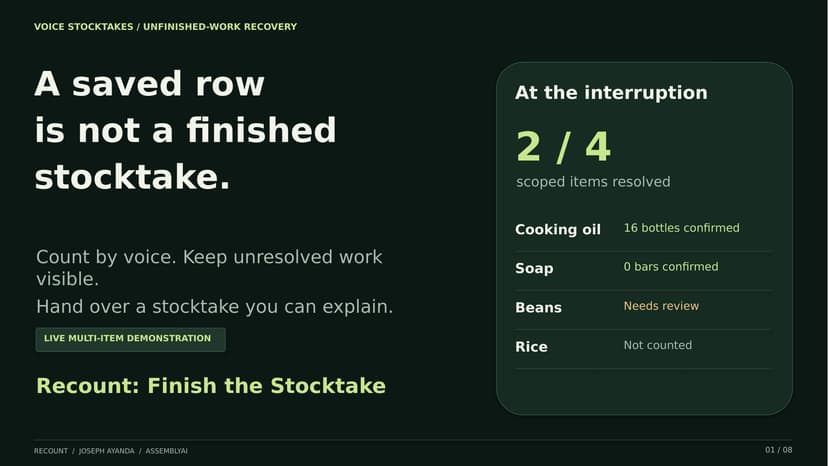
Recount helps a stockroom operator finish a count, not just transcribe it. Its unit of work is the whole scoped stocktake: what is confirmed, what needs review, and what has not been counted. AssemblyAI streams finalized speech into a revision-aware ledger. Counts stay in a draft until the quantity is explicitly confirmed. Switching items parks unfinished work in Needs review. Neural read-back pauses microphone capture, then listening resumes in the same provider session. The closeout view distinguishes a confirmed zero from an uncounted item. Partial exports remain available, but a complete-stocktake export is blocked while scoped work is unresolved. A transcript-free handoff records status and confirmation method. Explicit Save session and Open session actions let the operator resume unfinished work after reloading. The new public-site demonstration covers four items, not one rehearsed correction. It parks beans, rejects a mismatched oil confirmation, distinguishes zero soap from uncounted rice, restores a saved session, resolves beans on screen, and finishes rice by voice. Two real AssemblyAI sessions produced nine final turns, nine read-backs and four exact exported rows. Three counts were speech-confirmed; one was screen-assisted. Only microphone input was generated. The initial buyer hypothesis is a small-stockroom manager already using spreadsheets. Planned per-location software would add a voice-and-review layer without replacing their stock system. The next pilot compares exact final counts, assistance and time against the existing workflow. This is a four-item prototype, not a customer deployment. Two earlier human recording tests failed and remain documented. Human reliability and productivity are not yet established. Catalogue import and stock-system integrations are next-stage work. Built solo by Joseph Ayanda.
30 Sep 2026


